Tourism Industry Insight: When Better Becomes Expected
28 Aug 2026, 03:28 · by IzuCT · 4 min read · Tourism · EN
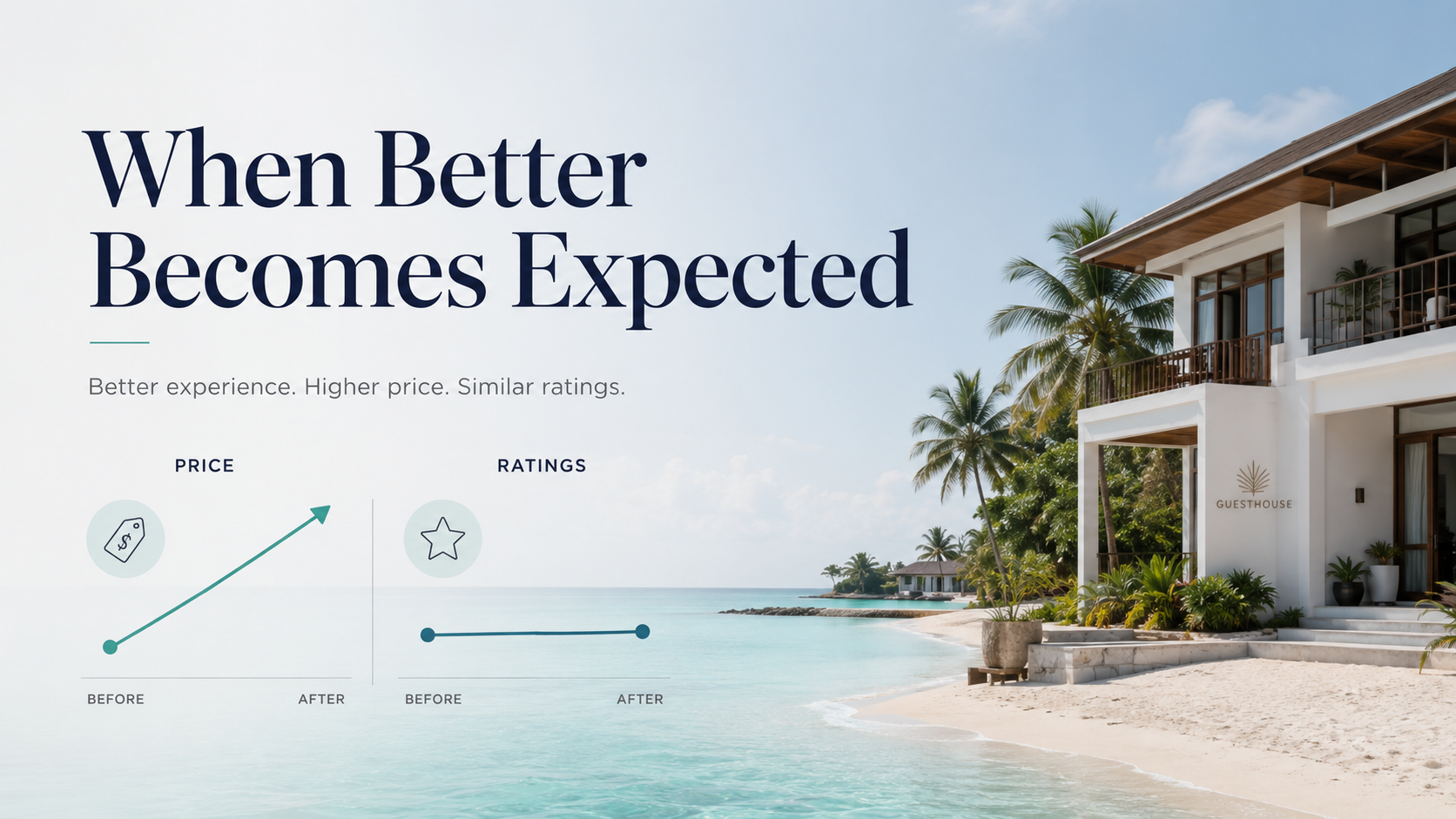
A better tourism experience does not always produce higher ratings. When improvements raise guests’ willingness to pay, prices may rise too, quietly absorbing the extra value. The result: better quality, stronger revenue, similar scores overall.
Free tourism insights
Get Free Tourism Insights
Receive selected MTO insights, tourism data alerts, and new resource updates by email.
Get Free Tourism InsightsImproving a tourism product can justify a higher price without producing better guest ratings, because higher expectations quietly absorb part of the improvement.
Imagine a guesthouse island that finally solves a problem visitors have complained about for years. The beach is cleaner. Waste is collected properly. Public spaces look better. Guests notice the difference.
Six months later, room rates have risen. Yet review scores have barely moved.
For a manager who has invested time and money in improving the experience, this can feel disappointing. If the product is objectively better, surely guests should be happier. But there is another possibility: the improvement worked so well that the market converted it into something else.
A higher price.
The improvement hidden inside the rate
A hotel room is never merely a room. Travellers buy a bundle: location, beach, neighbourhood, service, accessibility, safety, scenery and dozens of smaller attributes.
Economists call this hedonic pricing. Different characteristics become embedded in the price of the final product even when they are never separately sold.
Historical research on Maldivian guesthouses illustrates the mechanism unusually clearly. Using accommodation prices and island-level data collected in 2016, the analysis found that better environmental characteristics were associated with higher room prices. A one-unit improvement in a constructed beach-cleanliness index was associated with roughly a 1.1% increase in room price. Beachfront guesthouses commanded an estimated premium of about 21% over otherwise comparable properties. Poor waste-management conditions were associated with lower prices.
These estimates are historical associations, not universal pricing rules. But the underlying mechanism is important.
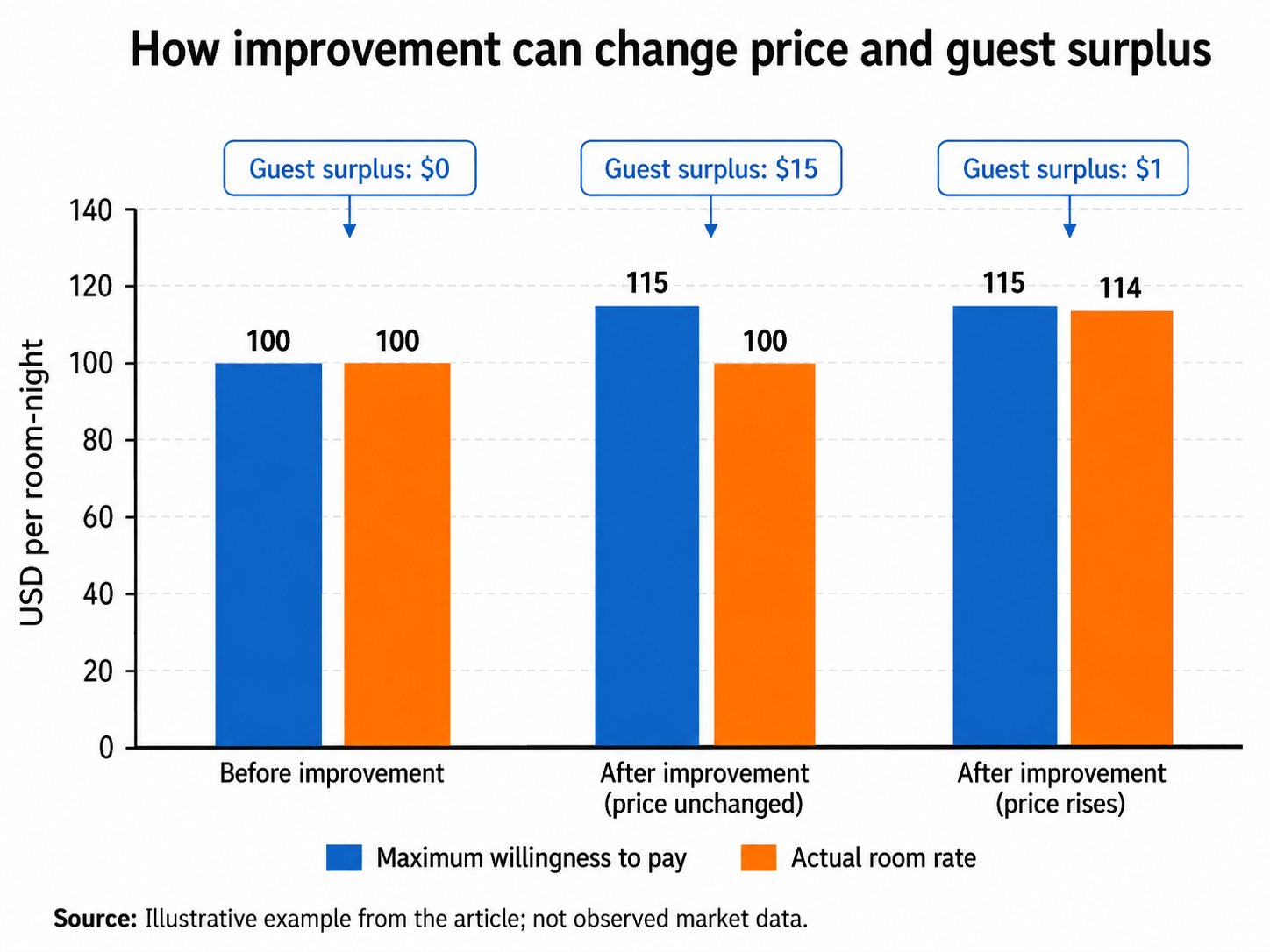
Suppose purely as an illustration, that guests are willing to pay 100 dollars for a room when the surrounding beach is mediocre. After substantial environmental improvements, their maximum willingness to pay rises to $115.
If the property still charges $100, the guest receives much more value for the same money. Satisfaction may rise sharply.
But suppose the market recognises the improvement and the room rate rises to $114.
The experience is unquestionably better. The guest is also paying almost all of the additional value.
Why the score may refuse to rise
This is where review scores become more complicated than they appear.
Guests rarely judge quality in isolation. They judge what they received relative to what they expected and what they paid.
A 70 dollars room can receive an exceptional review because the experience exceeded expectations. A technically superior $300 room can receive an ordinary one because excellence was already priced in.
In economics, the difference between what someone would have been willing to pay and what they actually paid is called consumer surplus. If a traveller would have paid 150 dollars but pays 110, there is $40 of surplus.
Improve the product while holding price constant and that surplus can grow. Improve the product and raise the price by roughly the same amount, and much of the additional economic benefit moves from the guest to the supplier.
The Maldives research explored the hypothesis that guest ratings might partly reflect this process: improvements in environmental quality could raise willingness to pay and therefore room prices without producing an equivalent rise in ratings. The thesis appropriately treated this interpretation cautiously; ratings are not a monetary measure of consumer surplus and can be influenced by many unobserved factors.
Still, the managerial implication is powerful.
Watch where the value goes
Hotels frequently evaluate investments by asking whether ratings improved. Destinations ask whether visitor satisfaction increased. Those measures matter, but they can miss value that has already appeared elsewhere.
After improving a beach, transfer service, breakfast, room design or staff capability, managers should also examine whether the property can sustain a stronger rate, whether guests are choosing higher categories, whether conversion remains healthy after price increases, and whether competitors begin pricing similar attributes differently.
The same principle applies beyond individual hotels. Cleaner public spaces, healthier reefs, safer streets and better transport can increase the economic value of an entire destination. Some of that gain may appear as higher accommodation rates, land values, excursion prices or visitor spending rather than dramatic changes in satisfaction scores.
Return to our guesthouse manager. The beach is cleaner, the room rate has risen, and the review score remains stubbornly unchanged. The investment may not have failed at all.
Sometimes the clearest evidence that tourists value an improvement is that they quietly agree to pay more for it.