Tourism Industry Insight: Why the Cheapest Transfer Can Cost a Resort More
31 Aug 2026, 14:24 · by IzuCT · 4 min read · Tourism · EN
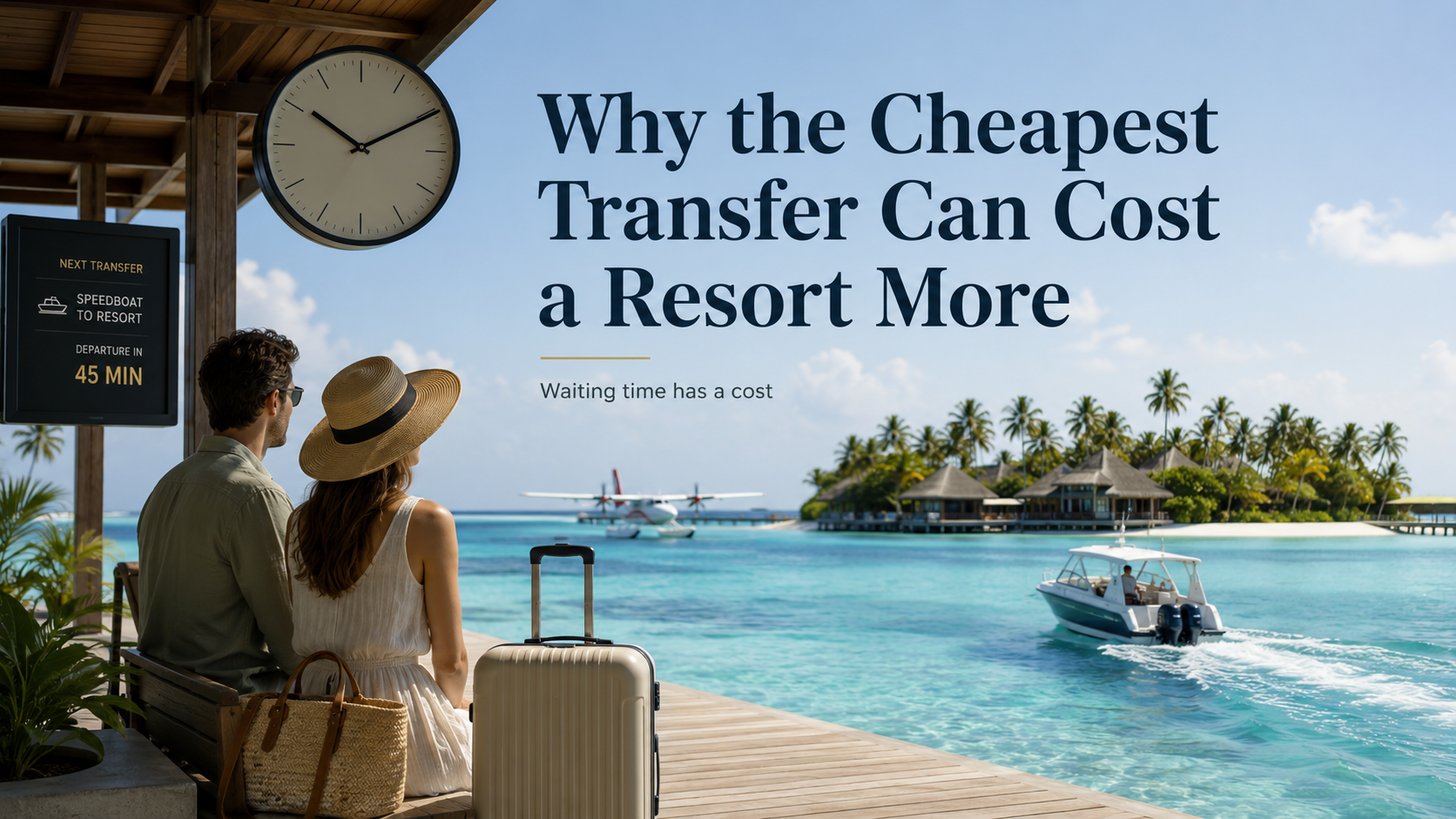
Transport is usually treated as a cost to minimise, yet unreliable transfers can quietly reduce the value of the accommodation they are meant to serve.
Free tourism insights
Get Free Tourism Insights
Receive selected MTO insights, tourism data alerts, and new resource updates by email.
Get Free Tourism InsightsA couple lands in the Maldives after an eleven-hour flight.
Their resort is ready. Their overwater villa is waiting. The lagoon they travelled halfway around the world to see is perhaps only 25 minutes away by speedboat.
But the boat does not leave.
The resort is consolidating transfers, so the couple waits for passengers arriving on another flight. Forty-five minutes becomes an hour. Then longer.
From the operator’s spreadsheet, the decision may look efficient. One fuller boat costs less than two lightly loaded departures.
From the traveller’s perspective, a different resource is being consumed:
holiday time.
That difference matters because, as I have argued previously, transport is part of the tourism product. The guest experience does not begin when someone opens the villa door. It begins when the destination takes responsibility for moving the traveller towards it.
The expensive hour nobody sells
Tourism businesses usually calculate transport efficiency through operating costs: fuel, crew, vessel utilisation, supplier fares and cost per passenger.
Those numbers matter. A half-empty speedboat can be expensive.
But transport economists use a broader idea called generalised travel cost. It recognises that passengers pay with more than money. They also pay through waiting, uncertainty, inconvenience and time.
That creates an interesting problem for high-value tourism.
Consider an illustrative four-night resort stay costing US$4,000. The accommodation represents roughly US$1,000 for each 24-hour period of holiday time.
If poor transfer coordination consumes an avoidable three hours across arrival and departure, roughly 3% of the usable trip has disappeared.
That does not mean the guest should literally be compensated US$125. The more useful insight is that management may be protecting a relatively small transport saving while consuming part of an experience for which the traveller paid considerably more.
And the shorter the holiday, the stronger the effect.
Two lost hours in a fourteen-night stay are inconvenient.
Two lost hours in a three-night escape change the shape of the trip.
This is closely connected to a principle I explored when examining how transfers should be priced across the entire journey. A transfer is rarely just the occupied leg visible to the traveller. Its economics may include vessel positioning, empty returns, luggage, staff coordination, flight monitoring, weather risk and missed connections.
The same logic should work in the opposite direction: operators should account for costs imposed on the guest, not only costs incurred by the vessel.
Waiting is heavier than travelling
Not every minute feels the same.
An hour travelling across turquoise water may already feel like part of the Maldives experience.
An hour standing near an airport counter asking when the boat will leave rarely does.
The difference is partly uncertainty.
A traveller who knows, “The boat departs at 4:15 p.m.” can organise expectations around that information. A traveller repeatedly told, “Just another few minutes,” experiences the same clock differently.
This is why the average transfer time may be a surprisingly weak management metric.
Imagine two resorts.
Both report an average airport waiting time of 40 minutes.
At Resort A, almost everyone waits between 30 and 50 minutes.
At Resort B, many guests leave within ten minutes, but a smaller group waits 90 minutes or more.
The averages may look nearly identical.
The experiences are not.
For this reason, resorts could monitor something more revealing: the 90th-percentile waiting time.
Instead of asking only, “How long does the average guest wait?”, ask:
“How long do the unluckiest 10% of our guests wait?”
That number exposes the long tail hidden inside the average.
And those guests may be precisely the ones most likely to arrive frustrated.
The transfer belongs inside the room economics
This changes how a transfer decision should be evaluated.
Suppose dispatching an additional speedboat costs US$180 more than waiting to consolidate passengers.
The conventional calculation stops there.
But imagine that immediate departure saves four guests 75 minutes each.
The decision has effectively purchased five guest-hours of holiday time for US$180.
Whether that is worthwhile depends on the market segment, room rate, length of stay, transfer promise and alternative use of the vessel. There is no universal answer.
But now management is asking a better question.
This also explains why small benefits can sometimes create more guest value than equivalent discounts. A US$20 discount costs the operator US$20 and creates US$20 of obvious monetary value. Good transfer coordination may cost much less while removing uncertainty from one of the most stressful moments of the journey.
The same issue becomes even more important when transport is included inside a package. Once rooms, meals, transfers and experiences are combined, the operator is selling a small interconnected system. Choosing the right package therefore means deciding how much of the guest journey the property is prepared to control.
Back at the airport, the couple eventually boards the speedboat.
The resort may never record the waiting time as a financial loss. The boat departed efficiently. The transfer budget performed well.
Yet the guests arrive having already spent part of their scarce holiday inventory somewhere they never intended to spend it.
For remote resorts, the cheapest transfer is only truly cheap when the traveller’s time is treated as free.