Tourism Industry Insight: How Hotels Can Turn More Options into Better Bookings
09 Sep 2026, 01:12 · by IzuCT · 4 min read · Tourism · EN
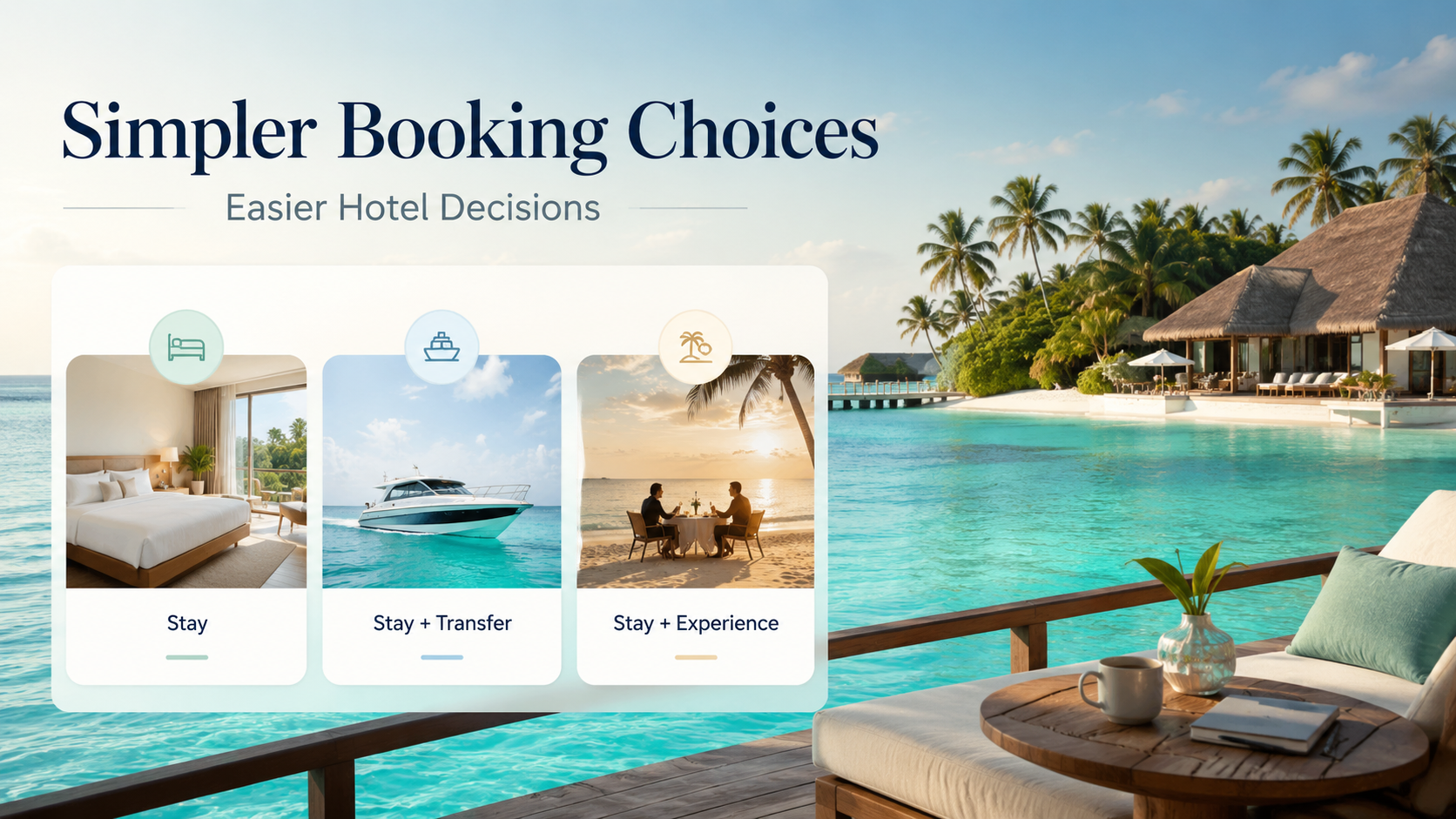
Hotels do not necessarily need fewer room types, packages or rates. They need to make the differences between them easier for travellers to understand.
Free tourism insights
Get Free Tourism Insights
Receive selected MTO insights, tourism data alerts, and new resource updates by email.
Get Free Tourism InsightsA traveller opens a resort booking page with a pleasant problem: there are several good ways to stay.
Beach villa or overwater villa? Breakfast or half board? Flexible or non-refundable? Shared transfer or private transfer? Perhaps an activity package as well.
Choice is valuable because travellers are different. The challenge for a hotel is therefore not to eliminate options. It is to organise them so well that the guest quickly sees which one fits.
That distinction can turn a complicated booking engine into something much more useful: a decision-making guide.
Good choice gives the traveller confidence
Hospitality naturally produces variety.
A family may value meal certainty. A honeymoon couple may prefer privacy. A short-stay visitor may want transfers arranged in advance, while an independent traveller may prefer room-only accommodation.
This is why, as I explored in Choosing the Right Package, different package structures solve different guest problems. Room-only preserves independence; meal plans create certainty; transfer-inclusive packages remove logistical friction; and all-inclusive arrangements can bring much of the holiday inside one predictable price.
The opportunity is to present those differences clearly.
Consider a hotel with three room categories, four meal plans and three cancellation policies. Behind the booking engine, those choices can generate 36 combinations.
There is nothing inherently wrong with having 36 commercially valid products.
The guest simply should not feel as though they need to analyse all 36.
Research on choice overload supports this more nuanced view. A meta-analysis covering 99 observations found that large assortments become particularly difficult when the decision itself is complex, customers are uncertain about their preferences, and comparing alternatives requires substantial effort.
Tourism frequently contains all three conditions because travellers are often buying an unfamiliar experience.
A first-time visitor may not yet know whether full board is useful, whether an overwater villa justifies the premium, or how much cancellation flexibility they need.
Good booking design helps them discover the answer.
Show the difference before showing the detail
Imagine two booking pages offering exactly the same underlying products.
The first displays:
Flexible Rate
Advance Purchase Rate
Bed & Breakfast Flexible
Bed & Breakfast Saver
Half Board Flexible
Half Board Advance Purchase
The second begins with three simple choices:
Best price
For guests whose plans are fixed.
Most flexible
For guests who want freedom to change.
Meals included
For guests who prefer greater holiday certainty.
The underlying rate architecture can remain sophisticated. What changes is the mental work required from the traveller.
This principle also applies to packages. In Building a Profitable Package, I described a package as a collection of moving economic parts: rooms, meals, transfers, excursions, supplier costs, taxes and cancellation rules. Operators need to understand all that complexity.
Guests usually do not.
The hotel’s job is to translate operational complexity into a simple promise.
That might mean describing packages according to the problem they solve rather than merely listing what they contain:
Freedom to Explore for independent travellers.
Easy Island Stay for guests who want meals and transfers arranged.
Complete Escape for travellers who prefer most major costs settled before arrival.
The names themselves matter less than the architecture. A guest should be able to understand the meaningful difference within seconds.
Make the recommended path obvious
There is another advantage to simplifying choice: it allows the property to communicate value more effectively.
Hotels frequently compete by adding another promotion. Yet, as I argued in Discount Less, Add More Value, relatively inexpensive benefits can sometimes create more perceived value than equivalent reductions in room rate.
The same principle applies to booking design.
A guest who is uncertain about transfers may value a clearly recommended transfer-inclusive package more than another US$10 discount. A family may appreciate being told which meal plan normally suits a seven-night stay. A honeymoon couple may benefit from seeing the most frequently chosen room-and-meal combination rather than twenty undifferentiated rate cards.
This does not mean manipulating the traveller toward the highest-priced option.
It means helping them recognise the option that best matches the trip they are already trying to create.
The property still needs sound economics behind those recommendations. Room rates must reflect costs and positioning, a principle developed throughout my Maldives Guesthouse Pricing Series. A beautifully simplified booking page cannot rescue a package whose transfers, meals or commissions have been incorrectly costed.
But once those economics are sound, simplicity itself can become part of the customer experience.
Return to the traveller deciding between the beach villa, overwater villa, three meal plans and two cancellation policies.
The hotel does not need to make those choices disappear. Each may serve a real purpose.
Its opportunity is more interesting: make the traveller feel that choosing is easy.
A sophisticated hospitality business may need hundreds of prices behind the screen. Good design ensures the guest only needs to understand the few differences that matter.