Tourism Industry Insight: The Cancellation Policy That Makes Forecasts Lie
31 Aug 2026, 10:51 · by IzuCT · 4 min read · Tourism · EN

A booking is not equally valuable at every stage before arrival: its probability of surviving to check-in can matter as much as the room rate attached to it.
Free tourism insights
Get Free Tourism Insights
Receive selected MTO insights, tourism data alerts, and new resource updates by email.
Get Free Tourism InsightsThree weeks before a holiday weekend, a hotel appears almost full. The revenue manager closes a discounted rate, raises prices and turns away a small group requesting ten rooms. Then the cancellations begin. By Friday, several rooms have returned to inventory, but the strongest booking window has passed. The hotel finishes with empty rooms it once believed were sold. Nothing was wrong with the occupancy report. Every reservation existed. The problem was subtler: the hotel had treated a reservation as if it were already a guest.
A room can be sold without being secured
Hotel dashboards usually describe future demand through rooms on the books. If 80 of 100 rooms are reserved for a particular night, the property appears 80 per cent booked.
Yet those 80 reservations are not identical assets.
A prepaid, non-refundable booking made by a repeat guest may have a very high probability of arriving. A flexible reservation that can be cancelled without charge until 24 hours before arrival carries more uncertainty. Both occupy one room in the property-management system. Economically, however, they represent different quantities of expected demand.
The distinction can be expressed with a simple idea from probability: weight each reservation by its likelihood of surviving until arrival.
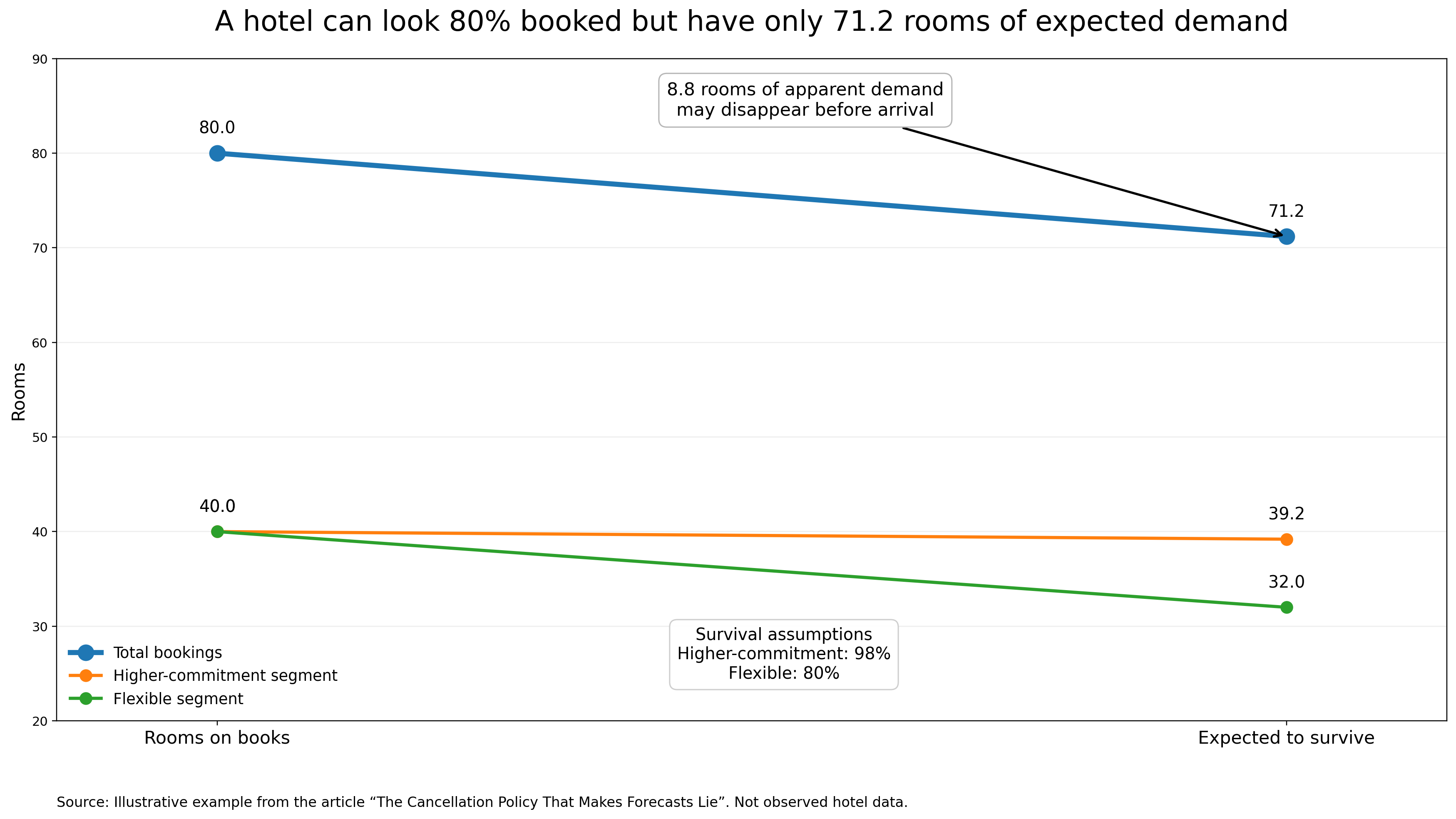
Imagine, purely as an illustration, that a hotel has 80 rooms booked. Forty are reservations that historically have a 98 per cent probability of materialising; the other 40 belong to a highly flexible segment with an 80 per cent probability.
The dashboard says 80 rooms.
Probability says something closer to 71:
40 × 0.98 + 40 × 0.80 = 71.2 expected occupied rooms.
That nine-room difference can change a pricing decision.
Flexibility creates an option for the guest
Why should flexible bookings behave differently? Because a generous cancellation policy gives the traveller something economically valuable: an option.
The guest can reserve today while preserving the right to change course tomorrow.
That flexibility has obvious commercial benefits. It reduces the perceived risk of booking, particularly when travellers face uncertainty over flights, visas, weather, health, work schedules or competing accommodation choices. Removing flexibility can therefore reduce conversion.
But flexibility also changes what a booking means.
A traveller may secure several elements of a trip before making the final decision. In some markets, guests can even hold competing hotel reservations and cancel the alternatives later. The booking system records commitment before the traveller has necessarily made an equivalent economic commitment.
This is why cancellation behaviour should not be treated merely as an operational nuisance appearing shortly before arrival. It is part of demand itself.
The effect can become especially important around periods when managers make aggressive inventory decisions. If a hotel sees 90 per cent occupancy on the books and closes lower room categories, the correct decision depends partly on how much of that 90 per cent is likely to survive.
Two dates with identical booking pace can therefore require different responses.
Watch the bookings that are likely to remain
This suggests a useful companion to conventional booking pace: survival-adjusted rooms on the books.
The calculation need not begin with sophisticated artificial intelligence. A hotel can start by examining historical cancellation rates by useful dimensions: days before arrival, booking channel, rate plan, source market, length of stay, season and refundable versus non-refundable conditions.
Suppose 50 reservations made 60 days ahead historically lose 20 per cent of their volume before arrival. Treating all 50 as equally firm can exaggerate expected demand. A simple historical survival rate would suggest roughly 40 surviving bookings, subject to the usual uncertainty around any forecast.
The purpose is not to predict precisely which guest will cancel. That can create false confidence. The useful question is how much of a portfolio of reservations is statistically likely to remain.
For revenue managers, this affects when to raise rates, restrict channels, accept groups or overbook cautiously. For destination analysts, the same principle warns against interpreting forward-booking data without understanding cancellation conditions. For tour operators and airlines, refundable inventory creates similar differences between reservations recorded and demand eventually consumed.
Return to the hotel that appeared almost full three weeks earlier. Its mistake was not accepting cancellable bookings; flexibility may have helped create those bookings in the first place. The mistake was allowing 80 uncertain reservations to behave in the forecast like 80 occupied rooms.
A reservation tells you that a customer has entered the booking system. Its probability of surviving tells you how much demand you may actually have.