The Visibility Problem: Why Better Hotels Sometimes Lose to Better Algorithms
01 Jul 2026, 11:15 · by i.zuhuree · 6 min read · Tourism · EN

Operators must treat digital visibility as core infrastructure, because bookings now depend on search ranking, reviews, pricing, content quality, and OTA conversion funnels.
Free tourism insights
Get Free Tourism Insights
Receive selected MTO insights, tourism data alerts, and new resource updates by email.
Get Free Tourism InsightsI searched for accommodation in the Maldives on several online travel agencies. I wasn't looking for the cheapest room. Nor the most luxurious. I wanted to answer a different question: How does a traveller actually discover a hotel?
The answer reminded me that tourism has changed. For decades, operators competed primarily through product. A better beach. A larger villa. Better service. Better diving. Today, many operators compete long before a guest ever sees the property.
Today, operators compete inside an algorithm.
For many accommodation providers—particularly guesthouses and independent resorts—the real challenge is no longer simply attracting tourists to the Maldives. It is becoming visible to the tourists who are already planning to come. That, I believe, is one of the defining operator problems of today's tourism economy.
The Market is Still Growing
The good news is clear. The Maldives continues to experience healthy international demand. The country welcomed its one millionth visitor of 2026 during 21 June, while official statistics continue to show positive year-on-year growth supported by strong performances from China, Russia, the United Kingdom, Italy and Germany.
For the destination as a whole, demand remains resilient. Yet many operators describe a different reality. Bookings arrive later. Price competition is stronger. Commission costs are rising. Direct bookings remain difficult.
How can both stories be true? Because destination demand and business visibility are not the same thing.
The First Page has Become the New Beachfront

Source: Visit Maldives
Imagine building a beautiful guesthouse. Excellent rooms. Outstanding reviews. Friendly staff. Thoughtfully designed excursions.
Now imagine appearing on page seven of an OTA search. The quality of the property has not changed. Its probability of being booked has. Digital visibility has become part of tourism infrastructure.
A property hidden from search results resembles a resort without a jetty. Technically it exists. Commercially it becomes much harder to reach.
The Mathematics of Visibility
We often say that bookings depend on demand. But for an individual operator, demand is not enough.
A traveller may want to visit the Maldives. They may have the budget. They may be ready to book. But if a property does not appear in the traveller’s search journey, that demand never becomes a booking.
Bookings = Searches × Visibility Rate × Click-through Rate × Conversion Rate
Or:
B = S × V × C × R
Where:
B = confirmed bookings
S = number of destination searches
V = visibility rate, or the share of searches in which the property appears meaningfully
C = click-through rate, or the share of visible impressions that become listing visits
R = conversion rate, or the share of listing visits that become bookings
This equation is simple, but it changes the operator’s problem. A property may have excellent rooms, good staff, and fair prices. But if visibility is weak, the rest of the equation collapses.
For example:
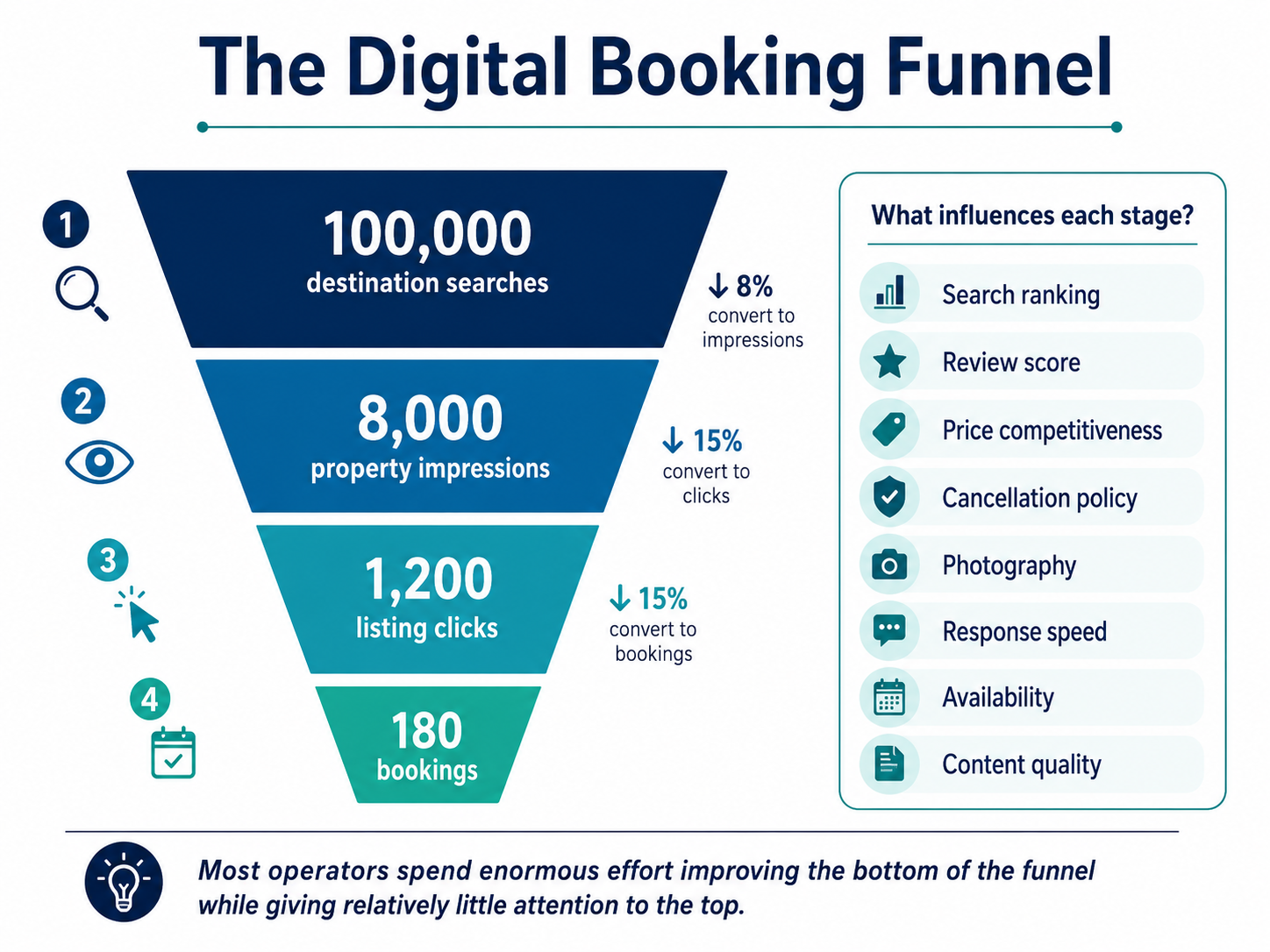
100,000 destination searches × 8% visibility × 15% click-through × 15% conversion = 180 bookings
Now imagine the operator improves conversion from 15% to 20%.
100,000 × 8% × 15% × 20% = 240 bookings
That is useful. But imagine instead the operator improves visibility from 8% to 12%, while everything else remains unchanged.
100,000 × 12% × 15% × 15% = 270 bookings
The lesson is not that conversion is unimportant. It is that visibility sits higher in the chain. A small improvement at the top of the funnel can create a larger effect downstream. This is why the first page of an OTA has become a kind of digital beachfront.
A beachfront room has higher value because it is physically visible, accessible, and desirable. A first-page listing has similar digital power. It places the property where demand is already moving. But visibility itself is not random. It is affected by several measurable signals:
V = f(Rank, Availability, Price, Reviews, Content, Response, Policy)
In plain language, visibility is a function of:
- search ranking,
- room availability,
- price competitiveness,
- review score,
- content quality,
- response speed,
- cancellation policy,
- and platform rules.
Then click-through depends on the first impression:
C = f(Photos, Headline Price, Review Score, Location, Room Type, Offer Clarity)
A traveller who sees a listing still has to choose it from many alternatives. The photograph, price, review score, location, and room type determine whether the traveller enters the property’s digital doorway.
Finally, conversion depends on trust and friction:
R = f(Value, Total Price, Cancellation Terms, Payment Ease, Reviews, Urgency, Confidence)
This is where many operators focus their effort: better offers, clearer terms, better room descriptions, easier booking, faster responses. These matter. But they matter most after visibility has already been achieved.
The danger is that operators often optimise the bottom of the funnel while remaining weak at the top.
They improve the room description but remain unseen. They adjust the cancellation policy but rank too low. They reduce price but do not understand whether the discount improves visibility, click-through, or conversion. This is where tourism intelligence becomes practical.
The question is no longer only: How many tourists are coming to the Maldives? The better operator question is: How much of that demand can see my property, click on it, and trust it enough to book?
That is the mathematics of visibility.
Why this Matters More in 2026
As accommodation capacity expands, competition increasingly occurs before guests arrive. More properties compete for the same digital attention.
Official statistics show continued growth in operational tourism capacity over recent years, while demand growth has become more moderate outside peak periods. That makes online discoverability increasingly valuable.
This is particularly important for independent guesthouses.
Unlike international hotel brands, many local operators depend heavily on OTA algorithms for market access.
Small improvements in ranking can produce meaningful improvements in bookings.
Conversely, small declines in ranking may reduce visibility disproportionately.
Visibility is Becoming a Management Discipline
Hospitality schools traditionally teach revenue management, service quality and operations. Increasingly, operators also need to understand digital distribution.
Questions that deserve management attention include:
- Which source markets actually see my property?
- Which search filters remove my listing?
- How frequently do guests abandon my booking page?
- Which photographs generate higher click-through rates?
- Does my cancellation policy reduce conversions?
- How quickly do I respond to guest enquiries?
- How does my pricing compare with similar properties nearby?
These are not marketing questions alone. They are operational questions.
What MTO can Contribute
One objective of the Maldives Tourism Observatory (MTO) is to help operators move beyond descriptive statistics. Tourism intelligence should not stop at arrivals. It should help explain why some businesses outperform others under similar market conditions.
Imagine combining:
- visitor arrivals,
- source-market composition,
- OTA pricing,
- review scores,
- transport accessibility,
- seasonality,
- accommodation capacity,
- and booking visibility indicators.
Together they begin to describe the competitive environment facing individual operators.
Instead of asking:
"How many tourists visited the Maldives?"
Operators can ask:
"How visible was my business to those tourists?"
That is a much more actionable question.
An Insight Operator Must Know
The Maldives has never been easier to discover as a destination. Ironically, individual accommodation providers have never faced greater competition to be discovered.
The next frontier of tourism competitiveness may not be building another room. It may be ensuring that the right traveller finds the room that already exists. For destination marketers, this means ensuring demand reaches diverse products. For operators, it means treating digital visibility as seriously as service quality. For policymakers, it highlights the importance of supporting digital capability alongside physical infrastructure.
Tourism has always been about connecting people with places. Increasingly, that connection begins with a search result. And understanding that invisible journey is exactly the kind of practical tourism intelligence I hope to build through the Maldives Tourism Observatory.