Two Inches Short: From One Liveaboard Question to a Simple Cutting Optimizer
28 Jun 2026, 15:49 · by i.zuhuree · 8 min read · AI · EN

A liveaboard mirror-cutting problem showed how AI can turn material waste decisions into clear options, helping entrepreneurs save cost through small adjustments, better layouts, and practical optimization
[To Use the Tool Click Mirror Cutting Optimizer]
Two days back, I was speaking to an entrepreneur who is trying to complete a liveaboard for operation. It was one of those practical conversations that begins with a small construction question and slowly opens into something much larger.
She had a boat to finish. The rooms needed mirrors. Fixtures had to be installed. Materials had to be ordered carefully. And like many entrepreneurs working with tight project budgets, she needed to avoid unnecessary cost.
Her question was simple: Can seven mirrors be cut from one large mirror sheet measuring 48 inches by 72 inches?
At first, this sounded like a normal glass-cutting question. But it was really an optimization problem.
The issue was not only whether the total area of the seven mirrors was smaller than the area of the large sheet. That is the easy calculation. The harder question was whether those seven rectangles could actually be arranged inside the sheet in a way that a mirror shop could cut.
A mirror is not liquid. It does not flow into unused space. It cannot bend around another piece. A leftover strip may look useful in total area but still be useless if it is too narrow for the next required mirror. That is where many small construction decisions become expensive. The mistake is not always in the measurement. Sometimes the mistake is in assuming that area alone tells the full story.
Hidden Geometry of a Business Decision
This same problem appears everywhere. A carpenter cuts plywood. A sign maker cuts acrylic. A contractor cuts wall panels. A boat owner cuts glass and mirrors. A guesthouse developer cuts tiles, boards, and cabinet parts.
The business question is always similar:
How do I get the required pieces from the available material with the least waste and the lowest cost?
In this liveaboard case, the entrepreneur had one large mirror sheet and seven required mirror sizes. Buying another full sheet would immediately increase cost. But forcing a poor cut could create waste, delay, or a badly fitted room feature.
So I used AI as a thinking partner. Not to replace the shop. Not to replace the glass cutter. But to test the layout before money was spent. I gave the model the sheet size, the mirror sizes, and the practical condition: find the most economical solution. The question was not simply, “Does the total area fit?” The better question was:
Can these rectangles be arranged inside one sheet in a workable cutting layout?
The result was more useful than a yes-or-no answer.
The original seven mirrors were very close to fitting into one sheet, but not quite. The optimizer found that if one mirror was reduced slightly, all seven pieces could fit. One mirror measuring 30 inches by 20 inches had to become 28 inches by 20 inches. That was the key.
Two inches changed the purchasing decision.
Instead of buying a second large sheet, the entrepreneur could check whether that one room could accept a slightly smaller mirror. If the answer was yes, the saving was immediate.
Why This Is More Than a Mirror Problem
What made this interesting was not the mathematics by itself. It was the decision clarity. The entrepreneur did not need a lecture on geometry. She needed answers she could act on: Can I use one sheet? Which piece should I modify? How much waste will remain? Can I show the shop a layout? What is the cheapest acceptable option?
This is where small digital tools become useful. The best tools do not overwhelm the user. They reduce uncertainty at the exact moment a decision has to be made. For a liveaboard, this matters because delays are costly. Every unfinished cabin delays readiness. Every extra material order affects cash flow. Every wrong cut can create rework. In a boat project, space is limited, imported materials can be expensive, and small errors compound quickly.
The lesson is simple: optimization is not only for large factories. It is also for small entrepreneurs trying to finish real projects with limited resources.

What the Mirror Cutting Optimizer Should Do
The idea that came from this conversation is a simple Mirror Cutting Optimizer. The tool would help users answer one practical question:
How can I cut the required mirror pieces from available stock sheets with minimum waste and minimum cost?
A user would enter:
- the size of the available mirror sheet;
- the list of required mirror sizes;
- the number of pieces needed;
- whether pieces can be rotated;
- whether small size adjustments are allowed;
- the cutting gap or safety margin required by the shop.
The tool would then produce:
- a recommended cutting layout;
- the number of sheets required;
- the estimated waste;
- a utilization percentage;
- a visual diagram;
- a cut list that can be shared with the mirror shop.
In the liveaboard case, the answer was simple: Use one sheet. Keep six pieces unchanged. Reduce one 30×20 mirror to 28×20. That is the kind of result a busy entrepreneur can use immediately.
Useful Output Is Not One Answer. It Is Options
A good optimizer should not only say “yes” or “no.” It should show choices.
For example:
Option A: Buy two sheets and keep every mirror size exactly as requested.
Option B: Use one sheet and reduce one mirror slightly.
Option C: Ask the shop whether an offcut can be used for one smaller mirror.
Option D: Change the orientation of one or more pieces if rotation is acceptable.
This is important because the cheapest mathematical solution is not always the best business solution.
A mirror may need to match a room design. A cabinet door may need a fixed width. A decorative panel may have grain direction. A treated material may not be rotatable. A shop may require a cutting margin. A boat interior may have tolerances that are different from a building.
The tool should therefore support decision-making, not pretend that the software knows everything.
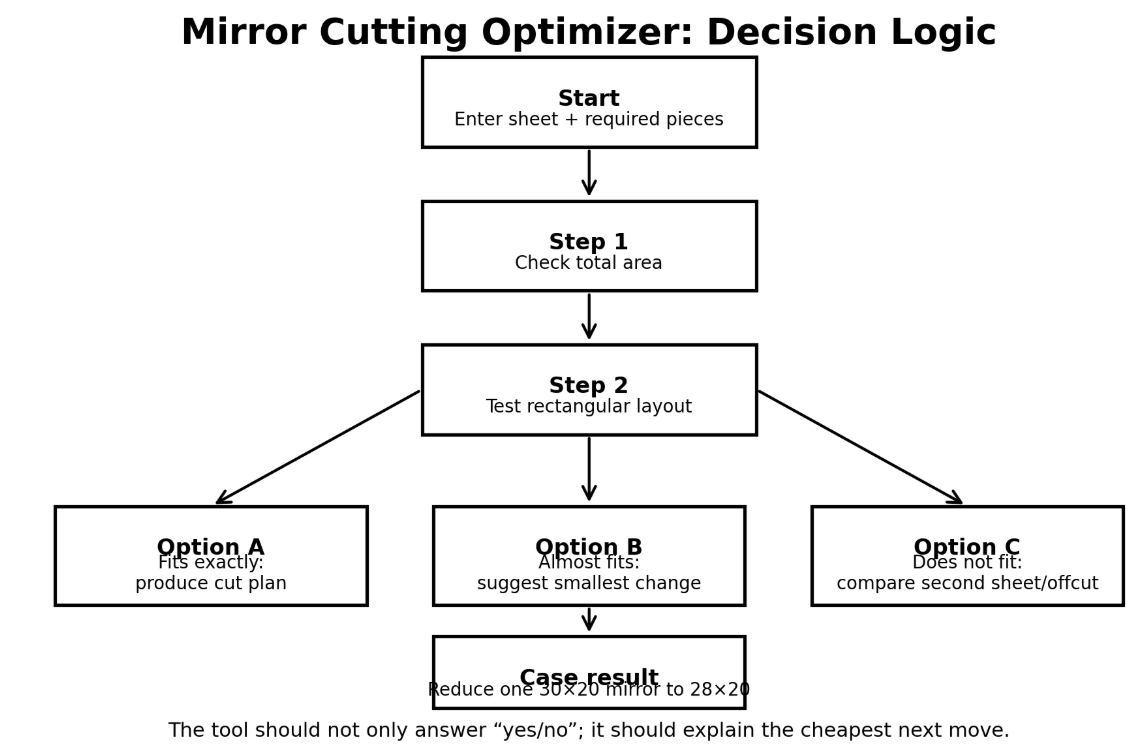
This is the real value of the tool. It turns a scattered conversation between entrepreneur, contractor, and shop into a structured decision.
A Simple Workflow
The user experience should be simple enough for someone using a phone. First, the user opens the Mirror Cutting Optimizer. Second, they enter the sheet size. For example: 48 inches by 72 inches. Third, they enter the required mirror pieces. Each row includes width, height, and quantity. Fourth, they choose whether rotation is allowed. Fifth, they enter any cutting gap or margin if the shop requires it. Sixth, they click “Optimize.”
The result should show whether the pieces fit, how they can be arranged, how much material remains, and what practical alternatives exist if the first layout does not work.
Prompt Users Can Paste Into an AI Model
A user does not need to wait for a dedicated app to test the idea. They can start with a simple AI prompt:
I have one mirror sheet measuring 48 inches by 72 inches. I need to cut the following mirror pieces: [list each width × height and quantity]. Pieces may be rotated unless I say otherwise. Assume a cutting gap of [insert gap, or say 0 if unknown]. First check whether the pieces fit by area. Then test whether they can fit geometrically in one sheet. If they do not fit, suggest the smallest practical adjustment to one piece, or tell me whether I need another sheet. Give me a cut list, a simple layout description, estimated waste, and questions I should confirm with the mirror shop.
For a more advanced version, the user can add:
Prioritize the lowest-cost solution. Do not reduce any piece unless necessary. If a size adjustment is needed, identify the smallest change and explain why that change helps the layout.
Why This Matters for Tourism and Marine Businesses
In the Maldives and other tourism-driven economies, many small businesses operate with imported materials, limited storage, tight launch dates, and narrow margins.
A liveaboard is a good example. The operator is not only building rooms. She is managing cash flow, supplier coordination, future bookings, and operational readiness. A second sheet of mirror may look like a small purchase, but repeated across furniture, glass, panels, fixtures, and fittings, these decisions become a serious cost category.
The same optimization logic can later be extended to other use cases:
- plywood panels;
- acrylic sheets;
- aluminum sheets;
- glass panels;
- signage boards;
- furniture boards;
- wall cladding;
- cabinet parts.
But the first version should stay focused. A useful tool should begin with one clear problem and solve it properly.
For this case, that problem is mirror cutting.
Lesson Learned
What stayed with me after the conversation was not only the cutting layout. It was the way a small question revealed a larger opportunity. The entrepreneur did not come asking for AI. She came with a real operational problem. She needed to finish a boat. She needed to control cost. She needed to know what to ask the shop. She needed a decision before spending money.
That is where useful innovation often begins. Not with a grand platform. Not with a fashionable technology word. But with a practical problem that many people quietly face.
The Mirror Cutting Optimizer is an attempt to turn that moment into something reusable. It takes a problem that normally depends on manual trial and error and turns it into a simple decision tool. In this liveaboard case, the answer was hidden in two inches.
One mirror, slightly reduced, made the whole sheet work.
Sometimes the difference between waste and efficiency is not a large investment. It is a clearer view of the problem.