The Hidden Unit of Maldives Tourism: Why I Count Visitor-Days and then one millionth tourist
22 Jun 2026, 06:35 · by i.zuhuree · 8 min read · Tourism · EN

Maldives tourism must move beyond arrival milestones, using bed nights, capacity, occupancy, pricing, and value-chain data to guide smarter decisions for operators, investors, and policymakers today.
Free tourism insights
Get Free Tourism Insights
Receive selected MTO insights, tourism data alerts, and new resource updates by email.
Get Free Tourism InsightsThere is a moment in tourism when a country counts.
The airport doors open. A traveller walks into the arrival hall. Cameras flash. Flowers are placed around the guest’s neck. The destination celebrates a milestone: one million tourists, two million tourists, another record year.
The Maldives has just crossed that familiar symbolic line again.
On 21 June 2026, the country welcomed its one millionth tourist of the year. It was a good moment. It showed that the Maldives brand remains strong, even after months of pressure on major air corridors and uncertainty in international travel. But as I looked at the number, I found myself thinking of a basic lesson from science: what we choose to measure determines what we are able to understand.
In physics, the same universe looks different depending on the instrument. A telescope shows galaxies. A microscope shows cells. A spectrometer shows hidden signatures of matter. None of these instruments is false. Each reveals a different layer of reality.
Tourism data works the same way.
Arrivals show one reality. Bed nights show another. Occupancy shows another. Average stay, prices, capacity, taxes, and source markets each reveal a different part of the system.
The danger is not that arrival numbers are wrong. The danger is that we ask them to explain too much
The Question Behind the Milestone
For decades, arrivals have been the public language of Maldives tourism. They are easy to understand. They are politically visible. They tell us whether the world is still choosing the Maldives.
But an arrival is only the beginning of the economic event.
A tourist who stays four nights and a tourist who stays ten nights both count as one arrival. At the immigration counter, they are equal. In the tourism economy, they are not.
The difference appears only when we count visitor-days or, more practically, tourist bed nights.
This is why I increasingly argue that the Maldives should pay more attention to a quieter unit of measurement: the tourist day.
A tourist day is not ceremonial. It does not arrive with garlands and cameras. But it is the unit that fills a room, supports a restaurant, justifies staffing, generates green tax, sustains a dive centre, uses electricity and water, creates waste, pays a service charge, leaves a review, and contributes to the daily rhythm of the tourism economy.
An arrival is a door opening. A bed night is the system working.
One Chart, One Insight
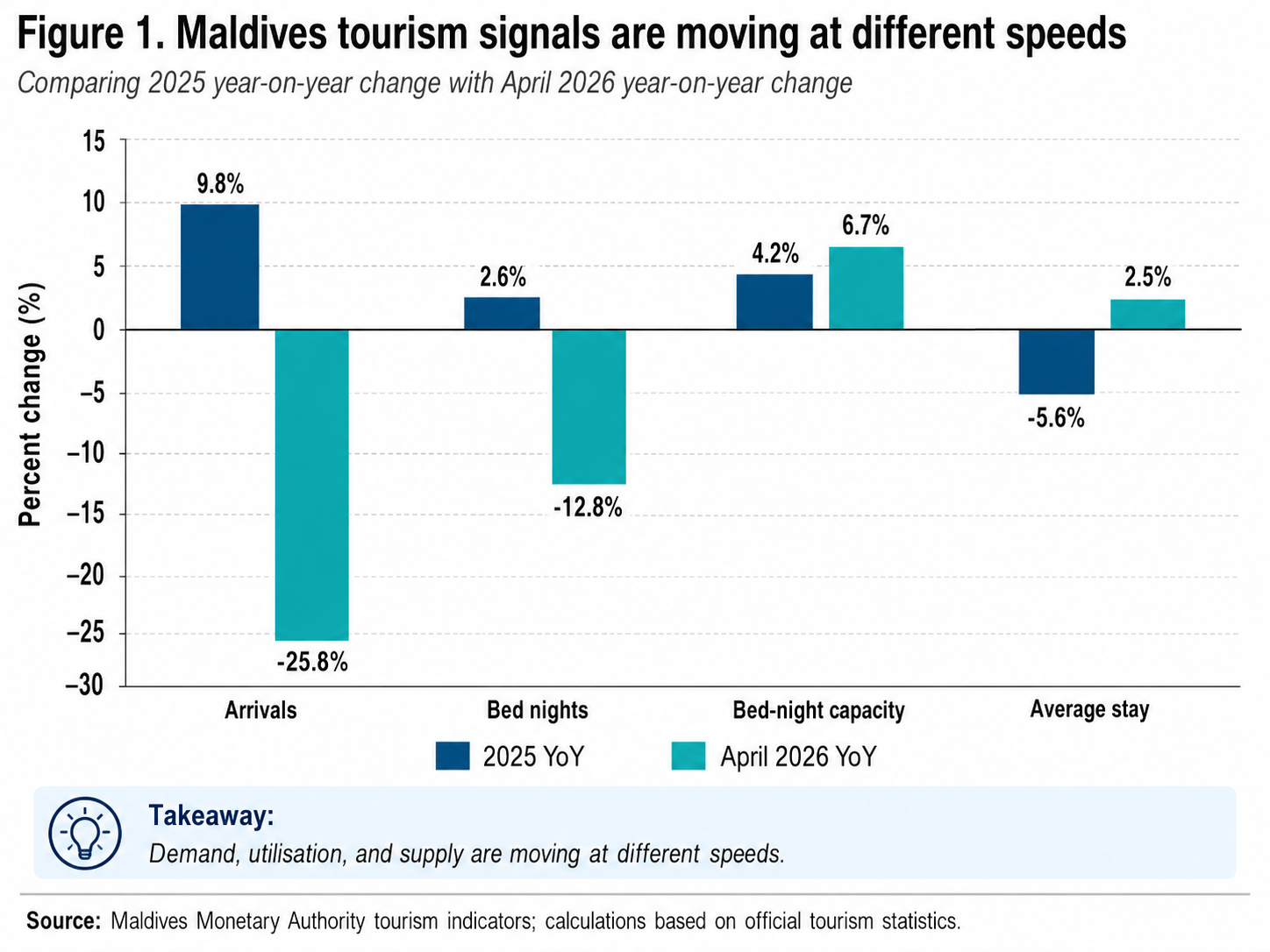
In 2025, arrivals grew strongly. The Maldives welcomed about 2.25 million tourists, up 9.8% from the previous year. But bed nights grew much more slowly, at about 2.6%. Bed-night capacity also increased, by about 4.2%, while average stay fell by 5.6%.
That is the first signal.
More people came, but each visitor, on average, stayed for fewer days. At the same time, the system had more beds to fill. Then April 2026 gives us a sharper warning. Arrivals fell year-on-year. Bed nights also fell. But bed-night capacity continued to rise.
This is the point at which tourism becomes a more complex system.
Growth in arrivals is not the same as growth in utilisation. Growth in capacity is not the same as growth in value. A destination can become more famous and more difficult to operate at the same time.
That is where the Maldives is now.
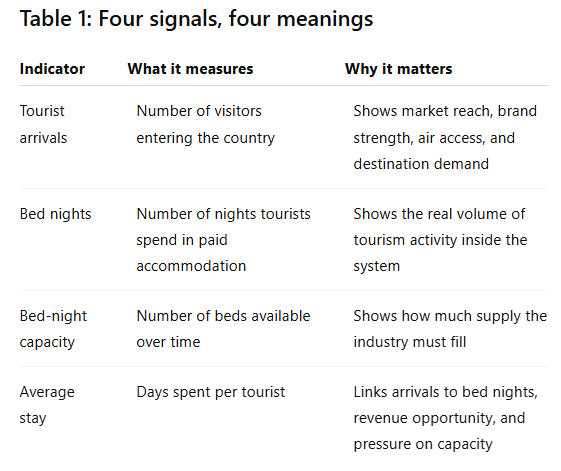
This table looks simple, but it changes the conversation.
If arrivals rise while average stay falls, the destination must work harder to produce the same number of bed nights. If capacity rises faster than bed nights, occupancy pressure grows. If occupancy pressure grows, operators may discount. If discounting spreads, revenue per visitor can weaken even when the country is welcoming record numbers.
Of course, for transport economics, it is a different story. Perhaps fewer bed-nights and more tourist transfers are better for that sector. But that is a story for another day.
Nevertheless, I do not see the one-millionth tourist milestone as the end of the story. I see it as the opening paragraph.
The Tourism Economy as a System
The Maldives tourism economy is not one machine. It is a network of linked systems. There is the accommodation system: resorts, guesthouses, hotels, safari vessels, room categories, staff ratios, debt structures, and seasonality. There is the island system: beaches, reefs, waste, harbours, councils, public spaces, community relations, and local business linkages. There is the fiscal system: tourism GST, green tax, airport taxes, departure tax, resort rent, and foreign exchange earnings. There is the market system: prices, reviews, booking channels, package structures, repeat visitation, and traveller expectations.
And there is the aviation system: routes, seats, disruptions, fuel costs, geopolitical shocks, and source-market access
Arrivals pass through all these systems. But they do not explain all of them.
A guesthouse owner does not experience tourism as a national arrival number. She experiences it as bookings by month, cancellations, average daily rate, OTA commission, staff availability, excursions sold, and the number of nights the guest actually stays.
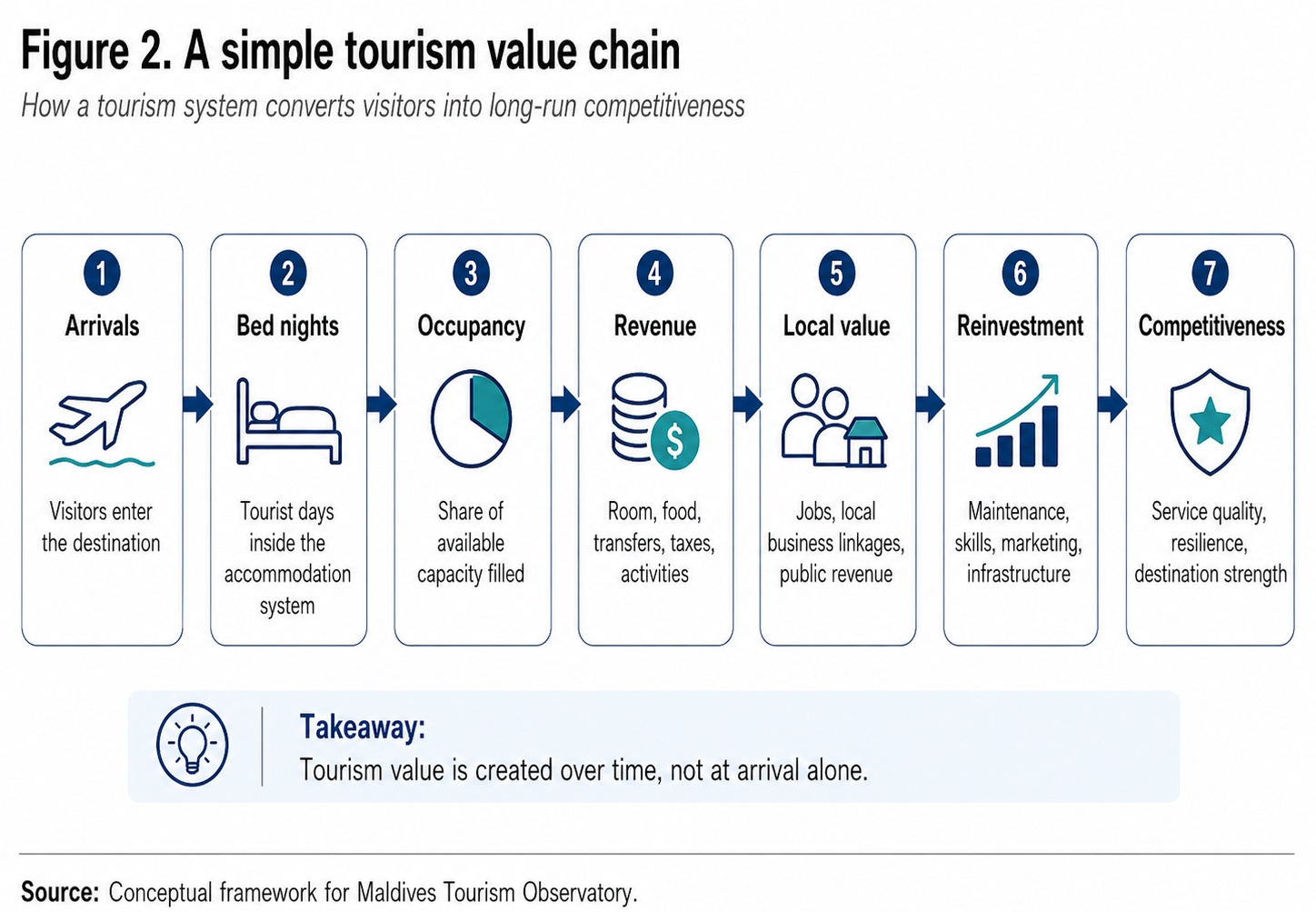
A resort does not operate on destination popularity alone. It operates on occupancy, rate integrity, transfer logistics, food cost, wage cost, capital expenditure, and brand positioning.
A policymaker should not look only at how many tourists arrived. The better question is how visitor-days are distributed across months, islands, accommodation types, and source markets — and whether the revenue generated is enough to sustain infrastructure, environmental management, and future competitiveness.
What this means for operators
For facility operators, the practical lesson is direct: design for visitor-days, not just bookings. This does not mean every property should chase longer stays at any price. It means operators should understand which guests create the most stable value for their specific business model. A five-night guest at a weak price may not be better than a three-night guest at a strong rate with high ancillary spending. A long-stay budget guest may support local restaurants and excursions. A shorter-stay premium guest may sustain room revenue and staff productivity. The point is not to romanticize length of stay. The point is to measure it properly.
For guesthouses, this is especially important.
Many local-island properties compete in a narrow price band. When the only strategy is “cheaper room,” the island risks a race to the bottom. But when islands compete on cleanliness, transfer convenience, excursions, food, public space, and service reliability, they can create reasons for visitors to stay longer and spend more locally.
The room is only one part of the product. The island is the operating environment.
What this means for investors
For investors, the hidden variable is not land cost. It is demand depth.
A low-cost plot can become expensive if it cannot produce enough bed nights. A remote island can be viable if it has a clear segment, reliable access, pricing power, and a reason for guests to stay. A popular island can still become risky if capacity expands faster than demand.
A serious feasibility study should therefore estimate bed nights by month, not just annual occupancy. It should ask:
Which source markets will come?
How long will they stay?
Which months will be weak?
What room rate is realistic after commissions and taxes?
How much capacity already exists on the island?
Is the island competing on price alone, or does it have a defensible value proposition?
Tourism investment is often described through construction: rooms, land, buildings, design. But the real investment question is temporal. Can this place produce enough paid nights over time?
Maldives Tourism Observatory
The Observatory is not meant to be a promotional tourism blog. It is a data infrastructure project. Its purpose is to collect, clean, connect, and interpret tourism information so that better decisions can be made.
The Maldives already has many useful public data points: arrivals, bed nights, average stay, occupancy, bed capacity, source markets, tax collections, and accommodation categories. Private and semi-public data add another layer: OTA prices, reviews, airlift, property attributes, guesthouse clusters, and investor observations.
The problem is that these data often sit apart. MTO is about connecting them. When we connect arrivals with bed nights, we see visitor-days. When we connect bed nights with capacity, we see utilisation. When we connect utilisation with prices, we see market pressure. When we connect prices with environmental quality and service quality, we begin to see value capture. When we connect taxes with visitor-days, we see public revenue capacity. When we connect all of this with geography, we see the hidden shape of the tourism economy.
That is the data centered story I want to tell through MTO. Not a story of slogans. A story of measurement.
The Maldives does not need to stop celebrating arrivals. Milestones matter. They remind the industry that the destination still holds a special place in the imagination of travellers. But the next frontier is more demanding. The next frontier is not only bringing more tourists.
It is understanding how long they stay, where they stay, what they value, what they pay, what they cost, what they leave behind, and how much of that value remains in the Maldives. That is why I am calling to count tourist days.
Because somewhere between the arrival gate and the checkout desk, the real tourism economy is formed.
And if we want better decisions: for operators, investors, policymakers, destination marketers, island councils, and communities, we need to measure that journey more carefully.