Policy Analysis Series: Why Maldives’ new 40% foreign-currency conversion rule
19 Sep 2026, 14:55 · by IzuCT · 7 min read · Tourism · EN

Maldives’ new 40% foreign-currency conversion rule aims to channel more tourism dollars through banks, strengthen reserves, improve formal FX liquidity, and reduce parallel-market dependence, while requiring resorts to adopt tighter reporting, budgeting, and treasury planning.
Free tourism insights
Get Free Tourism Insights
Receive selected MTO insights, tourism data alerts, and new resource updates by email.
Get Free Tourism InsightsThe Maldives faces an unusual economic puzzle.
Millions of tourists arrive carrying—or generating—foreign currency. Resorts sell rooms, transfers, meals and experiences largely in US dollars. Tourism is therefore one of the country's principal sources of foreign exchange.
Yet businesses and households can still find dollars difficult to obtain through the domestic banking system.
The explanation is that earning foreign currency and circulating foreign currency through the domestic financial system are not the same thing.
That distinction lies at the heart of the Government's latest foreign-currency reform.
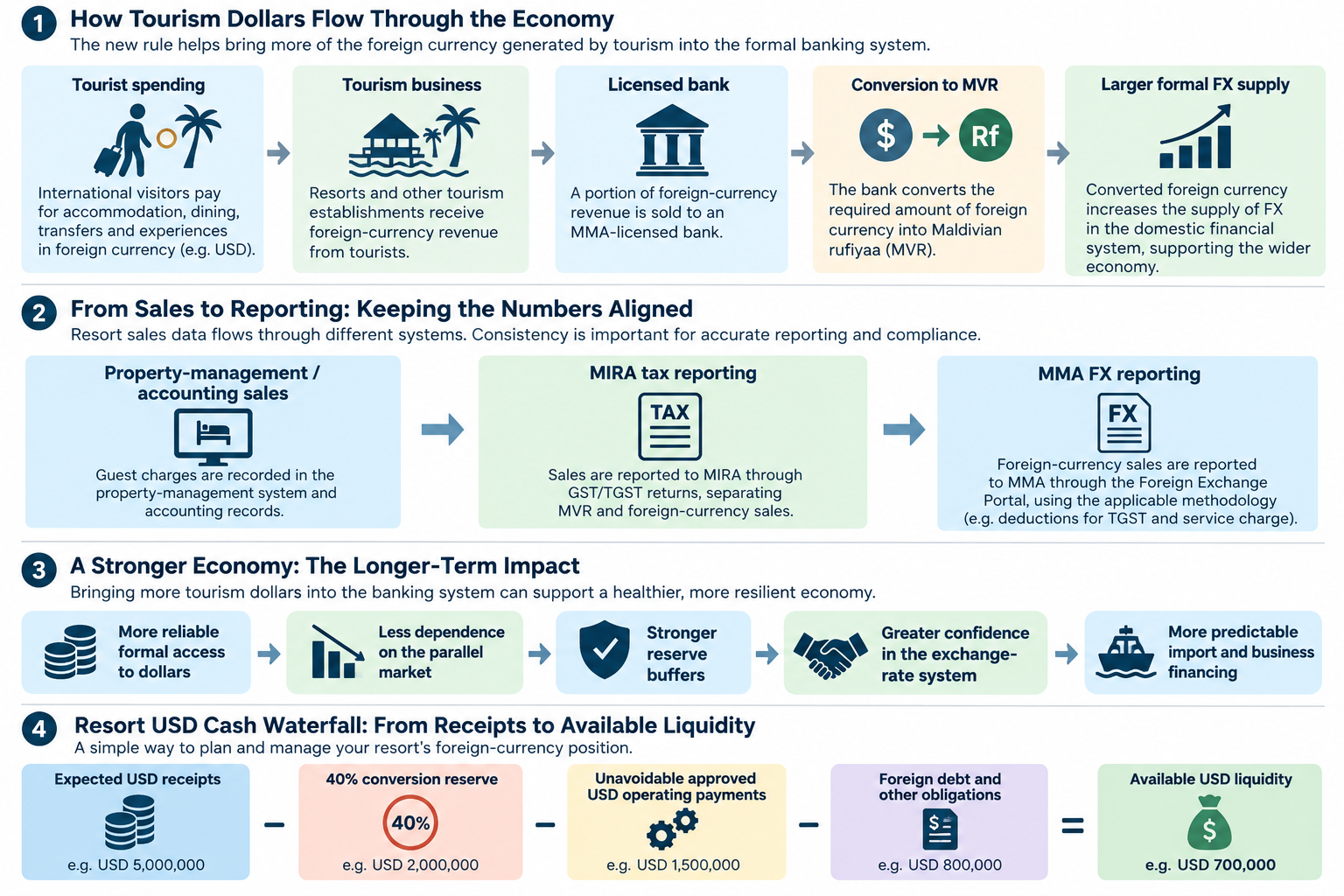
From 1 September 2026, Category A tourism establishments, including tourist resorts, integrated tourist resorts, private islands and resort hotels, must convert 40% of their monthly gross foreign-currency sales into Maldivian rufiyaa through an MMA-licensed bank. The previous alternative allowing Category A establishments to convert USD 500 per tourist has been removed. Conversion must now be completed by the 28th day of the immediately following month.
For the tourism industry, this is a significant operational change. But the larger story is about how the Maldives manages the foreign currency generated by its most important export industry.
Why does the Maldives need more tourism dollars in banks?
Tourism is economically an export of services. Instead of shipping a product overseas, the Maldives brings foreign consumers into the country and sells services to them.
That makes tourism particularly important for a small economy that imports much of what it consumes. Earlier Maldives tourism research has similarly emphasised tourism's role in generating foreign-exchange earnings for the economy.
Foreign currency is needed to purchase fuel, food, medicines, machinery, construction materials and numerous other imported goods. It is also required for external debt payments and many overseas services.
The challenge becomes obvious when reserves are thin.
The World Bank reported that official reserves recovered from USD 371.2 million in September 2024 to USD 1.3 billion in March 2026, before falling to USD 717.9 million in April 2026, following large external repayments. It also reported continuing FX-liquidity constraints and a widening parallel-market premium.
The central policy question is therefore not simply: How many dollars does tourism earn?
It is: How much of those dollars becomes available through the formal financial system?
The logic of the 40% rule
Imagine tourism businesses collectively earn USD 100.
If most of that foreign currency remains outside the domestic banking market or is immediately used outside the country, the tourism industry may be earning dollars while the formal banking system still has difficulty supplying FX to importers and other legitimate users.
Mandatory conversion changes the route taken by part of that money.

The intention is to bring a greater proportion of the foreign currency generated by the economy's principal export sector into the regulated banking system.
This is important because the 40% requirement is not a 40% tax.
When a resort converts dollars, it receives rufiyaa in exchange. What changes is the composition of its assets: the establishment holds less USD and more MVR.
There is already some evidence that the mechanism can work
The previous system began in 2025 with a lower conversion requirement.
MMA's 2025 Annual Report states that USD 492 million was received through mandatory foreign-currency conversion during 2025. MMA also reported that mandatory conversion contributed to increased foreign-currency inflows and reserve accumulation, alongside higher government FX revenues, bilateral support and other factors.
The IMF reached a similar, carefully qualified conclusion in June 2026, stating that the Foreign Currency Act had helped alleviate foreign-exchange liquidity pressures and build international reserves, while also emphasising that broader macroeconomic adjustments remain necessary.
This distinction matters.
The foreign-currency rules cannot by themselves solve fiscal deficits, external debt pressures or excessive import demand. But the available evidence supports the underlying mechanism: bringing more tourism FX through banks can strengthen the formal FX market and contribute to reserve accumulation.
The September reform increases the scale of that mechanism.
What exactly must Category A resorts do?
The operating cycle is now relatively straightforward.
Step | Requirement |
|---|---|
1. Determine monthly foreign-currency sales | Establish the relevant gross sales received in foreign currency for the month. |
2. Calculate the conversion amount | Category A establishments calculate 40% of the applicable monthly amount. |
3. Maintain the required FX with a licensed bank | Relevant proceeds are channelled through the designated foreign-currency account. |
4. Convert the required amount | The required FX is sold through the licensed bank in exchange for MVR. |
5. Complete conversion on time | Conversion must be completed by the 28th of the following month. |
6. Complete MMA reporting | Required information is submitted through the Foreign Exchange Portal. |
So, if the applicable September foreign-currency gross sales are USD 5 million, the conversion obligation is:
USD 5 million × 40% = USD 2 million
That amount must be converted through the banking system by 28 October 2026.
The change in timing is also significant. Under the previous framework, the conversion deadline was the 28th day of the third subsequent month. Resorts therefore need considerably tighter monthly treasury planning.
How should resorts calculate gross sales?
The existing MMA guidance defines gross sales broadly as total business revenue before deductions and links the calculation to sales reported in GST/TGST returns. For mandatory conversion, it considers foreign-currency sales and permits deductions for TGST and service charge; Green Tax is not included in the conversion calculation.
That guidance was published before the September 2026 amendment. Finance teams should therefore use the latest MMA instructions where updated reporting guidance supersedes earlier documentation.
The safest operational approach is to reconcile three records every month:

Differences between those systems should be resolved before the conversion deadline.
What about a resort's own dollar expenses?
This is the industry's most important operational concern.
Resorts themselves have substantial legitimate FX requirements: imported supplies, overseas services, insurance, technology, foreign contractors and other expenditure.
The amended regulatory framework therefore includes procedures for businesses subject to mandatory conversion to obtain MMA approval for relevant foreign-currency payments for goods and services. For expenditure during the remainder of 2026, applications are due by 25 September 2026. Thereafter, businesses should submit planned annual foreign-currency expenditure at least 30 days before the start of each year. Additional applications can be made where expenditure exceeds previously approved amounts or purposes.
MMA must notify applicants of its decision within 14 working days, according to the regulatory summary. Approved businesses also face six-monthly reporting requirements.
The practical implication is important:
Resort budgeting must now include an explicit foreign-currency budget.
The treasury process resorts should adopt
A useful weekly cash-flow structure is:
Expected USD receipts − 40% conversion reserve − unavoidable approved USD operating payments − foreign debt and other obligations
= available USD liquidity
The 40% should ideally be recognised as an obligation as revenue is earned rather than treated as freely available cash until the conversion deadline.
A rolling 13-week USD cash-flow forecast would allow management to identify shortages before they become payment problems.
This also creates a new connection between departments. Revenue managers influence when and in what currency money arrives. Procurement creates future FX requirements. Finance manages conversion. Ownership determines capital spending and financing.
Foreign-exchange management therefore becomes an operational issue, not merely an accounting one.
Why the long-run objective matters
There will inevitably be adjustment costs for businesses required to convert more FX and to forecast their foreign-currency requirements more carefully.
But the economic rationale becomes clearer when the system is viewed from the perspective of the whole economy.
A tourism economy cannot fully benefit from earning foreign currency if a large share of that currency does not circulate through its formal financial system.
If the reform succeeds in increasing bank FX liquidity, several longer-term benefits could follow:

The first year of mandatory conversion provides some evidence in this direction: MMA recorded USD 492 million through the mechanism in 2025, and the IMF subsequently assessed that the Foreign Currency Act had contributed to easing FX liquidity pressures and rebuilding reserves. Those results cannot be attributed to the FX regime alone, but they provide empirical support for its underlying logic.
For the system to deliver those benefits sustainably, however, one reciprocal condition is essential: businesses that bring dollars into banks must be able to obtain reasonable access to foreign currency for legitimate economic requirements.
That is where implementation will ultimately be tested.
What the industry need to know and should watch
Over the next year, the most informative indicators will not simply be how many dollars resorts convert.
Stakeholders should monitor bank FX availability, reserve accumulation, the parallel-market premium, approval times for legitimate FX payments, resort investment behaviour and whether businesses become less dependent on informal foreign-exchange channels.
If formal FX availability improves while tourism businesses continue to operate, invest and meet legitimate overseas obligations, the reform will have achieved something more important than regulatory compliance.
It will have strengthened the connection between the dollars tourism earns and the dollars the Maldivian economy needs.
That is the long-term economic case behind the 40% rule.