One-Island-One-Resort Model as the Centre of Gravity of Maldives Tourism
16 Jun 2026, 06:38 · by i.zuhuree · 8 min read · Tourism · EN
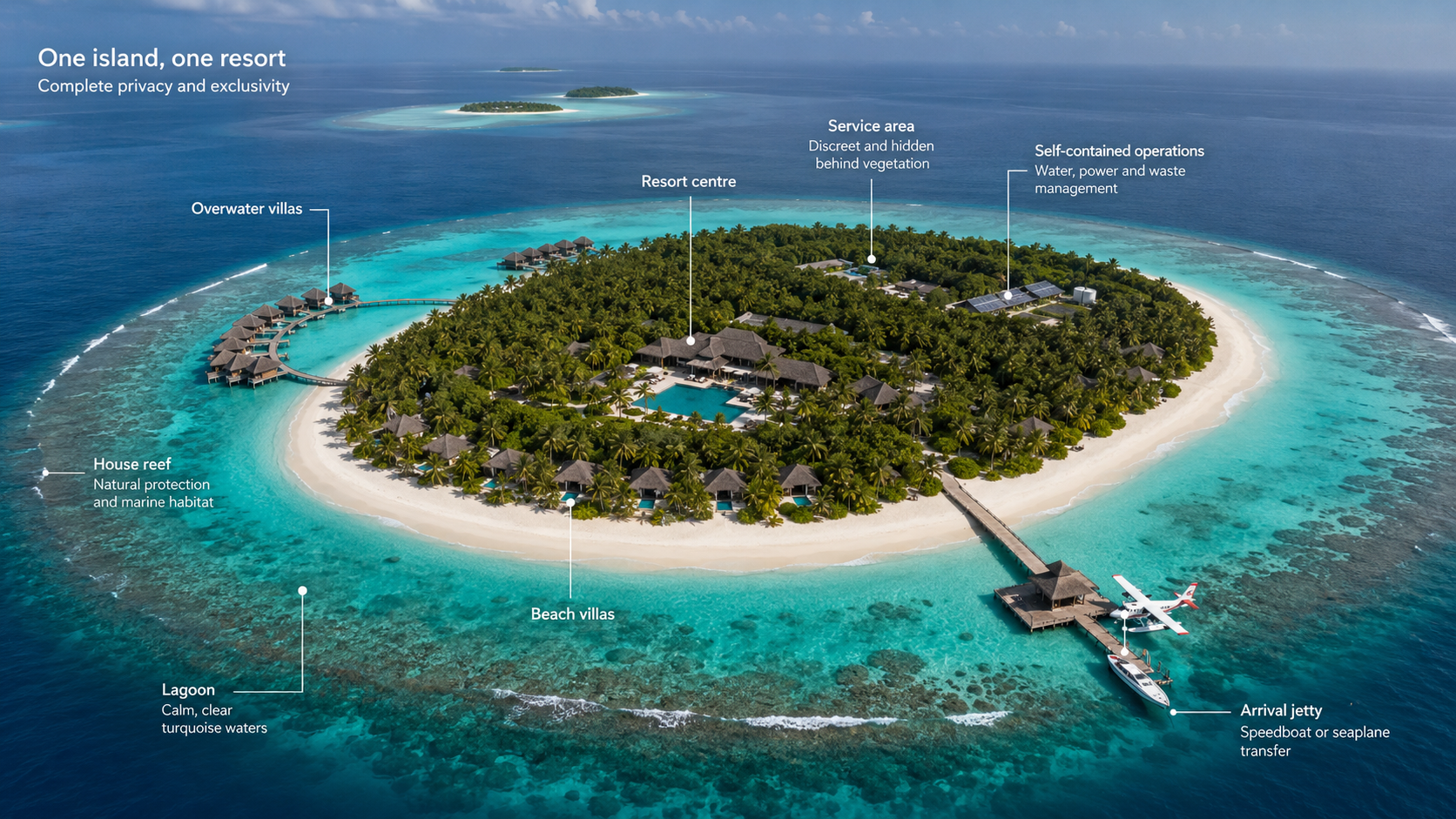
... In continuation of seven-part series (Day 2 ), the one-island-one-resort model remains Maldives tourism’s centre of gravity: turning geography into exclusivity, internalising externalities, dominating value and public value capture.
Free tourism insights
Get Free Tourism Insights
Receive selected MTO insights, tourism data alerts, and new resource updates by email.
Get Free Tourism InsightsIn every tourism economy there is a centre of gravity. It is not always the largest object by number. It is the object with the strongest pull.
In the Maldives, that centre is still the resort island. Not merely the resort as a hotel. Not simply luxury as a market category.
I mean the one-island-one-resort model (OIOR) as an institutional invention: a way of organising land, lagoon, labour, capital, regulation, environmental responsibility, and the tourist imagination within one bounded space.
This model did not fall from the sky fully formed. It emerged from geography. The Maldives was a scattered archipelago with small islands, limited infrastructure, high transport costs, and an extraordinary natural endowment: sun, sea, reef, lagoon, beach, privacy, distance. In the early days of tourism, the country did not have a large urban hotel base or mass coastal resorts. It had islands.
The genius of the model was that it converted an apparent weakness, separation, into an economic asset. In 1960s, foreign experts could not imagine that a small uninhabited island could become a self-contained tourism world.
But Maldivians found the magic formula, did the hard work, brought in innovations: the lagoon became the frame. The reef became the attraction. The beach became the theatre. The boundary became the brand.
By the early 1980s, this logic was institutionalised through tourism planning. The one-resort-one-island idea separated international tourism from inhabited islands and placed most tourism production and consumption on leased resort islands. In doing so, the Maldives created one of the most distinctive destination models in the world.
Model as a Governance Instrument
A resort island is not just a place where tourists sleep. It is a miniature jurisdiction of tourism production. The operator must organise accommodation, food, water, power, waste, staff housing, transport, recreation, safety, landscape, and environmental management. In a country of dispersed islands, this mattered deeply. The state did not have to build full public infrastructure for every tourism site. Much of the infrastructure burden was internalised by the operator.
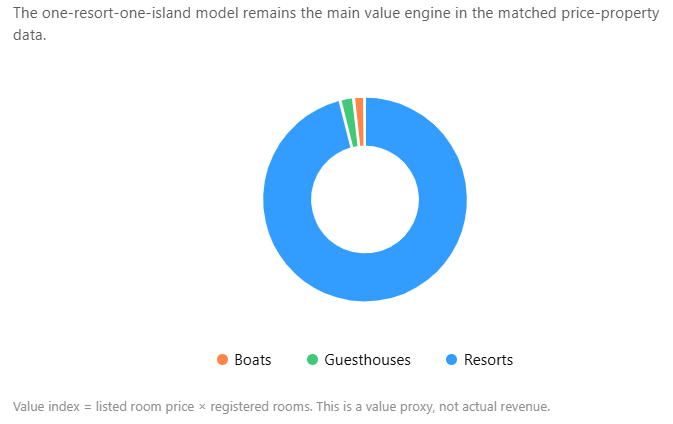
That is why the model still dominates. Resorts account for only 13.9% of facilities, but they hold 66.4% of national tourism beds. When price is added, the centre of gravity becomes even clearer. Resorts account for about 96.4% of the listed room value index. This index is only a proxy, not actual revenue. But as a signal of market weight, it is powerful.
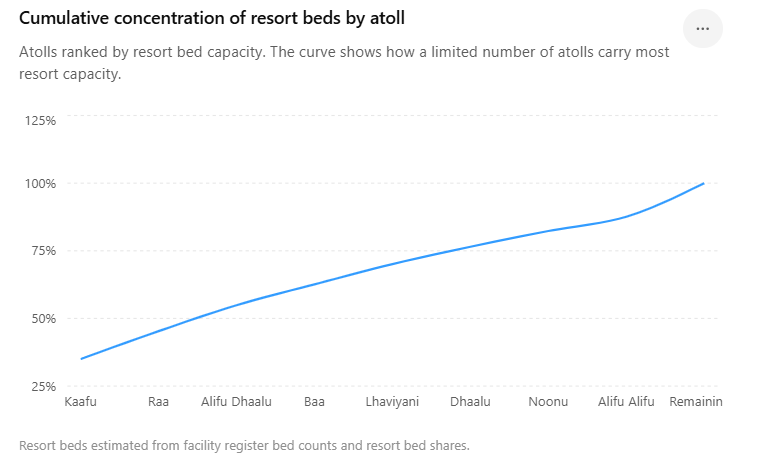
The resort backbone is also spatially concentrated. Kaafu alone accounts for a large share of resort beds. When atolls are ranked by resort bed capacity, the first few atolls carry most of the resort system. Kaafu, Raa, Alifu Dhaalu, Baa, Lhaviyani, Dhaalu, and Noonu form a strong resort belt.
This matters because resort development creates its own geography of power. Airports, seaplanes, domestic transfers, supply chains, labour movement, food imports, construction logistics, and environmental monitoring all begin to orbit these resort-heavy atolls.
Some atolls are not simply “tourism atolls.” They are resort economies.
Lhaviyani has about 99.2% of its tourism beds in resorts. Dhaalu has 97.0%. Raa has 92.0%. Noonu has 91.0%. These atolls are structurally different from mixed systems such as Kaafu, Alifu Alifu, Alifu Dhaalu, or Vaavu, where guesthouses and resorts coexist more visibly.
This difference should matter in law and policy. Resort-heavy atolls need strong lease governance, environmental compliance, labour planning, transfer regulation, reef monitoring, and reinvestment rules. Mixed atolls need all of that, but also local-island destination management: public waste systems, harbours, beach use, visitor conduct, community benefit-sharing, and island-level zoning.
Solving Externalities: One-island-one-resort as a property-rights story
The one-island-one-resort model solved one major problem better than almost any other tourism model in the region: externalities.
In tourism, many things tourists consume are not privately produced in the narrow sense. A tourist enjoys the beach, the reef, the view, the silence, the cleanliness, the feeling of escape. These are partly environmental public goods. When too many users consume them without clear responsibility, the result can be crowding, waste, reef damage, noise, and declining destination quality.
On a resort island, the operator has a strong incentive to protect the immediate environment because the environment is part of the price. If the beach erodes, if the lagoon is polluted, if the reef declines, if the landscape deteriorates, the product loses value. The resort model does not eliminate environmental risk, but it aligns responsibility more clearly than a fragmented multi-operator setting.
This is why one-island-one-resort is also a property-rights story. The leased island gives the operator enough control to manage the tourism product and enough exposure to suffer if the product declines. The economic signal is direct: quality is capitalised into price.
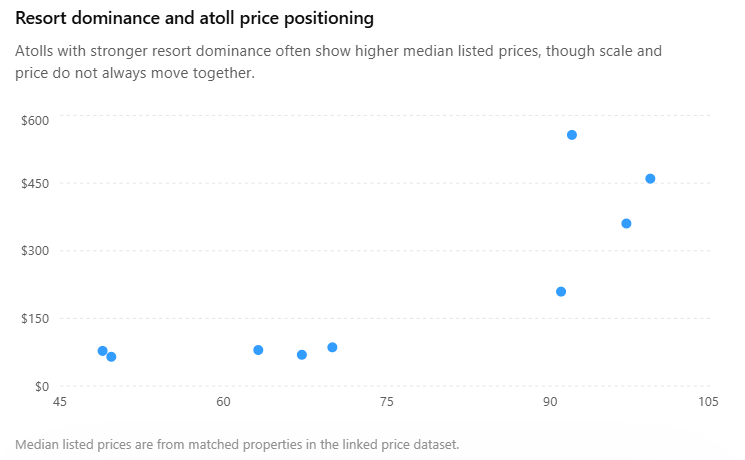
The value-positioning data reflects this. Resort-led atolls such as Raa and Lhaviyani sit much higher in median listed price than more mixed atolls. Kaafu is large, diverse, and strategically central, but its median listed price is pulled downward by the mix of accommodation types. Resort-heavy atolls are often smaller in number of facilities, but stronger in price positioning.
This is the gravitational pull of the resort model. It concentrates capital and responsibility. It protects exclusivity. It produces a globally recognisable image. It allows higher prices because the tourist is not buying a room alone. The tourist is buying a bounded universe.
Cost of The Model
Because it is capital-intensive, it can concentrate ownership and rents. Because it is spatially separated, it can limit everyday interaction between tourists and local communities. Because it internalises infrastructure, it can also create parallel systems: private energy, private water, private waste systems, private transport chains. Because it depends on environmental beauty, it is highly exposed to climate risk and reef degradation.
So the question is not whether the one-island-one-resort model can be abandoned. It cannot. The right question is whether the legal framework that governs it is sufficiently modern for the next phase.
The current legal architecture is evolving. The Maldives Tourism Act remains the central statute governing tourism leases and tourism development. Recent amendments point to important shifts. The 15th Amendment, ratified in March 2025, revised the framework for allocating islands, land and lagoons for tourism development under cross-subsidy, modified lease extension and redevelopment provisions, and established a Tourism Trust Fund. The 16th Amendment, ratified in December 2025, added further provisions on leasing areas for resort development, lagoon boundaries, tourism training resorts, tour operator licensing, and stronger penalties for unlicensed tourism services.
Law is moving from simple lease allocation toward a more complex governance framework: boundaries, redevelopment, training, safety standards, trust funds, and service regulation.
The Next Step
The legal framework should treat resort leases not only as land-use contracts, but as environmental and value-capture contracts. A resort lease should not only ask: has rent been paid? Has the resort opened? Has the island been developed? It should also ask: what is the condition of the reef? How is waste treated? How much energy is renewable? How much water is produced and discharged? How much local employment and training is generated? What is the resort’s contribution to conservation and destination resilience?
Some may see this as too much government interference. But the aim is not to undermine the one-island-one-resort model. It is to renew its social contract: preserving what made it successful while requiring stronger environmental responsibility, transparency, and public value capture.
Green Tax is already part of this conversation. From January 2025, the Green Tax framework charges higher rates across most tourism establishments, with differentiated treatment for smaller guesthouses and hotels on inhabited islands. This is a useful fiscal instrument, but it should be tied more visibly to environmental outcomes. Tourists and operators should be able to see how environmental taxes return to reefs, waste systems, coastal protection, marine monitoring, and climate adaptation.
The same principle applies to the Tourism Trust Fund. If structured well, it can become a bridge between value capture and public benefit. If structured weakly, it risks becoming another account without a visible destination-management logic.
The reform to be considered is not a single dramatic law. It is a set of linked changes:
First, consider stronger environmental performance reporting from resorts as a condition of lease renewal, redevelopment approval, and boundary extension. Second, connect Green Tax and trust-fund spending to measurable environmental indicators: reef health, beach stability, waste treatment, renewable energy, water discharge, and conservation finance. Third, make resort boundary and lagoon governance more transparent, especially where reef use, excursions, and marine space overlap with communities or other operators. Fourth, consider major redevelopment approvals to include climate adaptation and blue-natural-capital plans, not only construction plans. Fifth, and most importantly, build a comparable destination-management framework for guesthouse islands, because externalities do not disappear when tourism becomes more inclusive; they become more public.
Why The Backbone Must Evolve
The one-island-one-resort model remains the centre of gravity of Maldives tourism because it did three things remarkably well. It turned geography into exclusivity. It turned exclusivity into price. And it turned a fragile environmental setting into a governable tourism product.
But the universe around it has changed. The Maldives now has guesthouse islands, integrated tourism zones, safari vessels, expanding airports, larger tax needs, climate risk, and more demanding travellers. A model built for separation must now coexist with a tourism economy that is more connected, more visible, and more politically complex.
The resort backbone should not be broken. It should be strengthened with better evidence, better environmental accountability, and better public value capture.
The next chapter of Maldives tourism will not be written by choosing between resorts and guesthouses. It will be written by understanding what each model does best, and by governing the shared ocean, reef, and island systems on which both ultimately depend.