Monthly Tourism Review-June 2026: Reading the Signal Beneath the Season
03 Jul 2026, 11:02 · by IzuCT · 8 min read · Tourism · EN

June did not confirm a recovery trend. Tourist arrivals were lower than June 2025, and the second-half run-rate required to reach the 2.5 million target is now almost twice June's actual daily average. The stronger warning remains in utilisation. By May, the latest detailed accommodation data show a Capacity Pressure Index of 2.34x, meaning the tourism system carried more than twice the bed-night capacity that was actually sold.
Free tourism insights
Get Free Tourism Insights
Receive selected MTO insights, tourism data alerts, and new resource updates by email.
Get Free Tourism InsightsTourism trends rarely move in straight lines. They move more like tides: rising, pausing, retreating, and returning with a different force. For the Maldives, June 2026 should be read in that spirit. Not as a verdict on the year, and not as a sign of weakness in the destination, but as a useful signal from the system.
The deeper story is not that one low-season month was softer than last year. That is visible enough. The more interesting story is that Maldives tourism is entering a more demanding phase of maturity. The country is no longer managing scarcity alone. It is managing scale. It has more rooms, more beds, more islands in the tourism economy, more routes to defend, more market segments to understand, and more value to protect.
This is a good problem to have, if it is handled intelligently.
A small destination that once depended on a narrow resort geography has become a broad tourism system. Resorts remain the economic backbone. Guesthouses have expanded local participation. Source markets have diversified beyond the old European centre of gravity. China, Russia, India, Europe, the Middle East, and long-haul premium markets now form a living portfolio of demand. That portfolio will always move unevenly.
June 2026 gives us a timely opportunity to ask a better question: how can the Maldives convert demand into higher utilisation, stronger yield, and more resilient value before the low-season months deepen?
The signal from June
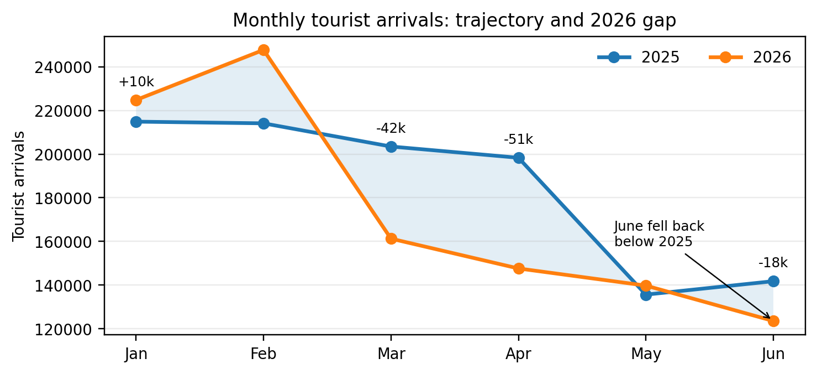
In June 2026, the Maldives received 123,552 tourists. That was 12.9 per cent lower than June 2025. For January to June, arrivals reached 1,044,667, compared with 1,108,130 in the same period of 2025, a decline of 5.7 per cent. These figures come from the June 2026 Monthly Toursim Review.

Those numbers matter. Still, they should not be read in isolation. June sits inside the Maldives low season, when monsoon effects, route patterns, school calendars, airfares, and booking behaviour interact. A weaker June is therefore not surprising by itself. The important point is whether June changes the expected shape of the year.
It does.
May had hinted that the March-April shock was easing. June suggests that recovery was not yet durable. The market remains active, the brand remains strong, and demand is still present. The task now is to turn that demand into confirmed bookings, longer stays, stronger occupancy, and better revenue capture.
This is where industry strategy becomes more important than destination promotion alone.
The mathematics of conversion
Tourism is often discussed as if arrivals are the main equation. They are not. Arrivals are only the first term.
A more useful way to think about the tourism economy is:
Tourism utilisation = (Arrivals × Average length of stay) ÷ Bed-night capacity
Or, more simply:
Occupancy depends on demand converted into bed nights, relative to the size of the bed base.
This small formula changes the conversation. It explains why a country can receive many tourists and still feel pressure in the accommodation sector. It explains why a longer average stay can cushion weaker arrivals. It also explains why capacity growth must be watched carefully. When bed-night capacity expands faster than arrivals multiplied by length of stay, occupancy weakens even if the destination still looks successful from the outside.
That is the real insight from June 2026.
The Maldives is not only trying to attract tourists. It is trying to keep the numerator growing faster than the denominator. In the formula, the numerator is value-producing demand: arrivals multiplied by stay length. The denominator is the system’s capacity to absorb that demand. When the denominator grows too quickly, the same number of visitors is spread more thinly across the industry.
This is not a reason for pessimism. It is a reason for precision.
The annual target remains alive
The Government’s 2026 target is 2.5 million tourist arrivals. After the first half of the year, the Maldives needs 1,455,333 additional arrivals between July and December. Across 184 days, that requires an average of about 7,909 arrivals per day.
June’s daily average was about 4,118.
This gap is large, yet the second half of the year is not shaped like June. The Maldives typically gains strength toward the final quarter. The question is whether July and August can limit the low-season drag sufficiently for the fourth quarter to do its work.
The target is therefore still mathematically possible. It is not comfortable. It requires sharper conversion, stronger air access coordination, and market-specific campaigns.
A broad campaign saying “visit Maldives” is no longer enough. The country needs route-linked demand activation. If seats are available from one market, campaigns should move there. If a market shows booking hesitation, the offer must address the reason: price, transfer complexity, safety perception, weather anxiety, family timing, or lack of package clarity.
A portfolio, not a single market
The June Review shows a mixed source-market picture. China and Russia are carrying much of the year’s momentum. China recorded 169,798 arrivals, or 16.2 per cent of the year-to-date total. Russia followed with 150,978 arrivals, or 14.4 per cent. The United Kingdom, Italy, Germany, India, France, the United States, Australia, and Switzerland complete the top ten.
This is not merely a ranking. It is a portfolio.
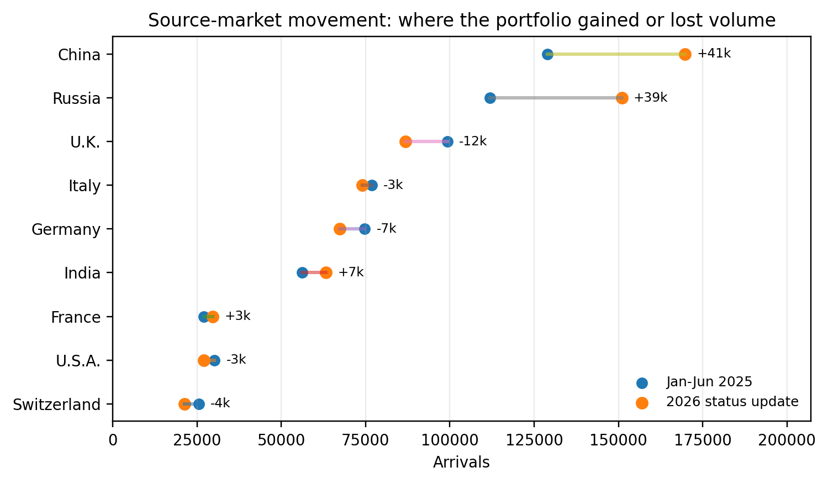
Each market behaves differently. China and Russia may provide scale. The United Kingdom and Switzerland are important for high-value resort demand. Italy has a distinctive seasonal and accommodation pattern. India offers proximity and potential for shorter booking windows. The Middle East can respond to luxury, family, wellness, and premium privacy products. Europe remains crucial for winter strength and repeat visitation.
The optimistic reading is that the Maldives is no longer dependent on one narrow source-market engine. The cautionary reading is that diversification requires management. A portfolio reduces some risks and creates others. It demands constant observation.
A good low-season strategy should therefore be segmented by market, route, product, and accommodation type. Resorts, guesthouses, safari vessels, and hotels should not all receive the same policy prescription. Their customers are not identical. Their conversion problems are not identical. Their value pathways are not identical.
The capacity pressure story
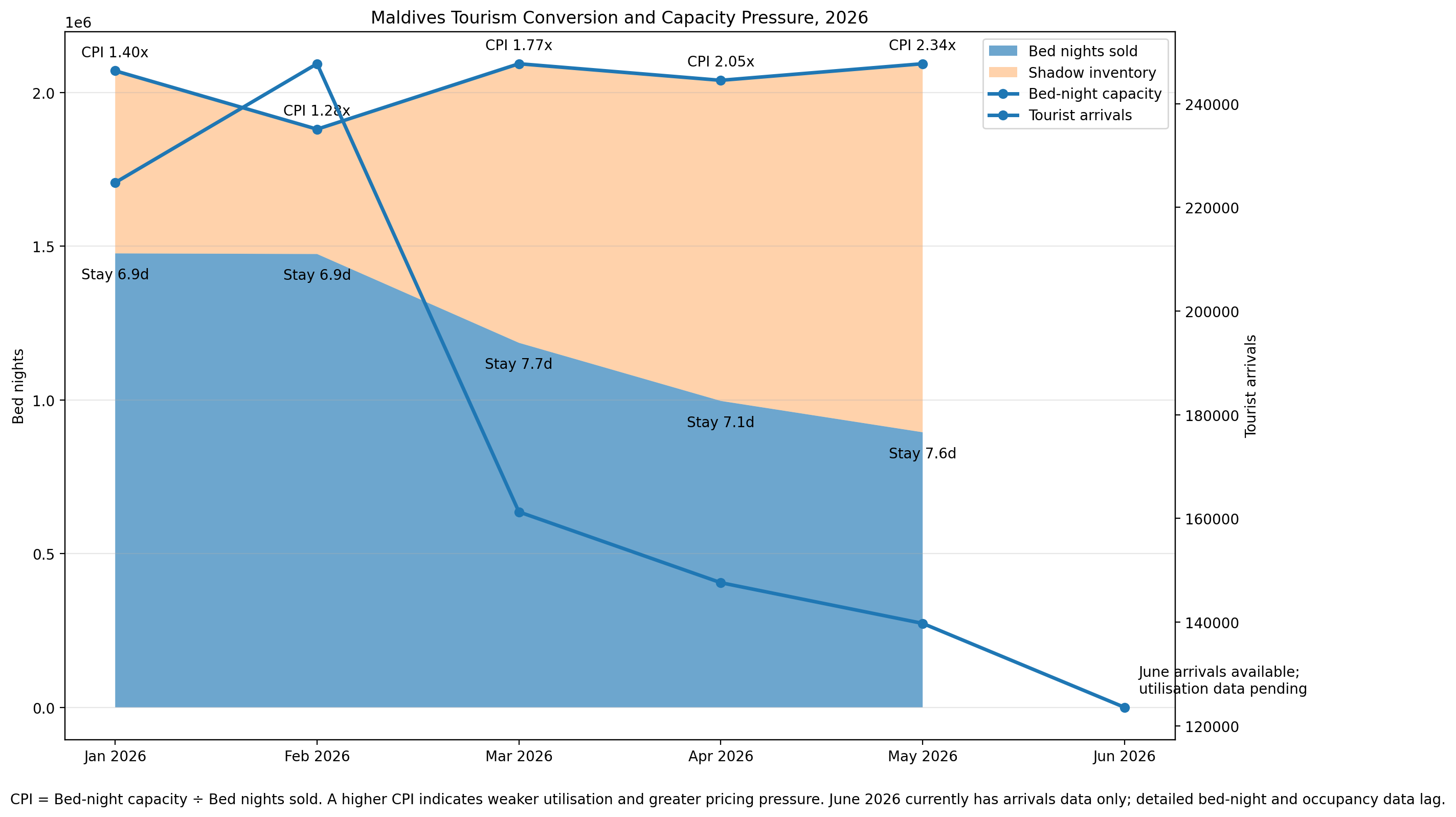
The most useful warning in the Review comes from utilisation data. Accommodation statistics lag behind arrivals, so the latest official bed-night and occupancy data used in the Brief run to May 2026. For May, total occupancy stood at 42.8 per cent, resort occupancy at 52.0 per cent, and bed nights sold at about 895,000. Bed-night capacity was about 2.094 million.
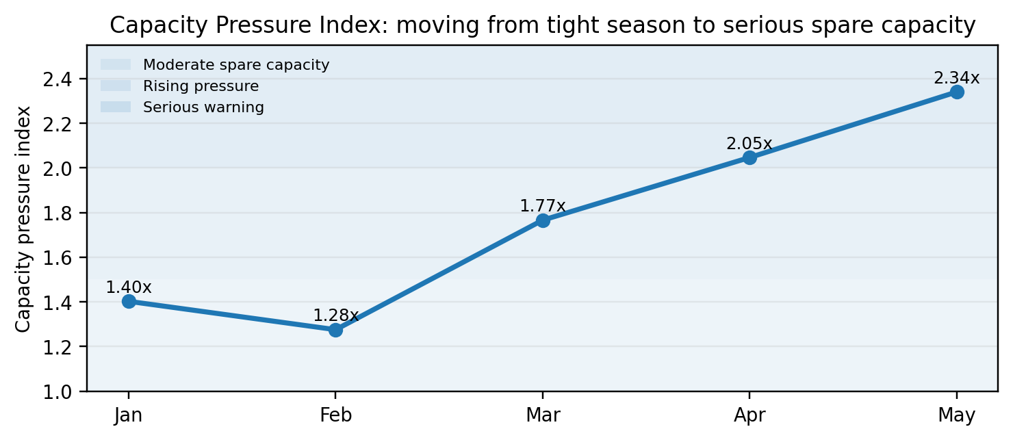
The Maldives Tourism Observatory calculates the Capacity Pressure Index as:
Capacity Pressure Index = Bed-night capacity ÷ Bed nights sold
For May 2026, this was:
2.094 million ÷ 895,000 = 2.34x
This means the system had more than twice the bed-night capacity that was actually sold. In practical terms, the Maldives carried about 1.199 million unsold bed nights in May. That sounds severe, and it deserves attention. Yet it also reveals where action can have the greatest effect. If arrivals recover, if average stay improves, if packages convert better, and if capacity is marketed more intelligently, occupancy can improve quickly. The system has room to absorb demand without immediately hitting physical limits.
That is the opportunity hidden inside spare capacity. The destination does not need to build its way out of this moment. It needs to convert better.
Shadow inventory is a management signal
The Review uses the term “shadow inventory” to describe unsold bed-night capacity. This is a powerful concept because it makes invisible pressure visible. Shadow inventory is not simply empty beds. It is potential revenue not captured. It is staff time not fully utilised. It is supplier demand delayed. It is tax revenue that may not materialise. It is marketing pressure transferred from the destination to individual operators.
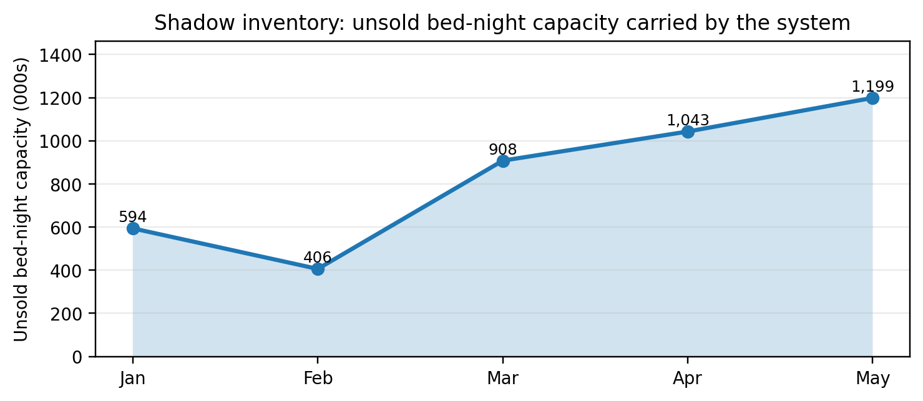
In January 2026, shadow inventory was about 594,000 bed nights. By May, it had risen to about 1.199 million. This does not mean the system is broken. It means the system is asking for better coordination.
A mature tourism economy should track shadow inventory with the same seriousness that it tracks arrivals. For policymakers, it signals whether capacity growth is aligned with demand. For investors, it reveals market pressure. For operators, it informs pricing discipline. For destination marketers, it shows where demand campaigns must focus.
What optimism should look like
Optimism in tourism should not mean ignoring difficult numbers. It should mean seeing the path of action more clearly.
The Maldives has several strengths in its favour. The brand remains globally recognised. The destination has diversified beyond a single market. China and Russia are performing strongly. India is positive. France is above its comparator. The fourth quarter remains a major recovery window. The accommodation base is large enough to absorb a strong rebound. The country has decades of experience adjusting to shocks.
The immediate task is to make the system more responsive.
Government and industry should coordinate around weekly air-access intelligence, forward bookings, cancellations, seat capacity, and market-specific demand signals. MMPRC campaigns should move from general visibility to conversion-focused precision. Resorts should protect yield with value-added offers rather than uncontrolled discounting. Guesthouses should improve response speed, photography, availability, review management, transfer clarity, and island-level experience packaging.
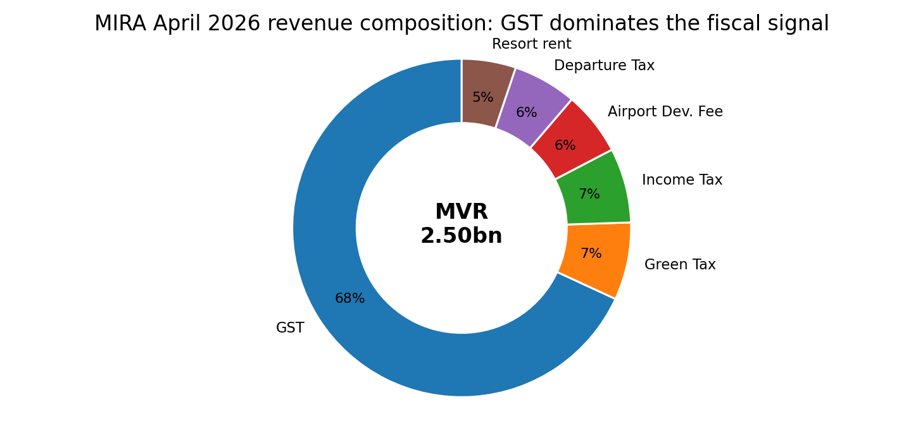
There is also a fiscal dimension. Tourism performance now gives an early signal about GST, Green Tax, airport fees, foreign exchange, and public revenue. This makes tourism monitoring a macroeconomic tool, not only an industry exercise.
The next question
July and August should be watched with curiosity rather than alarm. Are arrivals moving toward the catch-up path? Are visitors staying longer? Is occupancy improving faster in resorts or guesthouses? Is the Capacity Pressure Index easing? Are source markets broadening? Are booking windows stabilising? Are fiscal indicators following the demand signal?
These questions matter because the Maldives is not a static postcard. It is a living tourism economy. It learns, adapts, expands, and recalibrates. June 2026 should therefore be remembered not as a bad month, but as a useful measurement. It tells us that the country has moved into a phase where success depends less on headline arrivals alone and more on the science of conversion.
The formula is simple:
Value rises when arrivals become bed nights, bed nights become occupancy, occupancy becomes yield, and yield becomes resilience.
That is the next frontier for Maldives tourism.Not merely more visitors. More value from every visitor. Not only growth. Smarter conversion. And in that shift, there is reason to be optimistic.