Maldives Resort Series: The Restaurant Spillover
11 Sep 2026, 01:27 · by IzuCT · 4 min read · Tourism · EN
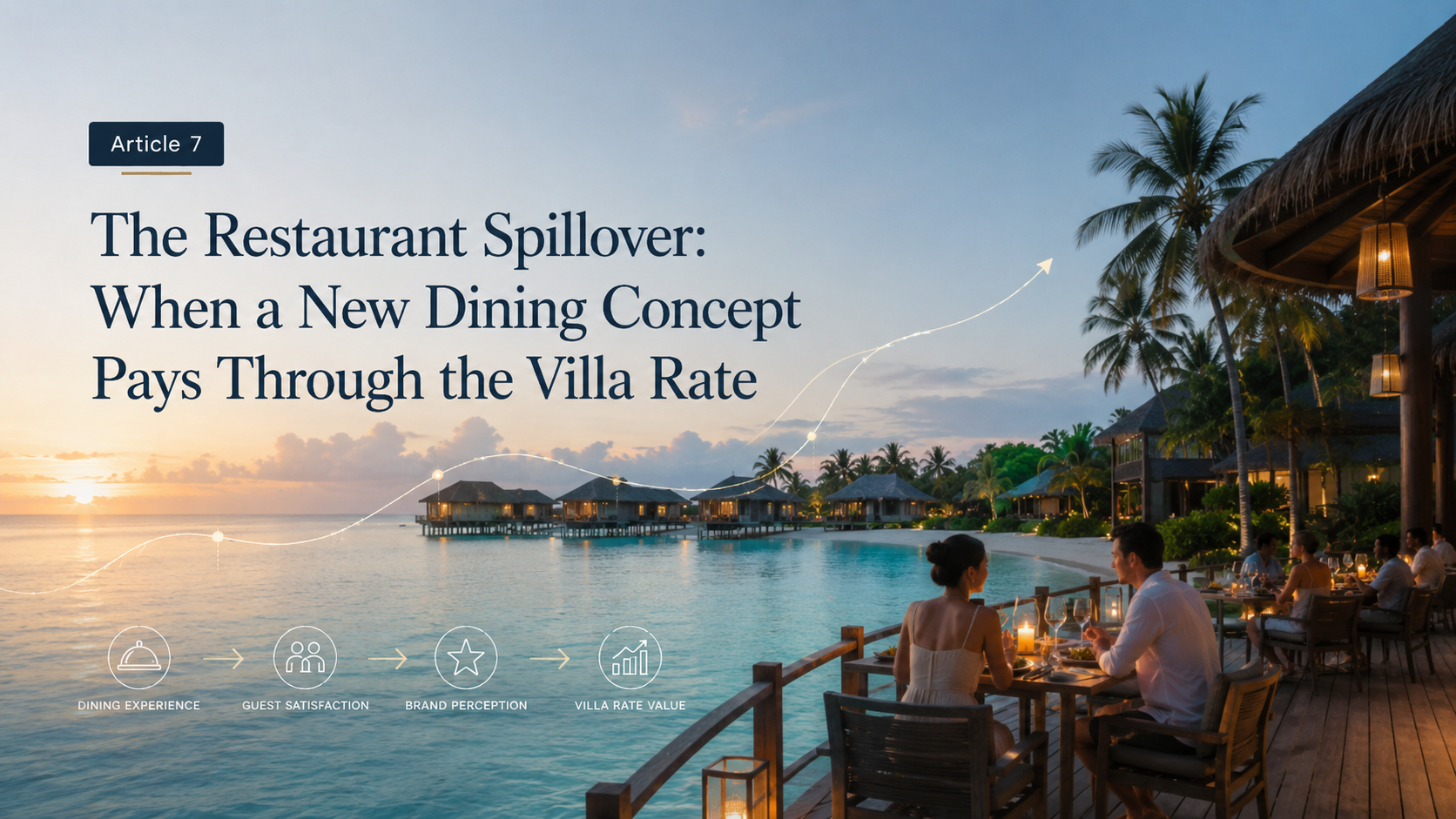
A new restaurant does not have to repay its investment entirely through dinner bills. On a captive resort island, modest effects on room willingness to pay can transform the economics of an otherwise marginal F&B project.
Free tourism insights
Get Free Tourism Insights
Receive selected MTO insights, tourism data alerts, and new resource updates by email.
Get Free Tourism InsightsCentral Question:
When can a resort restaurant be economically justified even when its direct F&B profit does not cover its full cost?
Hypothesis:
On a captive resort island, a distinctive restaurant can be economically worthwhile when its direct F&B contribution plus the accommodation value it supports exceeds its annualized capital and complexity cost.
Article
The Restaurant That Looks Unprofitable
A resort is considering a new specialty restaurant.
The design is beautiful. The location is compelling. But finance calculates the capital cost, additional chefs, imported inventory, refrigeration, staff accommodation, energy and maintenance.
The restaurant's direct cash flow looks weak.
So should it be rejected?
Perhaps.
But that calculation assumes the restaurant sells only food.
On a Maldives resort island, dining is part of the accommodation product because the guest cannot simply walk into a neighbourhood and choose twenty unrelated restaurants. Breakfast, lunch, dinner, bars and special experiences exist inside one bounded destination.
The restaurant may therefore affect the willingness to pay for the villa itself.
That is the hidden spillover.
A Resort Sells a System
This is one reason the one-island resort is better understood as a small island economy than as a collection of hotel departments.
Rooms generate diners.
Restaurants influence the perceived richness of a seven-night stay.
The quality and diversity of dining can affect reviews, package choice and the difference between “beautiful resort” and “there was enough to do for a week.”
Hospitality research supports the broader mechanism: food quality, service quality, menu variety and price perceptions contribute to resort restaurant satisfaction.
The challenge is not establishing that food matters.
It is deciding when it matters enough to support the investment.
The Fourth-Restaurant Test
Consider an illustrative 120-villa upper-upscale resort.
Assume:
occupancy: 70%;
occupied villa nights: 30,660;
1.9 guests per occupied villa;
approximately 58,254 guest-nights annually.
A proposed specialty restaurant requires:
capital investment: $2.4 million;
eight-year evaluation horizon;
10% hurdle rate;
annualized capital requirement: about $450,000;
additional fixed staffing, utilities, maintenance and complexity: $550,000 annually.
Total annual economic burden is therefore approximately $1 million.
After accounting for cannibalization from existing outlets, suppose the restaurant produces $12 of incremental F&B contribution per guest-night.
That creates approximately:
58,254 × $12 = $699,048
of annual direct contribution.
The restaurant is still about $301,000 short.
A departmental P&L says no.
What If It Also Supports the Room Price?
Now suppose the broader dining proposition allows the resort to support a modest accommodation premium.
If 90% of that incremental room price flows into contribution, the required premium is:
($999,866 − $699,048) / (30,660 × 90%) ≈ $10.90 per villa night.
That changes the decision.
Room-value spillover | F&B contribution | Room contribution | Net annual value after restaurant burden |
|---|---|---|---|
$0/night | $699,048 | $0 | –$300,818 |
$12/night | $699,048 | $331,128 | +$30,310 |
$15/night | $699,048 | $413,910 | +$113,092 |
$20/night | $699,048 | $551,880 | +$251,062 |
Evidence classification: Illustrative Analytical Model.
The restaurant does not need to generate another million dollars at the table.
It needs enough combined value across the island.
The Counterfactual Still Matters
The alternative is not necessarily “build” versus “do nothing.”
Suppose upgrading existing restaurants costs only $350,000 annually and produces $250,000 of incremental F&B contribution plus an estimated $5 nightly room-value improvement.
Under the same assumptions, that strategy creates roughly $38,000 of net annual value.
The new restaurant at a $15 spillover produces about $113,000.
The decision now depends on whether management believes the additional concept can genuinely support at least roughly $11 of accommodation value—or whether the lower-risk refurbishment captures most of the same benefit.
That is a more useful capital-allocation debate.
The Imported Complexity Behind the Plate
The Maldives also makes restaurant expansion more expensive than it first appears.
A new cuisine may require:
imported specialist ingredients;
additional cold storage;
more kitchen equipment;
another chef team;
employee rooms;
more energy and desalinated water;
additional waste management;
more marine logistics.
These costs are rarely visible to the guest, but they belong in the restaurant's shadow P&L.
This connects with the logic behind building profitable resort and accommodation packages: components must be evaluated by their incremental contribution and system effects, not their retail value.
Measuring the Spillover Instead of Assuming It
The dangerous version of this argument is:
“Our restaurant improves the brand, therefore any investment is justified.”
That is not analysis.
A resort can test the spillover.
Compare booking conversion before and after launch. Measure review text. Survey willingness to pay. Observe package mix. Compare ADR gaps against a suitable competitive set. Track length of stay and dining satisfaction.
The hypothesis is allowed to fail. A spectacular restaurant that merely moves existing diners from Outlet A to Outlet B may destroy value. But if it makes the whole island more desirable, its true product is larger than dinner.
The restaurant may be serving the villa before the guest has even booked it.