Maldives Resort Series: The Distance Premium
06 Sep 2026, 05:42 · by IzuCT · 4 min read · Tourism · EN
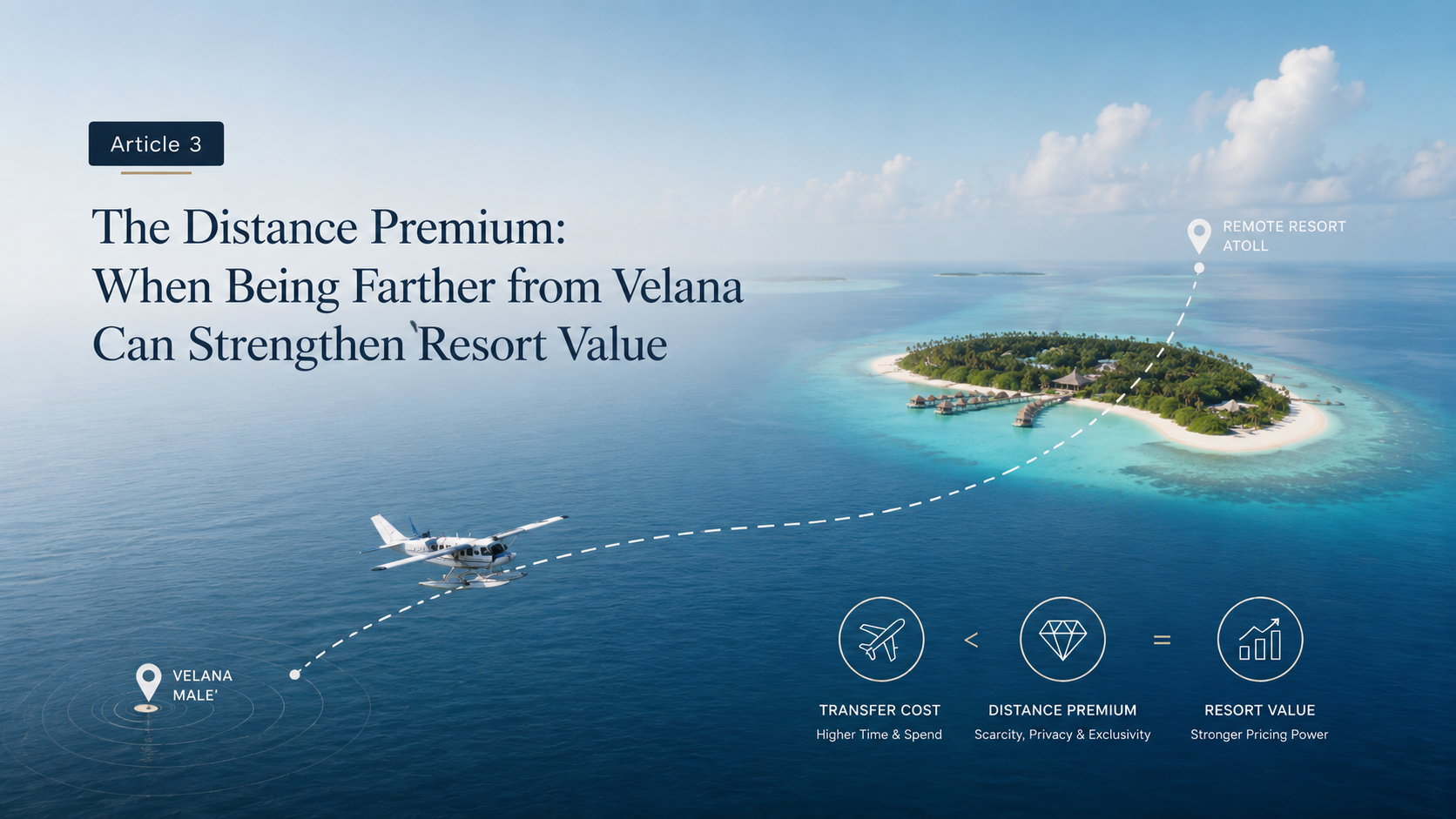
Distance from Velana creates cost, but it can also create scarcity. If privacy, geography and experience support enough rate premium, the same kilometres that complicate transfers can become a source of resort pricing power.
Free tourism insights
Get Free Tourism Insights
Receive selected MTO insights, tourism data alerts, and new resource updates by email.
Get Free Tourism InsightsCentral Question:
How large must the premium for remoteness be before distance becomes an economic asset rather than merely a transport cost?
Hypothesis:
Distance can create positive resort value when the willingness to pay for privacy, isolation and distinctive geography exceeds the additional guest-transfer and island-logistics burden.
The Island That Costs More to Reach
A resort 25 minutes from Velana International Airport has an obvious advantage.
A resort requiring a domestic flight and speedboat—or a long seaplane journey—appears to have the opposite.
Supplies cost more to move. Staff rotations become harder. Weather introduces greater transport uncertainty. Guests face another price and another stage in an already long journey.
The conventional conclusion is straightforward: distance is a cost.
And it is.
But distance can simultaneously produce something the resort industry spends heavily to manufacture: scarcity.
The farther island may have fewer visible neighbours, less marine traffic, darker night skies, a larger sense of escape and a stronger psychological break from ordinary life.
So the interesting question is not whether remoteness costs money.
It is whether the resort can monetize enough remoteness to pay for it.
What Earlier Evidence Tells Us
Historical Maldives evidence provides an important warning. My guesthouse hedonic analysis found that greater distance from the international airport tended to reduce room prices after other characteristics were considered. The national tourism-demand analysis similarly found travel cost to be significant.
That is exactly what standard economics predicts.
But guesthouses and private resort islands are structurally different products.
The one-island model described in the centre-of-gravity role of the Maldives resort system converts separation into part of the product: one island, one controlled environment, one beach system and a degree of spatial exclusivity that an inhabited island cannot reproduce in the same way.
Distance therefore creates two opposing forces:
access friction and scarcity value.
Putting a Price on Remoteness
Consider an illustrative 60-villa boutique resort located substantially farther from Velana than a comparable property.
Assume the remote location adds $600 per completed stay in economic burden relative to the closer alternative:
$400 of transfer support or equivalent guest-acquisition burden;
$140 of allocated incremental marine/air logistics;
$60 of additional arrival and coordination cost.
Now suppose remoteness also generates $120 of additional ancillary contribution per stay through distinctive excursions, private marine experiences or other location-specific products.
For a seven-night stay, how much additional ADR must isolation support?
If 90% of the additional room-price premium flows into contribution, the equation is:
7 × ADR premium × 90% + $120 ≥ $600.
The break-even premium is approximately:
$76 per villa per night.
Above that level, remoteness is no longer merely being compensated. It is contributing additional value.
A Small Change in Price Changes the Story
Remote-location ADR premium | Incremental value from room premium + ancillary contribution | Additional remote cost | Net contribution per stay |
|---|---|---|---|
$50/night | $435 | $600 | –$165 |
$100/night | $750 | $600 | +$150 |
$150/night | $1,065 | $600 | +$465 |
Evidence classification: Illustrative Analytical Model.
This is a useful example of a threshold rather than a universal truth.
A remote property charging $50 more may simply be recovering part of its disadvantage.
At $150 more—with demand willing to pay it—the same geographical constraint becomes an economic moat.
Geography Is Not Distance Alone
This is where simple atoll comparisons can mislead.
As explored in the hidden geography of Maldives tourism, tourism capacity and value are distributed unevenly across the archipelago. Two resorts equally distant from Velana may not have equal scarcity.
One could sit beside a growing tourism cluster with heavy boat traffic. Another could face an uninterrupted horizon.
One may have exceptional diving or manta access. Another may simply be inconvenient.
Distance is therefore not the amenity.
What distance protects or reveals is the amenity.
Testing the Counterfactual
Imagine the same investment opportunity in a closer atoll.
The closer resort saves $600 per stay but faces greater visual competition and more substitutes. If that means it must charge $100 less per night, the seven-night revenue difference is already $700 before ancillary effects.
The farther resort can win.
But if guests are unwilling to pay even $50 more for its location, proximity wins decisively.
This suggests that feasibility studies should not ask only for transfer time and construction logistics. They should attempt to estimate a remoteness premium through comparable rates, guest reviews, direct choice research and willingness-to-pay testing.
The price should then be compared with the full shadow cost of distance.
The Management Opportunity
Remote resorts have traditionally treated transport as something that must be explained after the room is sold.
A stronger strategy is to treat remoteness as an attribute that must be designed, communicated and monetized.
The arrival experience matters. So does privacy, reef access, marine traffic, views, noise, astronomy, excursion exclusivity and the emotional narrative of “leaving everything behind.”
The lesson also connects back to why the seat before the villa matters: a remote resort creates value only when the journey and the destination are managed as one product.
Distance does not automatically create pricing power.
But the Maldives is one of the rare tourism systems where inconvenience and exclusivity can be generated by exactly the same kilometres.