Maldives Resort Series: The Beach Capital Test
10 Sep 2026, 17:16 · by IzuCT · 4 min read · Tourism · EN
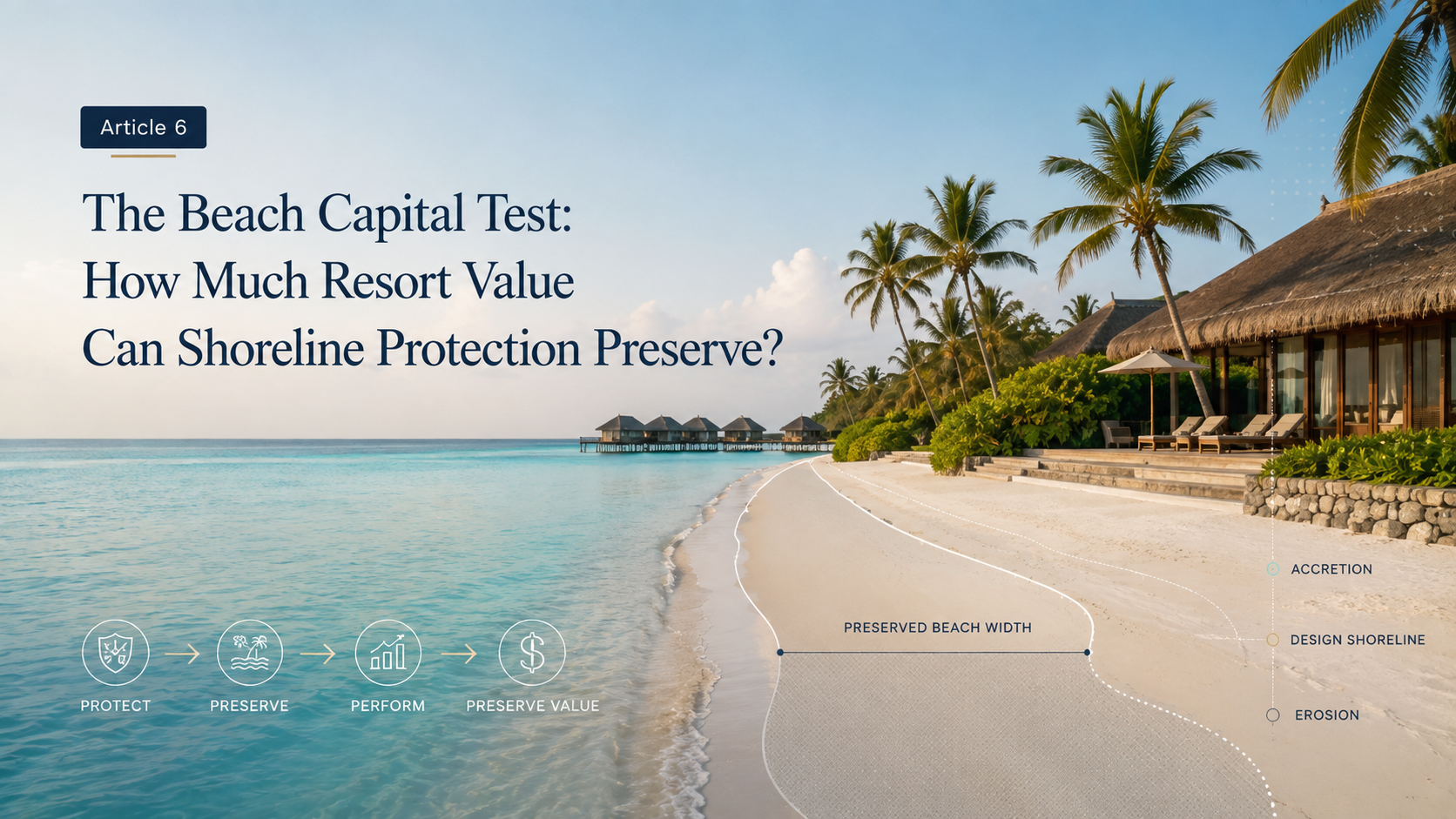
Beach protection may need to preserve far less room-rate value than expected to pay for itself. For an illustrative Maldives resort, preventing about 2.8% of beach-villa ADR erosion covers a $250,000 programme.
Free tourism insights
Get Free Tourism Insights
Receive selected MTO insights, tourism data alerts, and new resource updates by email.
Get Free Tourism InsightsCentral Question:
How much room-rate value must beach management preserve before proactive shoreline investment becomes economically attractive?
Hypothesis:
Because beachfront attributes carry measurable pricing value, preventing even a small deterioration in that value can justify substantial annual beach-management expenditure.
Article
The Beach Is Already in the Room Rate
A beach villa is built on land.
But part of what the guest buys is outside the villa.
The few metres between the terrace and the water may influence the photograph, the booking decision, the morning routine and ultimately the price the resort can command.
My historical Maldives hedonic analysis found that accommodation located directly in front of the beach carried an estimated price premium of approximately 21%, holding measured characteristics constant.
International evidence points in the same direction. Research on coastal hotels in Spain estimated beachfront premiums around 13–17%, while later spatial analysis in Thailand found substantial beachfront rate premiums, although effects varied by location and shoreline conditions.
These results do not tell us what a metre of Maldivian beach is worth today.
They tell us something more fundamental:
the market already capitalizes beach access into accommodation value.
From Maintenance Cost to Avoided Revenue Loss
This suggests a different way to evaluate shoreline management.
A resort may see nourishment, monitoring, vegetation management or other adaptation as an annual environmental cost.
Finance can instead ask:
How much pricing power must this expenditure prevent us from losing?
That is an avoided-loss calculation.
It connects naturally to the earlier discussion of how environmental quality becomes embedded in room value and to the broader question of tourism's relationship with usable beach space.
A 40-Villa Beachfront Portfolio
Consider an illustrative 100-villa resort, of which 40 are beach villas.
Assume:
beach-villa occupancy: 75%;
occupied beach-villa nights: 10,950 annually;
ADR: $900;
incremental price contribution retained: 90%;
annual proactive beach-management programme: $250,000.
Suppose deteriorating beach conditions would otherwise force the property to discount these villas to maintain demand.
How much rate erosion must the programme prevent to pay for itself?
Annual beach-villa room revenue is:
10,950 × $900 = $9.855 million.
Using a 90% incremental contribution factor, the protection programme breaks even when it prevents approximately:
$250,000 / ($9.855m × 90%) = 2.82%
of ADR erosion.
The threshold is unexpectedly small.
Three Possible Futures
Rate erosion prevented | Economic value preserved | Programme cost | Net annual value |
|---|---|---|---|
2% | $177,390 | $250,000 | –$72,610 |
5% | $443,475 | $250,000 | +$193,475 |
10% | $886,950 | $250,000 | +$636,950 |
Evidence classification: Illustrative Analytical Model.
A resort need not prove that its beach creates the entire historic beachfront premium.
It needs to determine whether deteriorating conditions would erase more than roughly 2.8% of the rate value of this particular villa portfolio.
Why Protection Method Matters
There is an important complication.
“Protect the beach” is not a single intervention.
Hard structures can protect particular assets while altering sediment flows, visual quality or neighbouring shoreline conditions. The Thailand hotel study, for example, found that some hard coastal-protection structures were associated with modest reductions in hotel rates even while beachfront location itself commanded a strong premium.
The financial analysis therefore cannot stop at “erosion prevented.”
It must ask what the intervention does to the guest-facing quality of the coast.
A wall that stabilizes land but weakens the beach experience may preserve one asset while damaging another.
The Maldives Multiplies the Stakes
The issue is unusually acute on a resort island.
The shoreline is finite. There is no adjacent municipal beach to substitute into the product. Villas, restaurants, service roads, utility plants and staff facilities share a constrained physical platform.
Climate risk increases the importance of this calculation. World Bank analysis identifies coral reefs and natural coastal systems as important protective assets for the Maldives and highlights increasing exposure to sea-level rise, flooding and climate damage.
The economic value of shoreline management can therefore include:
preserved room pricing power;
avoided villa closures;
avoided infrastructure damage;
preserved guest experience;
reduced future emergency expenditure.
Those components should be modelled separately to avoid double counting.
A Beach-Adjusted RevPAR
One useful management innovation would be to treat environmental condition as a leading commercial indicator.
Instead of tracking only ADR, occupancy and RevPAR, the resort could monitor:
usable beach width;
erosion/accretion by zone;
guest mentions of beach condition;
days of beach-villa impairment;
shoreline-management spending;
beach-villa ADR premium over non-beach categories.
Over time, the property could estimate its own beach-value function.
That would turn shoreline management from a reactive engineering conversation into an asset-management system.
What the Numbers Change
A $250,000 annual beach programme sounds large when viewed as a maintenance expense.
Against nearly $10 million of annual beach-villa room revenue, it looks different.
The question becomes whether the programme can protect less than three cents of value in every dollar of beach-villa rate.
In a destination whose rooms are partly priced on sand, that is the kind of threshold worth knowing before the next shoreline disappears.