Maldives Resort Series: Reef as Productive Capital
11 Sep 2026, 01:25 · by IzuCT · 4 min read · Tourism · EN
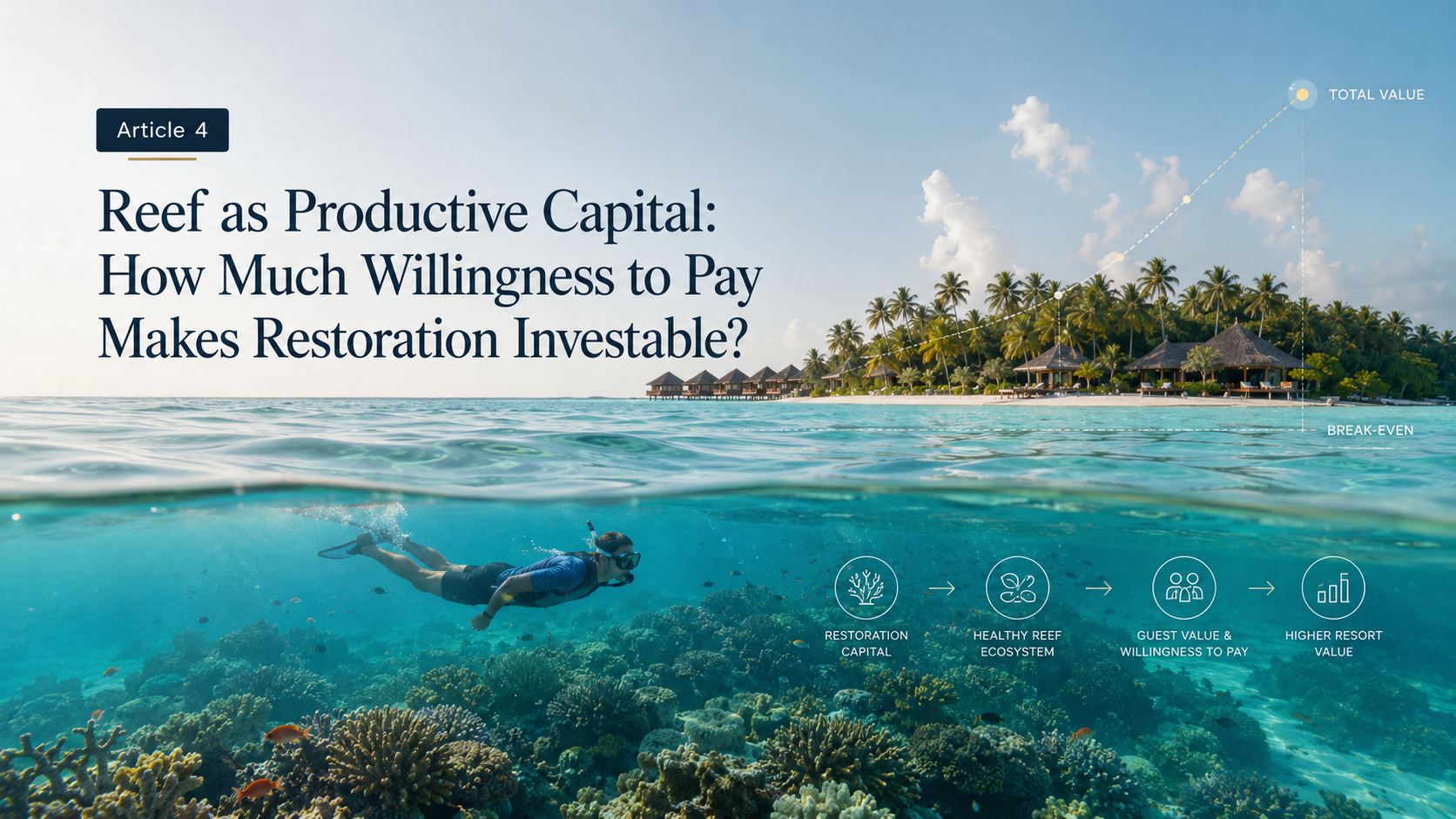
A half-million-dollar reef project can look enormous until its cost is spread across thousands of occupied villa nights. In an illustrative resort, roughly $11 of additional nightly value could make restoration economically investable.
Free tourism insights
Get Free Tourism Insights
Receive selected MTO insights, tourism data alerts, and new resource updates by email.
Get Free Tourism InsightsCentral Question:
How much additional guest value must reef restoration create before it can be treated as a resort investment rather than only an environmental expense?
Hypothesis:
For reef-dependent Maldives resorts, even a relatively small sustained premium in guest willingness to pay can justify substantial conservation expenditure because the environmental asset supports thousands of occupied villa nights.
Article
The Asset Outside the Balance Sheet
A resort general manager can open a balance sheet and find villas, boats, kitchens, generators and perhaps a spa.
The house reef is harder to locate.
Yet guests snorkel over it. Divers pay to visit it. Marketing photographs it. Reviews describe it. Fish abundance, coral structure and water clarity shape the experience long before anyone orders dessert.
Economically, the reef behaves like productive capital.
The World Bank has repeatedly emphasized that coral reefs and marine ecosystems underpin Maldives tourism, fisheries and coastal protection. Reef systems also contribute to beach formation and help buffer islands and infrastructure from waves.
The puzzle is therefore not whether reefs have value.
It is how a resort can determine whether a specific restoration investment creates enough capturable tourism value to pay for itself.
We Already Know Tourists Value the Environment
Historical Maldives research gives us useful clues.
My hedonic work found that cleaner beach conditions were associated with higher accommodation prices and that suppliers appeared able to capture part of environmental improvements through prices. That relationship is discussed further in the analysis of when better environmental quality becomes expected.
Separate Maldivian marine-valuation research estimated willingness to pay for reef conservation. A study of Dhigali Haa found a mean one-off conservation willingness to pay of roughly $35 per visitor, while later Maldives work estimated that a visitor levy around $41 could potentially finance significantly greater marine protection. These are historical studies, not current resort-pricing estimates, but they demonstrate that reef conservation can possess monetary value to visitors.
The next question is whether that value can support an actual resort investment.
Testing a Restoration Project
Consider an illustrative 100-villa luxury resort.
Assume:
occupancy: 70%;
annual occupied villa nights: 25,550;
reef-restoration investment: $500,000;
project evaluation horizon: 5 years;
hurdle rate: 10%;
annual monitoring, maintenance and marine-biologist cost: $120,000.
Annualizing the initial capital investment over five years at 10% gives approximately $131,900 per year.
Total annual economic requirement becomes approximately:
$251,900.
Now ask a different question:
How much nightly willingness to pay must improved reef quality support?
If 90% of an incremental room-price premium flows to contribution:
$251,900 / (25,550 × 90%) ≈ $10.95 per occupied villa night.
That is the hidden equation.
The $500,000 project does not require a $500 improvement in room rates.
Under these assumptions, it requires a sustainable price-equivalent benefit of roughly $11 per occupied villa night.
Sensitivity Changes the Investment Story
Capturable reef-related value | Annual incremental room contribution | Annual project requirement | Net annual value |
|---|---|---|---|
$5/villa-night | $114,975 | $251,899 | –$136,924 |
$12/villa-night | $275,940 | $251,899 | +$24,041 |
$20/villa-night | $459,900 | $251,899 | +$208,001 |
Evidence classification: Illustrative Analytical Model.
Published reef-restoration costs vary enormously depending on method, location, monitoring and scale; a recent Maldives-focused review reports a very wide range. That uncertainty is exactly why restoration should be evaluated through scenarios rather than one generic “cost per hectare.”
Value Does Not Have to Arrive Through ADR
The $11 threshold should not be interpreted literally as “raise room rates by $11 and the reef pays.”
Restoration could create value through several channels:
greater willingness to pay;
higher direct-booking conversion;
better reviews;
more diving and guided-snorkelling revenue;
stronger repeat intention;
differentiation from substitute resorts;
reduced erosion or wave exposure in some settings;
reduced future rehabilitation cost.
The economic mistake would be to count all of these simultaneously without evidence.
The better approach is to calculate each channel separately and avoid double counting.
The One-Island Advantage
The one-island, one-resort structure has an unusual property-rights advantage.
A resort that improves its immediate reef environment can capture a meaningful share of the tourism benefit through its own rooms, diving centre, excursions and brand.
That does not eliminate ecological spillovers—the reef remains connected to a larger marine system—but it can reduce the classic free-rider problem.
In economic terms, the resort has more incentive to invest because the environmental asset and the commercial beneficiary occupy largely the same spatial system.
From CSR to Capital Allocation
This changes the boardroom discussion.
Instead of:
“How much should we donate to reef restoration?”
the question becomes: “What improvement in guest value, ecosystem resilience or future avoided loss would make this project meet our investment hurdle?”
That framing does not diminish conservation.
It makes conservation compete on the same analytical ground as a restaurant renovation, villa refurbishment or new boat.
A healthy reef may be ecologically irreplaceable.
The more surprising insight is that it may also be financially investable at a much smaller per-night value threshold than managers imagine.