Maldives Resort Series: Can a resort run out of space before it runs out of demand?
07 Sep 2026, 07:16 · by IzuCT · 6 min read · Tourism · EN
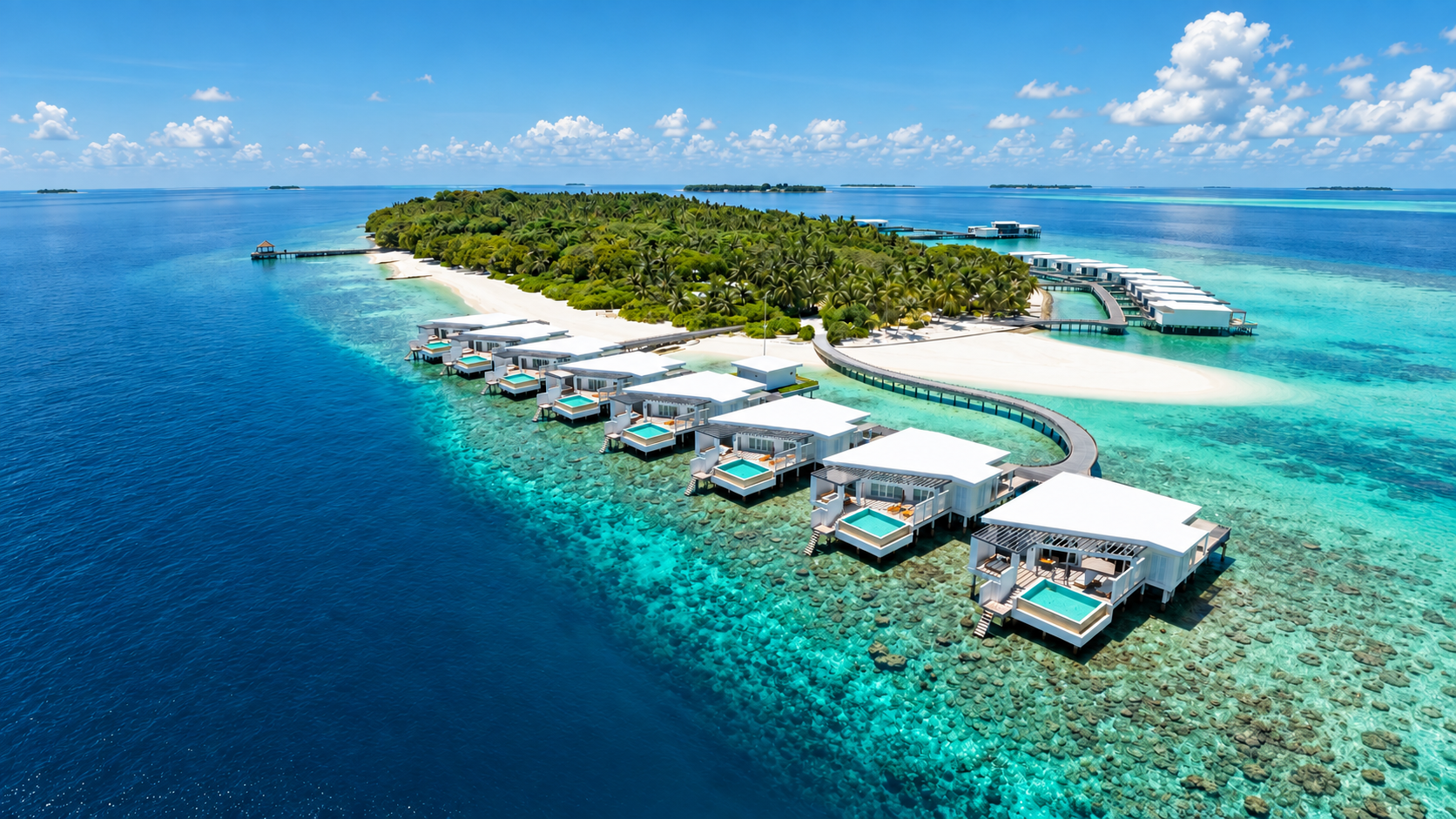
Adding villas looks like straightforward growth. But on a Maldives resort, each new key can weaken the scarcity supporting existing ones. An illustrative model shows why just 3.4% ADR dilution can erase expansion value.
Free tourism insights
Get Free Tourism Insights
Receive selected MTO insights, tourism data alerts, and new resource updates by email.
Get Free Tourism InsightsA Maldives resort can run out of island before it runs out of demand. That sounds like a planning problem, but it is really a pricing problem.
Imagine a successful 100-villa resort. Occupancy is healthy, rates are strong, and management discovers that another ten villas can physically fit. The architects can design them. The utilities team can supply them. The market may even absorb them.
The obvious conclusion seems simple: more villas should mean more revenue and more profit. But on a one-island, one-resort property, an additional villa does something unusual. It does not merely add another unit of inventory. It can change the value of every villa already on the island.
That is where the economics becomes interesting.
The Island Is Part of What the Guest Buys
A hotel room in a city is largely sold as a room within a destination. A Maldives resort sells something broader.
The villa matters, but so do the empty beach beside it, the uninterrupted lagoon, the vegetation between neighbouring rooms, the absence of crowds, the quiet at breakfast and the feeling that much of the island somehow belongs to the guest.
Economically, some of that emptiness has value.
Our earlier research on Maldives accommodation found that environmental and location characteristics were reflected in prices. Beachfront properties commanded premiums, while indicators associated with crowding showed negative relationships with prices. The analysis concerned mainly guesthouses rather than luxury resorts, so it should not be treated as direct evidence of resort-density effects. But it points towards an important idea: space itself can become part of the tourism product.
Economists might describe part of this as a scarcity rent. The resort earns value precisely because something is limited: beach frontage, privacy, lagoon space and the number of people sharing the island.
The Hidden Cost of Adding Capacity
Suppose a resort adds ten villas. The conventional feasibility model measures the revenue of those ten villas against their construction and operating costs. But another term belongs in the equation:
the effect of the additional density on the existing 100 villas.
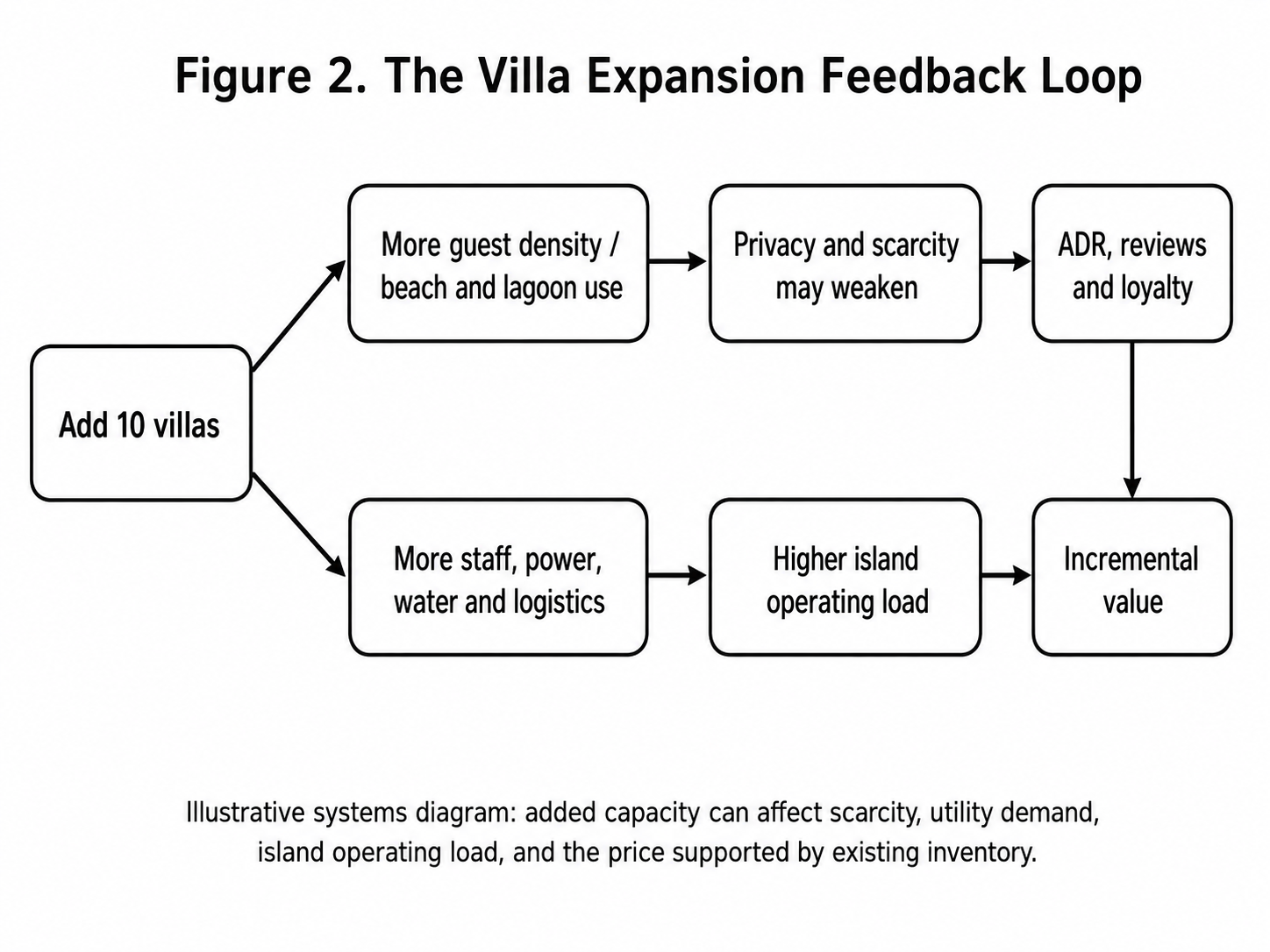
More guests may mean more activity around the beach and lagoon. More villas require additional staff, power generation, desalinated water, wastewater treatment, housekeeping capacity, food inventory and transport movements.
More importantly, the island may feel slightly less scarce.
If that weakens willingness to pay across the whole property, the financial consequence does not fall only on the new villas. It affects every room being sold.
A 100-to-110 Villa Experiment
Consider an illustrative 100-villa luxury resort operating at:
ADR: USD 900
Occupancy: 72%
Room contribution margin: 65%
Management proposes ten additional villas costing USD 800,000 each.
Assume the investment requires a 10% annual return and creates another USD 160,000 per year in staffing, maintenance, utilities and island operations.
How Sensitive Is the Threshold?
Illustrative assumption | Favourable | Base | Adverse |
|---|---|---|---|
Existing villas | 100 | 100 | 100 |
Villas added | 10 | 10 | 10 |
ADR | $950 | $900 | $850 |
Occupancy | 75% | 72% | 68% |
Room contribution margin | 67% | 65% | 62% |
Capex per new villa | $600,000 | $800,000 | $1,000,000 |
Required annual return on capital | 8% | 10% | 12% |
Additional fixed island cost | $120,000 | $160,000 | $200,000 |
Maximum tolerable ADR dilution | ≈6.0% | ≈3.4% | 0%* |
*In the adverse scenario, incremental villa contribution does not cover the assumed capital-return requirement and additional fixed operating cost even before any portfolio-wide ADR reduction.
Under these assumptions, the ten additional villas produce approximately USD 1.54 million in annual room contribution.
The annual required return on the USD 8 million investment is USD 800,000. Add USD 160,000 of incremental operating cost, and the project initially appears to create roughly:
USD 577,000 of additional annual value.
So far, building looks attractive.
Now change just one assumption.
Suppose the additional density causes the resort's achievable ADR to fall slightly across all 110 villas.
The 3.4% Problem
After expansion, the enlarged room portfolio generates approximately USD 16.9 million in annual room contribution before the incremental capital and fixed-cost commitments.
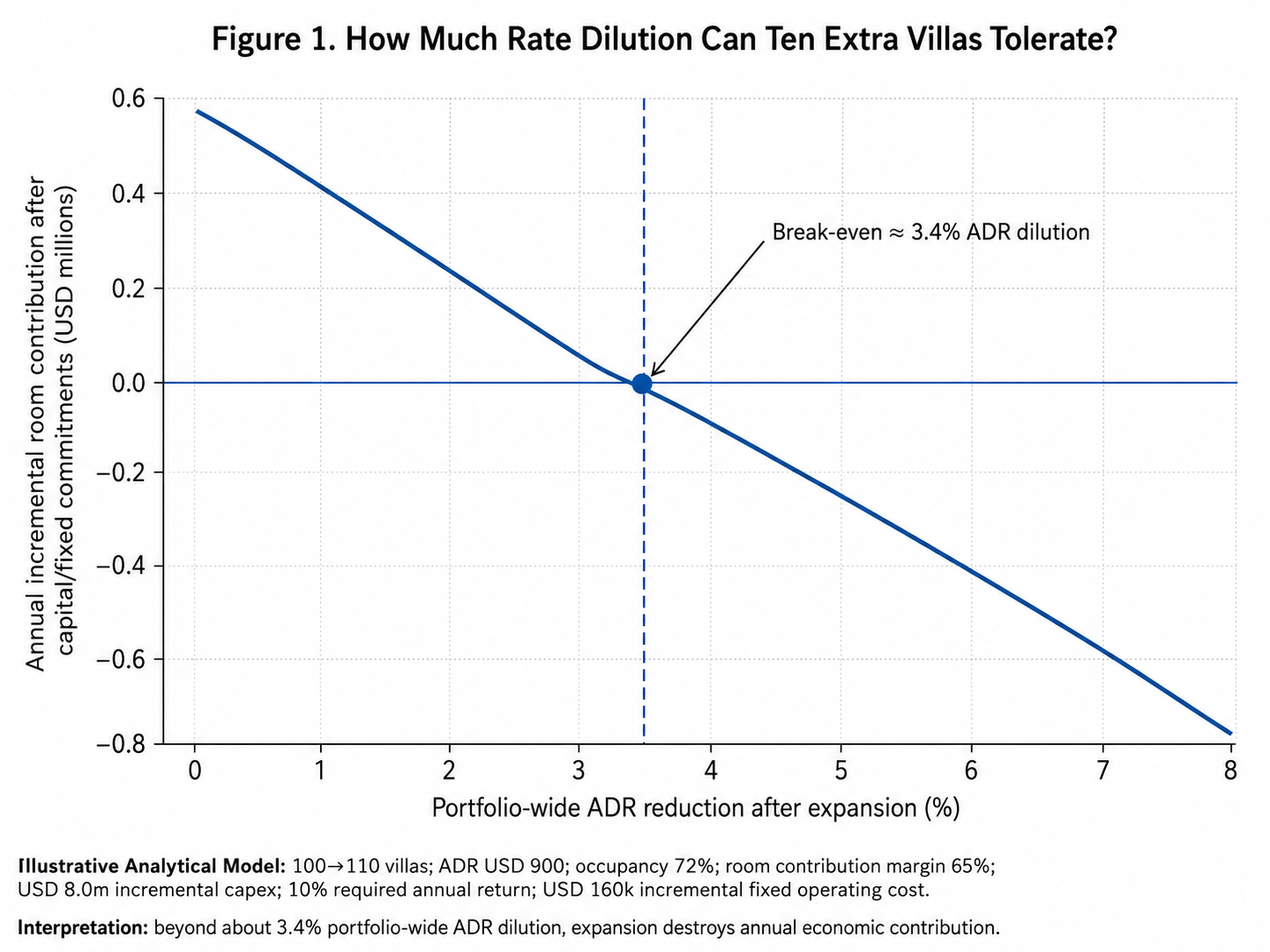
A 1% portfolio-wide decline in ADR therefore removes roughly USD 169,000 of contribution. At 2%, the loss is approximately USD 338,000. At 3%, most of the apparent economic benefit of expansion has disappeared. At approximately 3.4% ADR dilution, the project reaches break-even.
Beyond that point, the resort sells more villas but creates less economic value.
This is the hidden equation:
Value from additional villas
− capital requirement
− additional island operating cost
− value lost across existing inventory
Traditional feasibility analysis concentrates heavily on the first three terms.
The fourth may be the most dangerous.
Why Maldives Changes the Calculation
This mechanism matters especially in the Maldives because the hotel occupies the entire tourism environment. A new room in an urban hotel does not materially change the density of the city surrounding it. A new villa on a small coral island can.
It consumes finite shoreline or lagoon space. It introduces more guests into restaurants and public areas. It requires more employees and infrastructure. And because privacy and low density can themselves support premium positioning, expansion may gradually consume the scarcity that helped produce the original room rate.
The Maldives resort therefore contains a peculiar economic contradiction:
unused space can be productive.
It does not appear as revenue on a departmental profit-and-loss statement, but it may help every villa command a higher price.
The Decision Is Not “Can We Fit Ten More?”
The more useful management question is: How much portfolio-wide value can the new inventory destroy before the expansion stops making economic sense?
In the illustrative base case, the answer is approximately 3.4% of ADR.
The exact number will differ enormously between properties. Construction costs, brand strength, villa type, island size, beach length, staff ratios, utility efficiency and guest segment all matter.
But the decision rule remains useful: If the expected dilution of rate, demand or equivalent guest value across the enlarged resort exceeds the contribution created by the additional inventory, expansion destroys value.
That principle should influence investment committees long before concrete is poured.
Empty Space May Be an Asset
There is no evidence that adding ten villas to a particular Maldives resort will automatically reduce ADR by 3.4%. Good design, additional facilities, stronger landscaping or careful positioning may allow capacity to increase without noticeably weakening the experience.
The scenario is therefore an Illustrative Analytical Model, not observed resort accounting data.
Its purpose is to expose a relationship that is easy to miss. A villa earns revenue because somebody occupies it. But the empty beach beside that villa may help determine how much the guest was willing to pay in the first place.
On a Maldives island, what looks like unused land may not be unused at all.
It may be inventory of a different kind.