Tourism Industry Insight: Higher average daily rate (ADR) can be Bad News
29 Aug 2026, 05:54 · by IzuCT · 3 min read · Tourism · EN
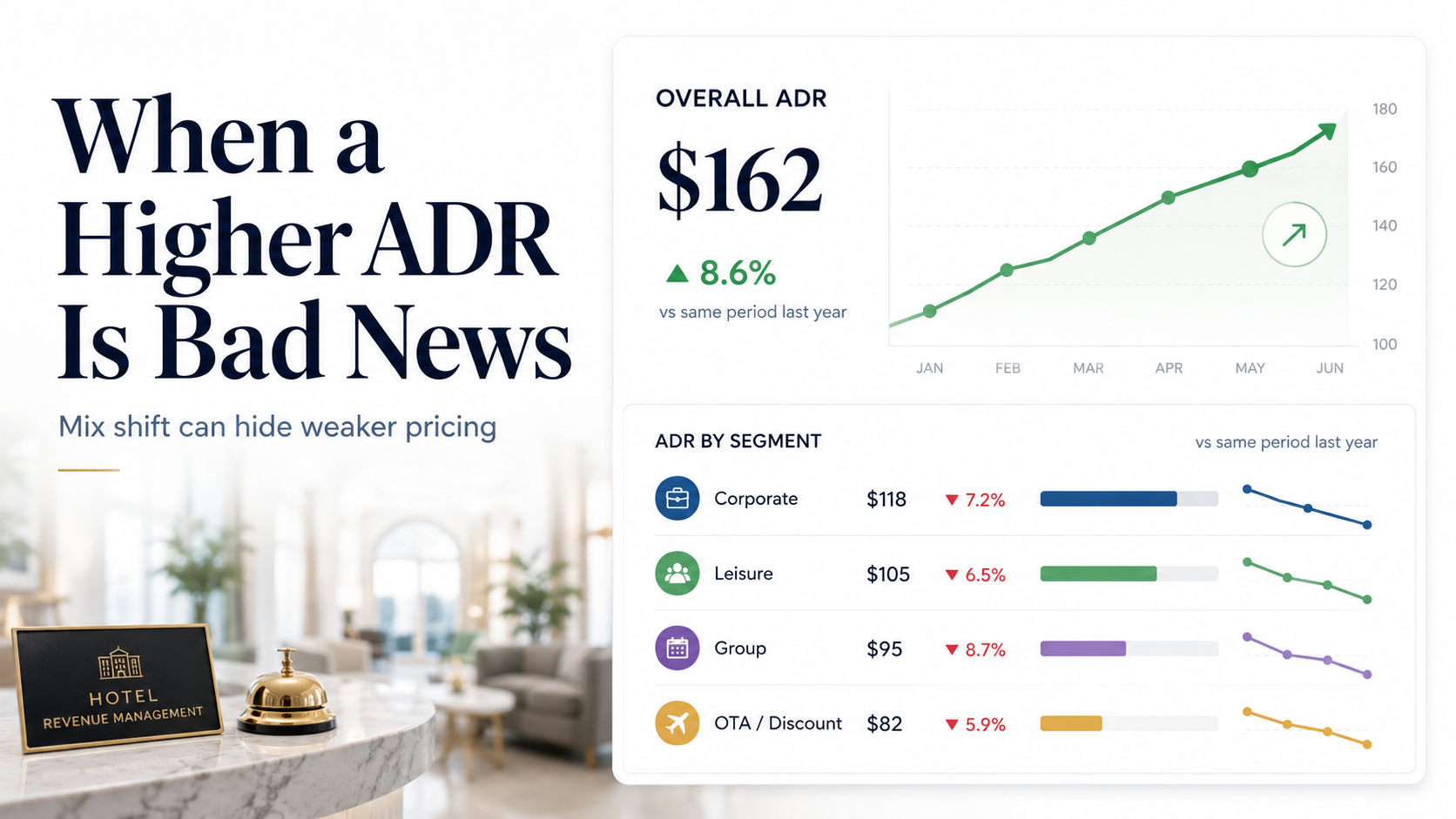
A hotel’s average daily rate can rise even while every important customer segment is paying less. The culprit is not pricing power, but changing mix.
Free tourism insights
Get Free Tourism Insights
Receive selected MTO insights, tourism data alerts, and new resource updates by email.
Get Free Tourism InsightsOn Monday morning, a revenue manager opens the weekly dashboard and sees something reassuring: average daily rate has risen from 240to252. Occupancy is broadly unchanged. At first glance, pricing appears stronger. Then she opens the segment report. Direct leisure guests are paying less than last year. OTA guests are paying less. Group business is paying less too. The hotel has not become better at holding price. It has simply sold fewer rooms to its cheapest segment. The average improved while the underlying prices weakened.
The average that changes its meaning
ADR is simple: room revenue divided by rooms sold. That simplicity is useful, but it also hides the composition of the rooms underneath it.
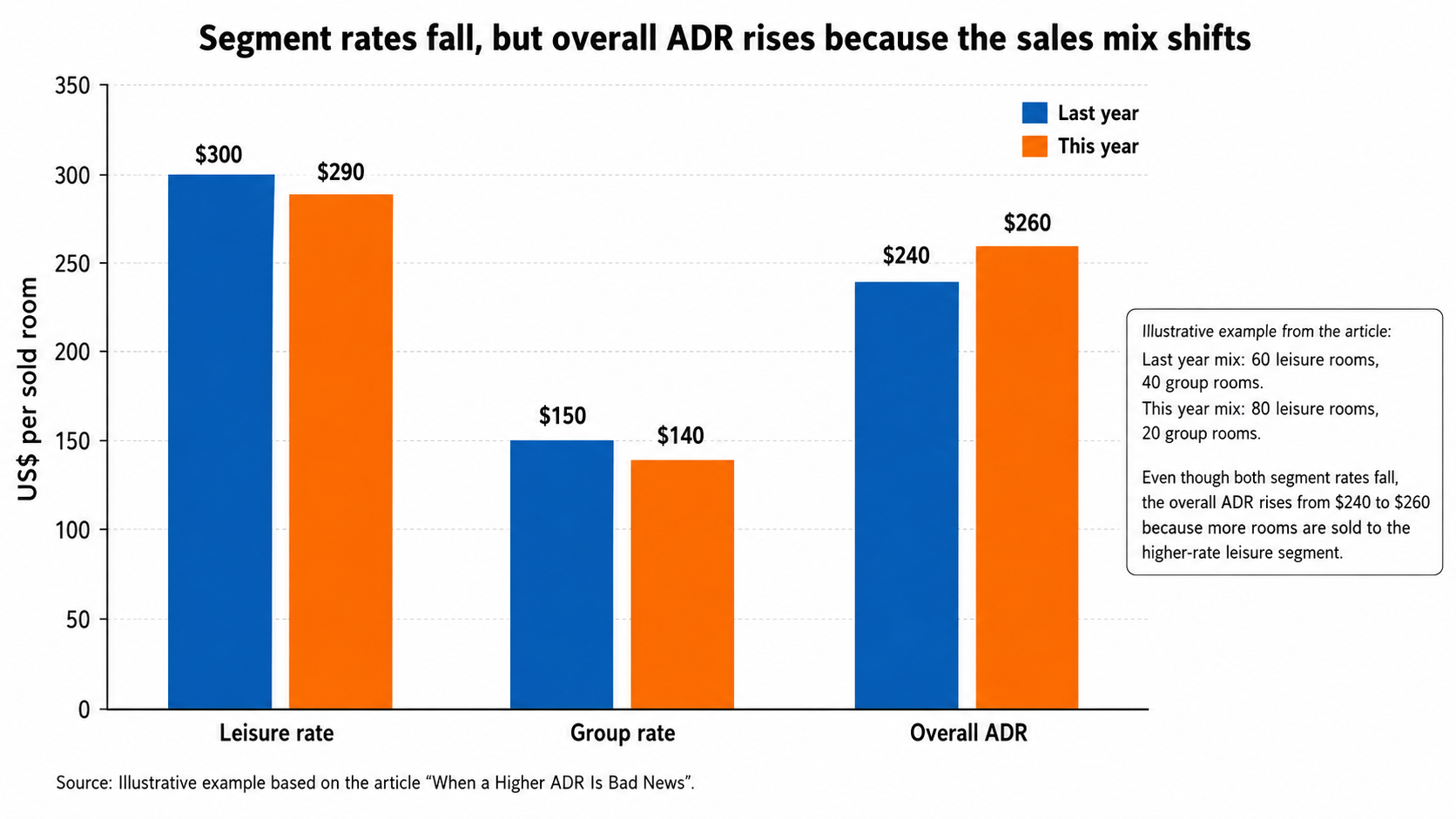
Consider an illustrative 100-room-night sample. Last year, a hotel sold 60 rooms to leisure guests at 300 dollars and 40 group rooms at 150. Total room revenue was 24,000, giving an ADR of 240.
This year, suppose leisure rates fall to 290andgroupratesfallto140. Prices are weaker in both segments. But the hotel now sells 80 leisure rooms and only 20 group rooms. Revenue becomes 26,000,andADRrisesto260.
Nothing in that increase proves stronger pricing. The hotel is charging less to every comparable customer type. The average rises because high-rate leisure guests now represent a larger share of the business.
Statisticians know this family of effects as Simpson’s paradox: a relationship visible in aggregated data can weaken, disappear, or even reverse when the data are separated into meaningful groups. Hotels encounter it whenever the sales mix changes across source markets, channels, room categories, meal plans, lengths of stay, or seasons.
When the mix moves beneath the dashboard
Tourism businesses are unusually exposed to this problem because their customers are heterogeneous. A resort may simultaneously sell honeymoon packages, wholesale contracts, OTA inventory, repeat-guest offers, domestic packages, and premium villas. A destination may receive backpackers, families, luxury travellers, conference delegates, cruise passengers, and long-stay visitors.
The headline average combines all of them.
That matters when managers interpret improvement. Suppose a destination’s average visitor expenditure rises after a sharp decline in short-stay budget travellers. Policymakers might conclude that visitors have become more valuable. Yet spending among luxury, mid-market, and budget travellers could each have fallen. The aggregate rises because the destination is receiving a different mixture of people.
The same distortion can appear in length of stay. Average stay may increase because short-stay markets contract, even though travellers from every major source country are individually shortening their trips.
For hotels, ADR is especially vulnerable when room-type mix changes. Selling more overwater villas can lift property-wide ADR even if the rate for an overwater villa and the rate for a beach villa have both been discounted. A rising aggregate ADR can therefore coexist with weakening willingness to pay.
A better question than “Did ADR rise?”
This does not make ADR useless. It changes the question managers should ask next.
When the headline number moves, decompose it. Compare like with like: the same room type, channel, source market, booking window, meal plan, or customer segment across comparable periods. The exact segmentation will differ by business, but the principle is constant. Separate the effect of price from the effect of mix.
One useful mental model is to imagine freezing last year’s sales mix and applying this year’s segment prices to it. In the illustrative hotel above, keeping the old 60:40 mix while using the new 290and140 prices would produce an ADR of 230.Thatistheclearersignalofpricingmovement:down10, not up $20.
The remaining difference between 230andtheobserved260 comes from the change in who bought the rooms.
Back on Monday morning, the revenue manager’s dashboard is no longer telling a comforting story. The $260 ADR is real; the revenue is real. But the interpretation has changed. The hotel benefited from a more favourable mix while losing price within each segment. If that mix reverses next month, the weakness may suddenly become visible.
An average is not merely a number. It is also a description of who is inside it.