Guesthouse Pricing Series: The Price the Guest Pays Is Not the Revenue You Keep
20 Jul 2026, 13:17 · by IzuCT · 8 min read · Tourism · EN
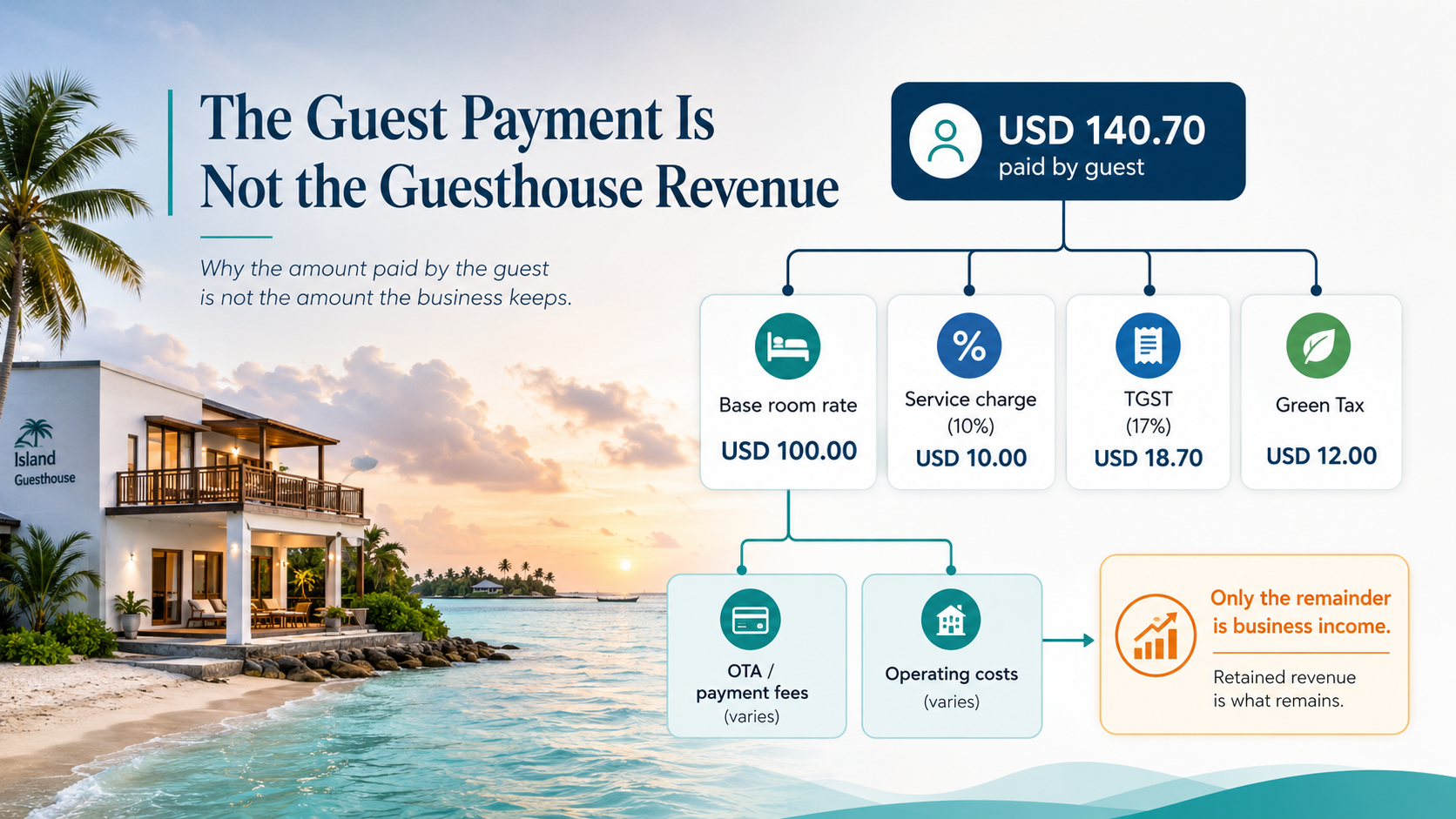
A guest’s payment is not the guesthouse’s revenue. Service charge, TGST, Green Tax, OTA commissions, promotions and payment fees must be separated, recorded and compared by net retained revenue to protect cash flow and profitability.
Free tourism insights
Get Free Tourism Insights
Receive selected MTO insights, tourism data alerts, and new resource updates by email.
Get Free Tourism InsightsA guest completes a reservation and pays USD 140.70. For a moment, the number looks reassuring. It appears on the booking confirmation, passes through the payment system and enters the account as evidence that the room has generated more than USD 140.
Yet much of that money was never revenue belonging to the guesthouse. Part belongs to the government. Part belongs to employees. Part may go to an online travel agency, a card network, a bank or a payment processor. Only what remains is available to pay for breakfast, laundry, salaries, electricity, maintenance, rent and profit.
This is one of the most important distinctions in guesthouse pricing: The amount paid by the guest is not the amount retained by the business. If an MSME fails to separate taxes and other statutory charges from its own revenue, it may unknowingly spend money owed to MIRA and accumulate tax debt.
The first article in this series calculated what a guesthouse room needs to earn. This second article follows the money after the price has been set.
Visit our digitaltools page to test the ideas discussed here.
One room price, several destinations
Consider a one-night booking for two adults with a base room rate of USD 100. The rate begins as one number. By the time it reaches the guest, it has several layers.
Price component | Amount |
|---|---|
Base room rate | USD 100.00 |
Service charge at 10% | USD 10.00 |
TGST at 17% | USD 18.70 |
Green Tax for two adults | USD 12.00 |
Final amount paid | USD 140.70 |
Figure 1. The journey from base price to final guest price.
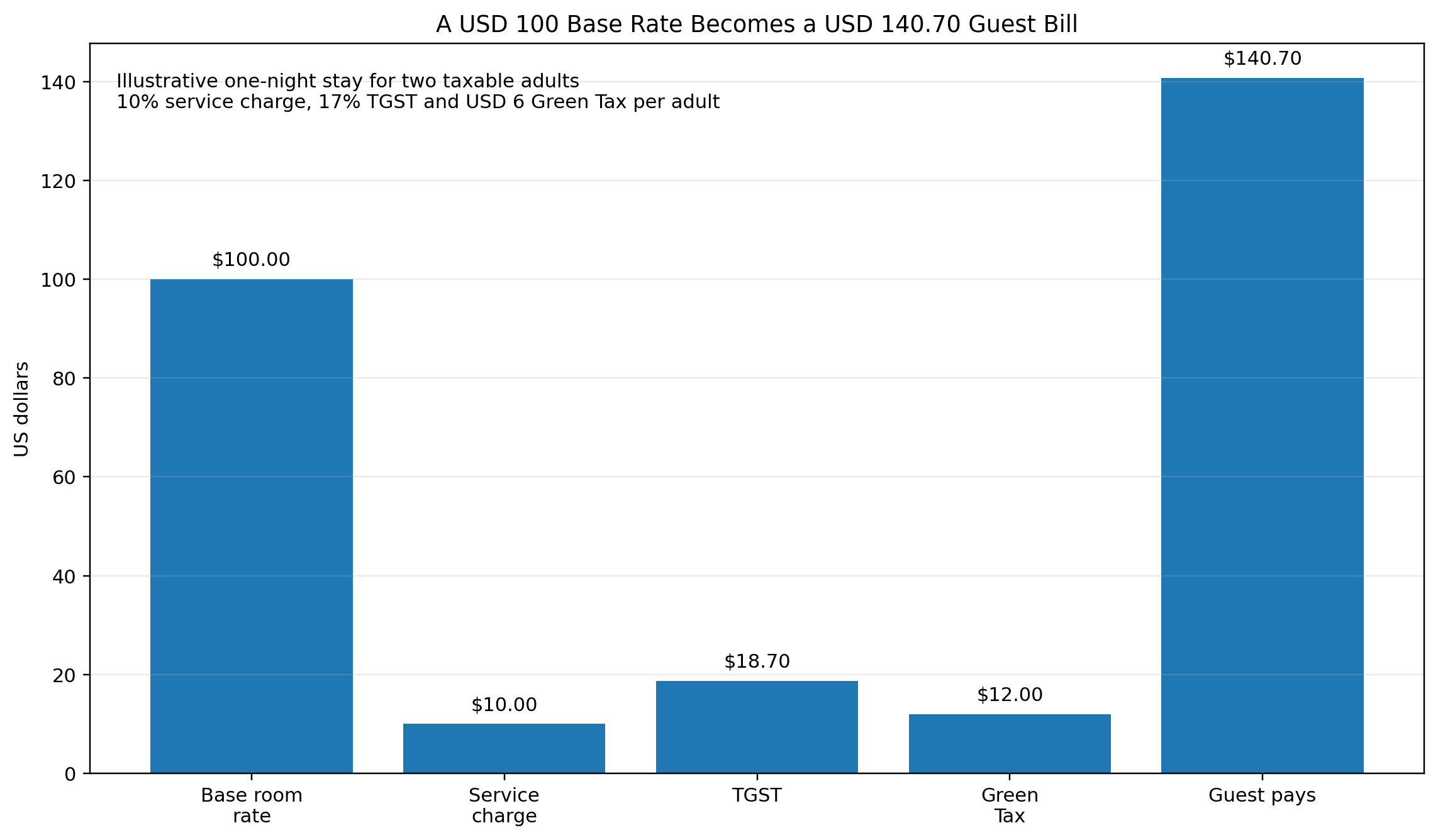
Illustrative one-night booking for two taxable adults at a small inhabited-island guesthouse.
The chart reveals an apparent paradox. The guest pays USD 140.70, yet the property’s ordinary room revenue begins at USD 100.
To understand why, each layer must be treated separately.
1. The base price is the business price
The base price is the underlying value of the accommodation before service charge, TGST and Green Tax.
This is the figure that should normally be used to measure:
room revenue;
average daily rate;
profitability;
OTA commission exposure;
payment costs; and
contribution towards fixed costs.
When a guesthouse says, “We received USD 140.70 from this room,” it risks overstating its revenue. The more accurate statement is: “The guest paid USD 140.70, of which USD 100 was the underlying room price before channel deductions and operating costs.”
That difference changes almost every financial indicator.
2. Service charge is collected, but it is not ordinary room revenue
Tourism businesses in the Maldives must levy a service charge of at least 10% on services. The regulations require service charge to be distributed equally among eligible employees contributing directly or indirectly to the service. An employer may retain an administrative amount of no more than 1% of the service charge collected.
In the example, the USD 10 service charge should therefore not be treated as an additional USD 10 of operating income. It should be recorded separately as:
service charge collected;
administrative amount retained, where applicable; and
service charge payable to employees.
A guesthouse that uses service charge receipts to cover electricity, rent or room expenses may create a misleading picture of profitability and a future cash-flow shortage when the employee distribution becomes due.
3. TGST is collected on behalf of the state
The tourism-sector GST rate increased to 17% from 1 July 2025. MIRA’s guidance states that the applicable rate depends on the time of supply, generally linked to when the invoice is raised or payment is received. In the example:
TGST = 17% of USD 110
The taxable amount includes the USD 100 room price and USD 10 service charge. This produces:
TGST = USD 18.70
The guesthouse collects this amount, but it is not profit. It creates a tax liability, subject to the business’s applicable GST accounting and input-tax arrangements.
The important operational lesson is simple: Cash in the bank is not always cash available to spend.
A practical accounting system should move collected TGST into a separate tax-liability category immediately rather than waiting for the filing deadline.
4. Green Tax belongs outside the room rate
From 1 January 2025, tourist guesthouses with 50 or fewer rooms operating on inhabited islands charge USD 6 per tourist per day of stay. Guesthouses with more than 50 rooms and guesthouses on uninhabited islands are generally subject to USD 12 per tourist per day. For two taxable adults staying one night:
Green Tax = USD 6 × 2 = USD 12
Green Tax is based on the number of taxable guests and days, not the room price. It should therefore be recorded separately from room revenue. This distinction becomes especially important for:
single versus double occupancy;
children below the applicable exemption age;
long stays;
complimentary rooms;
late checkouts; and
changes in the number of guests.
A USD 60 room and a USD 160 room may generate the same Green Tax when occupied by the same number of taxable guests for the same period.
5. The booking channel takes its share
After taxes and service charge are separated, the guesthouse still may not retain the full base room price.
The core calculation is:
Net booking revenue
Net booking revenue = Base revenue − OTA commission − payment fees − promotional costs
The formula is deliberately simple. The difficulty is identifying every deduction.
An illustrative channel comparison
Suppose the starting base rate is USD 100.
Booking channel | Illustrative deduction | Base revenue retained |
|---|---|---|
Direct bank transfer | 1% transaction and administration cost | USD 99.00 |
Direct card booking | 3% payment-processing cost | USD 97.00 |
Standard OTA booking | 15% commission | USD 85.00 |
OTA with 10% promotion | 10% discount, then 15% commission | USD 76.50 |
These percentages are examples, not standard Maldives rates. Each guesthouse must use its actual merchant agreement, OTA contract, bank charges and monthly invoices.
Figure 2. The same starting price can produce different retained revenue.
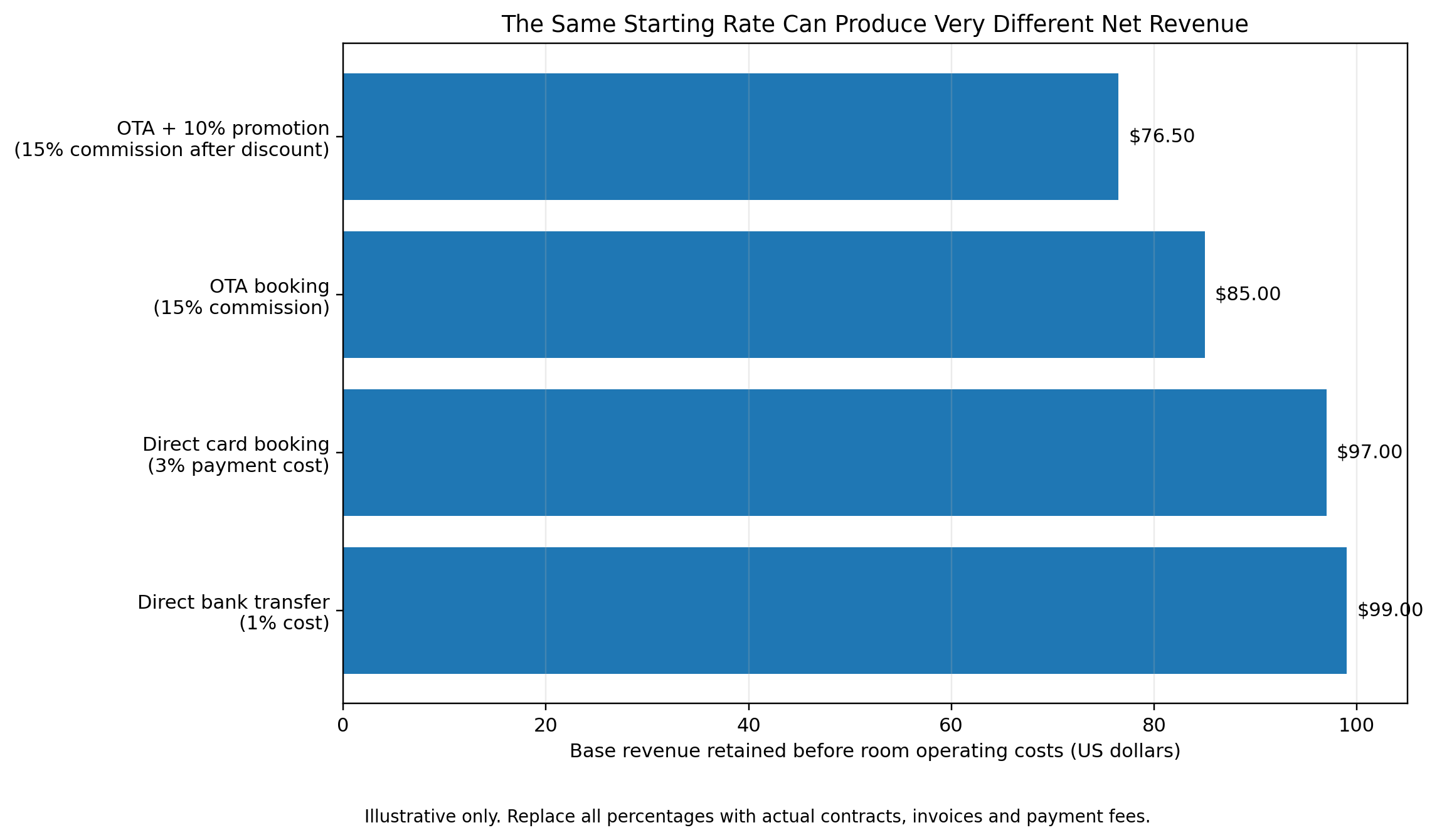
The figures exclude room operating costs and use illustrative channel assumptions. The final example is particularly revealing. The guesthouse begins with a USD 100 rate. A 10% platform promotion reduces it to USD 90. A 15% commission on that amount removes another USD 13.50. The property retains USD 76.50 before paying for:
breakfast;
housekeeping;
laundry;
electricity;
salaries;
rent;
maintenance; or
debt.
A promotion that appears to reduce the price by 10% has reduced retained base revenue by 23.5%. This is why discounts and commissions must be examined together.
Card payments are not one simple cost
International card-processing fees can contain several components: a fee to the issuing bank, a card-network assessment and a processor markup. The exact rate may also vary with card type, country, currency, transaction method and the merchant’s agreement. A guesthouse should check for:
percentage processing charges;
fixed charges per transaction;
international-card supplements;
currency-conversion costs;
chargeback fees;
refund fees;
payout fees;
settlement delays; and
differences between online and terminal payments.
A quoted 3% card cost may become more than 3% once fixed fees, foreign cards or currency conversion are included. Refunds create another complication. A guest may receive the full booking amount back while the processor retains some transaction charges. Cancellation policy and payment policy must therefore be designed together.
Direct bookings are cheaper, not free
Direct booking removes or reduces OTA commission, but it still has acquisition and processing costs. These may include:
website hosting;
booking-engine fees;
digital advertising;
social-media production;
staff time answering messages;
payment processing;
abandoned enquiries;
fraud and chargeback risk; and
loyalty benefits offered to secure the booking.
The correct comparison is not: OTA commission versus zero
It is: OTA acquisition cost versus direct acquisition cost. A direct booking is more profitable only when the total cost of attracting, processing and servicing that booking is lower.
The Maldives Guest house Decision Tools can support this calculation by allowing operators to test room rates, occupancy, channel costs and retained contribution under different scenarios.
Display the total price clearly
MIRA’s tourism-sector guidance states that prices must be displayed inclusive of the applicable TGST rate. The GST Regulation also requires displayed prices to include GST, subject to specific provisions for businesses levying service charge; where prices are shown without GST, the customer must still be able to calculate the total amount payable. For guests, transparency should mean seeing:
the room amount;
whether service charge is included;
whether TGST is included;
Green Tax;
mandatory transfer charges;
payment-related charges;
meal-plan inclusions; and
the final amount payable.
A low headline rate followed by several compulsory charges may win a click while losing trust.
The simplest display is often the strongest: Total for two adults, one night: USD 140.70 Includes room, service charge, TGST and Green Tax. Transfer not included.
Action checklist for guesthouse owners
Separate guest payment from business revenue.
Record the base room price independently.
Record service charge as an employee-related liability.
Record TGST as a tax liability.
Record Green Tax separately by guest and taxable day.
Check the commission basis in every OTA contract.
Record platform promotions separately from commission.
Calculate the real cost of card payments.
Include website, advertising and staff costs in direct-booking calculations.
Compare net revenue—not headline rates—across channels.
Reconcile OTA statements against reservations.
Show guests the final payable price clearly.
Review channel profitability every month.
The next article
Knowing what remains after taxes and distribution is only half the pricing problem. The next question is more dangerous: What happens when a competitor displays a lower price? Article 3 will examine how to build a useful competitor set, compare like with like and avoid copying rates from businesses with completely different costs, rooms and island conditions.