Guesthouse Pricing Series: Stop Copying Competitor Prices and Build a Rate That Fits Your Island
22 Jul 2026, 16:56 · by IzuCT · 8 min read · Tourism · EN

In this 'third article of the series', we propose that Guesthouse operators treat competitor prices as signals, not instructions. Sustainable rates combine a property’s cost floor, comparable market range and value ceiling, while accounting for taxes, inclusions, reviews, transfers, room quality and island characteristics.
Free tourism insights
Get Free Tourism Insights
Receive selected MTO insights, tourism data alerts, and new resource updates by email.
Get Free Tourism InsightsOpen a booking platform and a small universe appears.
One room is USD 65. Another is USD 110. A third property promises a “deluxe sea-view experience” for USD 175. Somewhere nearby, a newly opened guesthouse offers a discount large enough to make every other operator uneasy.
It is tempting to select the lowest number and follow it. But prices are like stars seen from Earth. Two may appear close together while, in reality, they are separated by enormous distances. Two rooms may display similar prices while differing in location, breakfast, taxes, cancellation terms, beach access, reviews, transfers and service quality.
As outline in the first article of this series: What Should Your Guesthouse Room Really Cost?. In the second article of the series we argued that the Price the Guest Pays Is Not the Revenue You Keep, And in this article, we suggest stop copying competitor prices and build a rate that is comparable to your guesthouse.
A competitor’s price is useful information. It is not an instruction. The purpose of competitor analysis is not to discover what price to copy. It is to understand where your property sits within the market—and why.
The three-point pricing compass
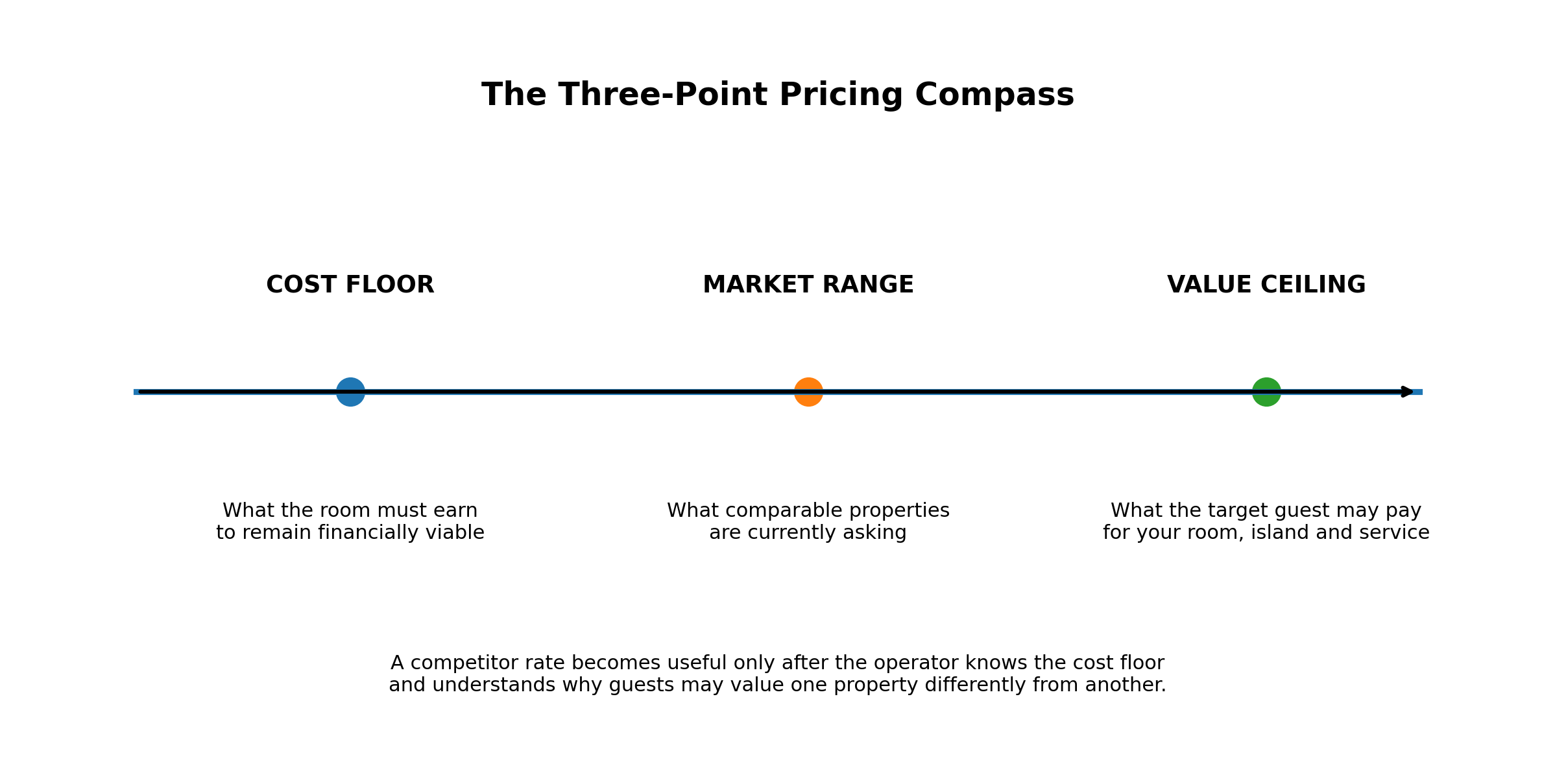
A sustainable rate should be considered against three reference points.
1. The cost floor
The cost floor is the minimum rate the room must earn to cover its share of fixed costs, variable costs and distribution expenses. This number comes from your accounts, not from booking platforms. Refer to What Should Your Guesthouse Room Really Cost?and the Price the Guest Pays Is Not the Revenue You Keep.
A competitor may operate from a family-owned building while you pay rent. It may have no loan, employ fewer staff or postpone maintenance. Its cost floor may therefore be far below yours.
Selling below your own cost floor because another property does so does not create competitiveness. It transfers the competitor’s financial problem into your business.
2. The market range
The market range is what genuinely comparable properties are asking for equivalent stays.
It helps answer:
Is your rate unusually high or low? Are competitors increasing prices for particular dates? Is the island experiencing stronger or weaker demand? Does your property offer enough value to sit above the middle of the range?
The market range is a signal, not a command.
3. The value ceiling
The value ceiling is the highest price your target guest may be willing to pay for the complete offer.
Guests do not buy square metres alone. They buy cleanliness, sleep quality, breakfast, beach access, confidence, transfer convenience, hospitality and the wider island experience.
A property with a higher cost floor can still succeed when it creates sufficiently higher value. A low-cost property can still fail when guests see little reason to choose it.
What current advertised prices appear to show
The following table records price indicators displayed on Booking.com destination pages on 20 July 2026.
Indicative advertised accommodation-price signals
Destination | Region | Platform category | Page-reported general average | Current-weekend average |
|---|---|---|---|---|
Maafushi | South Malé Atoll | Guest houses | USD 56 / MVR 864 | USD 112 / MVR 1,727 |
Dhigurah | South Ari Atoll | Guest houses | USD 71 / MVR 1,095 | USD 177 / MVR 2,729 |
Ukulhas | North Ari Atoll | Guest houses | USD 67 / MVR 1,033 | USD 243 / MVR 3,747 |
Dharavandhoo | Baa Atoll | “Cheap hotels” | USD 91 / MVR 1,403 | USD 160 / MVR 2,467 |
Fulidhoo | Vaavu Atoll | Guest houses | USD 96 / MVR 1,480 | USD 150 / MVR 2,313 |
Addu Atoll | Southern Maldives | Regional guest-house page | Not available | USD 88 / MVR 1,357 |
What the chart does—and does not—tell us
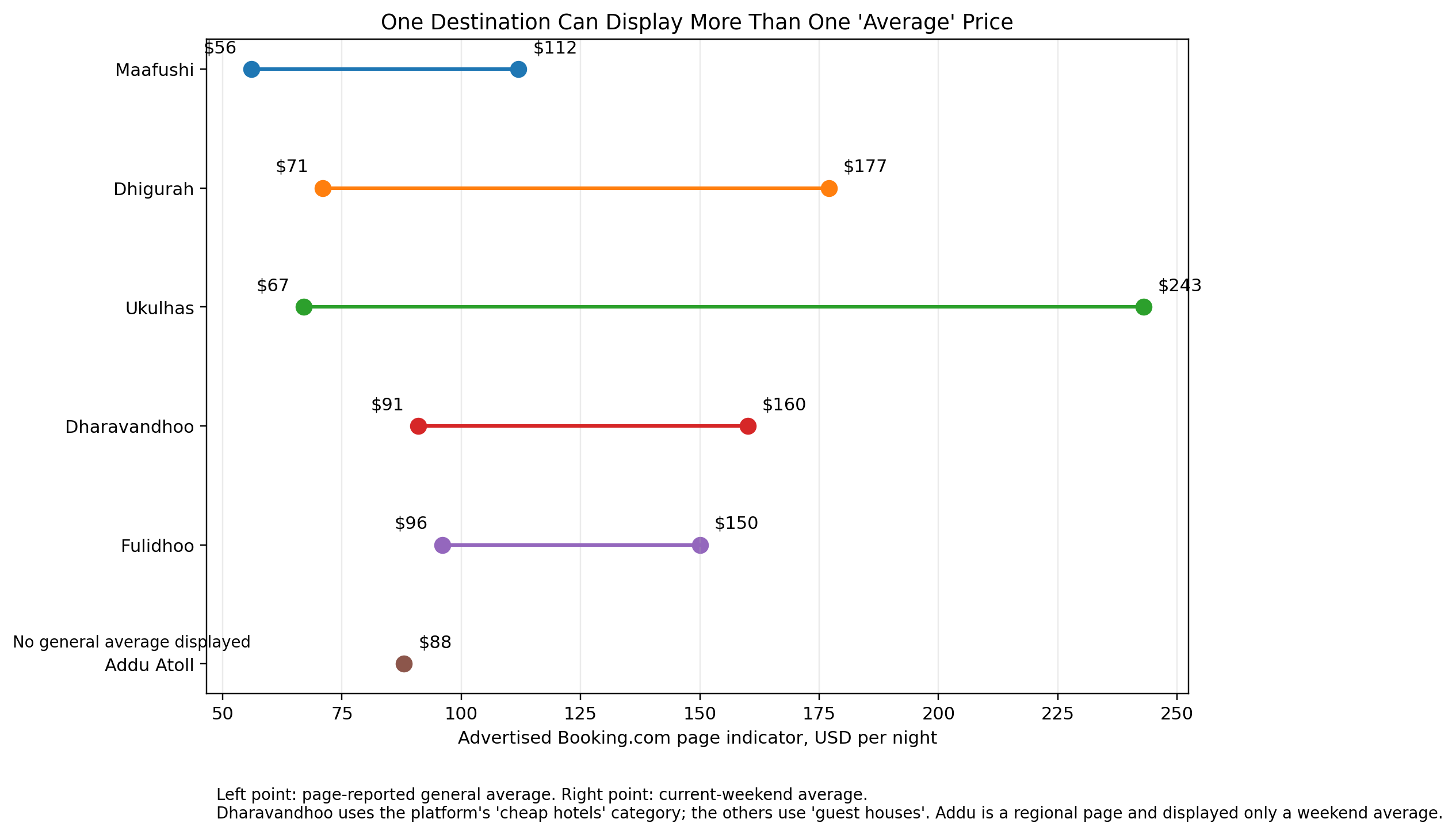
The weekend indication ranges from USD 88 in Addu to USD 243 in Ukulhas. That does not establish that Ukulhas guesthouses are generally worth almost three times as much as Addu guesthouses.
The Ukulhas figure may reflect limited remaining inventory, different room types, a temporary demand concentration or a small number of expensive available properties. The Addu figure comes from a regional page covering several islands rather than a single-island market. Dharavandhoo is classified under “cheap hotels,” while most other observations use “guest houses.”
The table is therefore a market snapshot, not a controlled price comparison and not an official industry average. Its most important lesson is not the ranking of the islands. It is the instability of the word average.
Select competitors that are genuinely comparable
A useful competitor set usually contains five to eight properties. They do not all need to be on the same island, but they should compete for a similar guest.
Compare the following characteristics.
Comparison factor | Why it matters |
|---|---|
Island and transfer route | A direct scheduled speedboat is not equivalent to a domestic flight followed by a boat |
Beach position | Beachfront, sea view and inland rooms offer different value |
Room type and capacity | Standard doubles should not be compared with suites or family rooms |
Meal plan | Room-only and breakfast-inclusive prices are not equivalent |
Cancellation terms | A flexible booking has greater value than a non-refundable rate |
Taxes and charges | Compare the final amount payable, not only the headline price |
Review score and volume | A strong rating supported by hundreds of reviews is different from a new score based on a few stays |
Facilities and service | Pool, lift, restaurant, equipment, trained staff and room quality affect positioning |
Transfer support | Clear coordination may be valuable even when the transport itself is charged separately |
A guesthouse should not compare itself only with the cheapest properties. It should compare itself with the properties appearing beside it when the target guest searches.
Compare the final guest price
Suppose a competitor advertises:
USD 80 per night
Your property displays:
USD 118 total
At first glance, your room appears USD 38 more expensive.
But imagine the competitor’s USD 80 is a base rate, with 10% service charge, 17% TGST and USD 6 Green Tax for each of two adults added later.
The competitor’s final price becomes:
Base room: USD 80
Service charge: USD 8
TGST: USD 14.96
Green Tax: USD 12
Final price: USD 114.96
Your actual difference is not USD 38.
It is USD 3.04. And your USD 118 offer may also include breakfast, flexible cancellation or better transfer assistance. This is why screenshots of headline prices can mislead operators.
Your island is part of the room
A guesthouse sells private characteristics and shared island characteristics at the same time.
The private characteristics include:
the bed;
room size;
bathroom quality;
air-conditioning;
breakfast;
staff service; and
cleanliness.
The shared characteristics include:
the beach;
reef and lagoon;
island cleanliness;
congestion;
waste management;
harbour conditions;
restaurants;
public spaces; and
transport access.
Historical Maldives research undertaken using 2016–2017 accommodation and survey data found that beachfront location was associated with a substantial price premium after controlling for other characteristics. Beach quality, staff language capability and management training were also associated with higher prices, while poor waste management and crowding could reduce them. These are historical estimates rather than current pricing rules, but they demonstrate that the market values more than the room itself.
A guesthouse located inland should not automatically copy the rate of a beachfront property. But it can compensate through better rooms, superior breakfast, reliable service, stronger reviews or a more convenient package.
Why atoll-wide averages may mislead
An atoll is an administrative and geographical unit. It is not necessarily one accommodation market.
Dhigurah and Ukulhas are both associated with Ari Atoll tourism, but they offer different island environments, transport routes, marine experiences and property mixes. A Dharavandhoo property may benefit from domestic-airport access and proximity to Baa Atoll marine attractions. A Maafushi guesthouse operates within a dense, highly visible tourism cluster.
In the historical dataset used for my dissertation, differences between atoll-level price clusters were relatively modest, while differences among islands—even within the same atoll—were much larger. The study therefore cautioned that broad atoll averages could conceal the characteristics that actually explain room-price differences.
For an individual operator, the island is usually the more useful unit of analysis.
Build a monthly competitor-rate tracker
A competitor tracker does not need to be complicated.
Choose:
five to eight comparable properties;
one low-season stay date;
one shoulder-season date;
one high-season date; and
the same number of guests and room nights.
Record the following every month:
Field | Example |
|---|---|
Observation date | 20 July 2026 |
Stay dates | 15–18 November 2026 |
Property and island | Property A, Dhigurah |
Room type | Standard double |
Guests | Two adults |
Meal plan | Breakfast included |
Cancellation | Free until seven days before arrival |
Headline price | USD 95 |
Service charge and tax | Included or additional |
Green Tax | Included or additional |
Final payable price | USD 132 |
Transfer | Excluded; scheduled speedboat available |
Review score and count | 9.1 from 340 reviews |
Availability signal | Three rooms remaining |
Notes | Mobile discount displayed |
Over time, the tracker will reveal more than today’s cheapest rate. It will show:
which properties raise prices first;
when inventory begins to tighten;
whether your rate moves with the market;
which competitors rely heavily on discounts; and
whether your position is improving or weakening.
Action checklist
Before changing your rate because of a competitor:
Confirm your own cost floor.
Compare the same stay dates and number of guests.
Match room type and meal plan.
Compare cancellation conditions.
Calculate the final price after all mandatory charges.
Account for beach position and island quality.
Compare review score together with review volume.
Include transfer cost and convenience.
Use five to eight competitors, not one.
Record observations monthly rather than reacting to a single screenshot.
Treat advertised prices as market signals, not proven transaction prices.
Raise or reduce rates only when the evidence supports the decision.
Conclusion
A competitor’s price is a distant signal.
To interpret it, an operator must know what lies behind it: cost, quality, inventory, taxes, transfer, reputation and island characteristics.
The strongest pricing decision is not: They charge USD 80, so we should charge USD 78.
It is: Our room needs at least USD 86, comparable properties are asking USD 95–115, and our location, reviews and inclusions justify a position near the upper half of that range.
That is no longer copying. It is pricing with a map.
Next in the series
When Should You Raise or Lower Your Room Rate?
The next article will examine seasonality, booking pace, remaining inventory, early-booking offers and last-minute discounts.