Guesthouse Pricing Series: Choosing the Right Package
03 Aug 2026, 17:52 · by IzuCT · 7 min read · Tourism · EN

The right package balances guest certainty with operational control. Room-only suits independent travellers; meal plans support islands with limited dining; transfer and activity inclusions reduce friction, while all-inclusive packages require systems, capacity and cost discipline.
Free tourism insights
Get Free Tourism Insights
Receive selected MTO insights, tourism data alerts, and new resource updates by email.
Get Free Tourism InsightsA hotel room has walls. A package has boundaries.
Those boundaries tell the guest which parts of the holiday are certain and which remain undecided. Breakfast may be included. Dinner may be waiting. Transfers may already be arranged. An excursion may be promised for a particular day.
The more a guesthouse includes, the more control it gains over the experience—but the more financial and operational responsibility it accepts.
Choosing a meal plan is therefore not simply a marketing decision. It is a decision about risk.
The package spectrum
At one end is room only. The guest purchases a place to sleep and makes most other decisions independently.
At the other end is all-inclusive. The guest purchases a controlled holiday system in which accommodation, food and selected experiences are brought inside one price.
Between these two points lies a spectrum of possibilities.
Figure 1. Package choice as a trade-off between control and exposure.
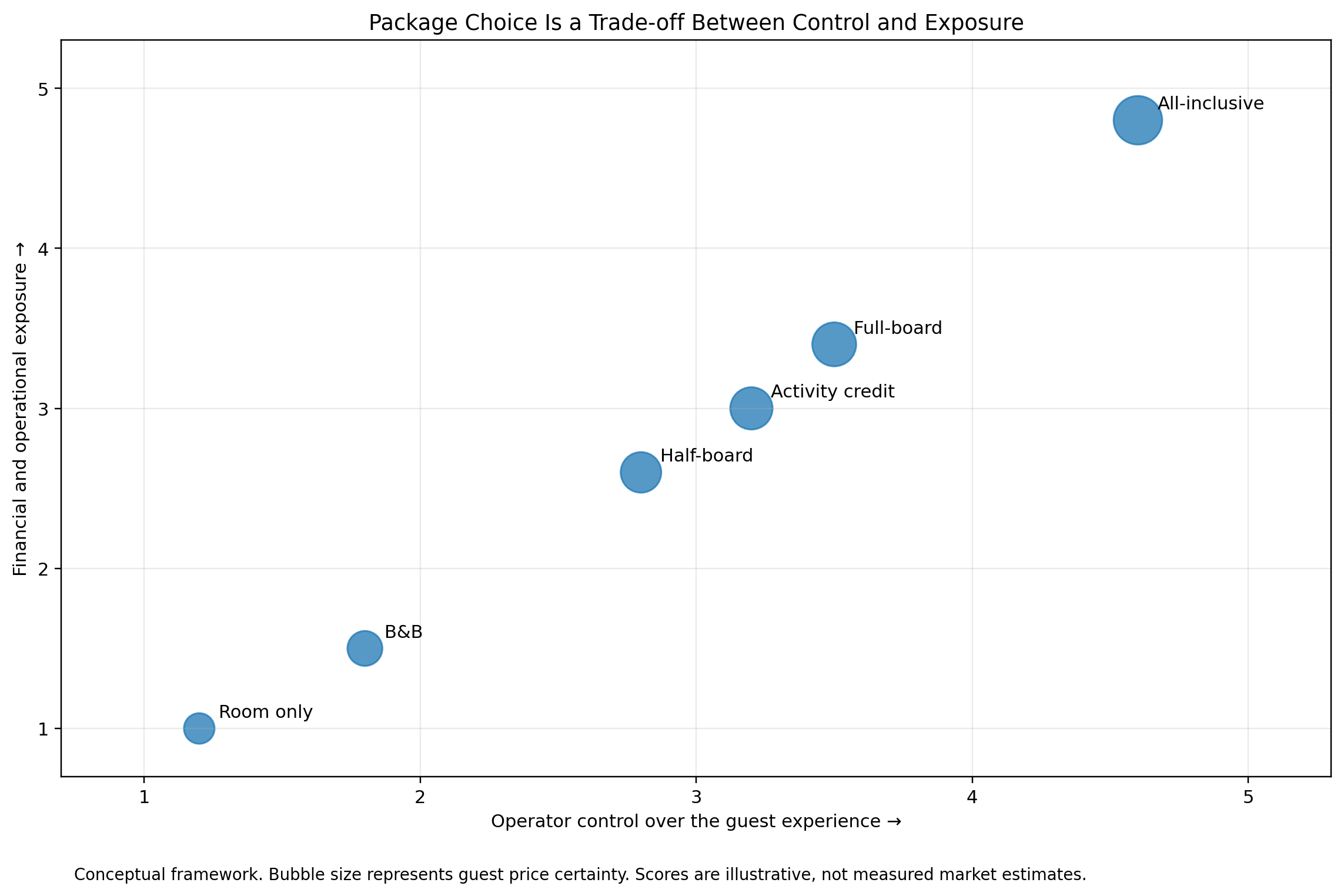
The scores are conceptual rather than measured estimates.
A historical Maldives Visitor Survey found that 44% of respondents selected all-inclusive meal plans in 2015. The sample was dominated by resort visitors, so this figure should not be interpreted as evidence that local-island guesthouses should copy the resort model. It shows that price certainty has long been important within the wider Maldives market.
Comparing the main package models
Package | What it normally includes | Guests it may suit | Operational advantage | Main financial risk | Suitable island conditions |
Room only | Accommodation | Independent, budget-conscious or repeat visitors | Lowest food exposure | Weak ancillary capture | Many restaurants and easy transport |
Bed and breakfast | Room and breakfast | Most short-stay leisure guests | Creates a reliable morning service point | Breakfast waste and labour | Nearly all guesthouse islands |
Half-board | Breakfast and dinner | Couples, families and excursion guests | Captures evening spend | Guests skipping dinner; menu inflation | Limited evening dining or strong in-house kitchen |
Full-board | Three daily meals | Families, groups and remote-island guests | High food control | High wastage and staffing exposure | Few external restaurants |
Transfer-inclusive | Accommodation and defined transfer | First-time and convenience-oriented guests | Reduces booking friction | Schedule changes and supplier increases | Stable, well-defined transfer route |
Activity-inclusive | Room and named excursion | Marine-experience travellers | Differentiates the offer | Weather and wildlife cancellation | Reliable activity suppliers |
All-inclusive | Room, meals, drinks and selected activities | Guests seeking certainty | High capture and predictable guest spending | Consumption and service-capacity risk | Strong kitchen, controls and activity capacity |
Activity-credit | Package includes a monetary activity allowance | Guests wanting choice | Limits operator liability | Credit redemption and supplier accounting | Several bookable activities |
Build-your-own | Guest selects components | Digitally confident and mixed-interest guests | Better segmentation | System complexity | Reliable booking and pricing system |
Long-stay | Reduced average rate or added benefits for extended stays | Remote workers, divers and repeat visitors | Lower acquisition and turnover cost | Blocking high-demand dates | Stable services and suitable rooms |
Room only: freedom with a revenue boundary
Room-only pricing can work well where the island already has:
several restaurants;
reliable cafés;
independent excursion businesses;
easy transport; and
guests comfortable organising their own stay.
Its advantage is clarity. The guesthouse does not carry food-consumption risk.
Its weakness is that the guest may spend most of the holiday budget elsewhere. A room-only guest paying USD 80 may be less valuable than a half-board guest paying USD 110, even when the room cost is identical.
Room only should not mean service only when requested. Transfer information, island orientation and basic guest support remain part of accommodation quality.
Bed and breakfast: the natural anchor
Breakfast is often the most defensible inclusion for a small guesthouse.
It provides:
a predictable daily service;
a point of contact with guests;
an opportunity to explain weather and activities;
a clear distinction from an unserviced room; and
relatively manageable food costs.
However, breakfast should be costed by occupied room-night, not by registered bed capacity.
Its real cost includes food, drinks, preparation, staff time, cleaning, utilities, spoilage and dietary alternatives.
A flexible breakfast can be more valuable than a larger buffet. Guests departing early for diving or the airport may value a packed meal more than a wide selection they cannot use.
Half-board: control the evening
Half-board commonly includes breakfast and dinner.
It can be effective when guests spend the middle of the day on excursions but return to the island in the evening. It also gives families and couples greater certainty about their holiday budget.
The operator should calculate:
Half-board supplement = Expected dinner cost + service cost + required contribution
A buffet designed for 20 guests but serving eight may lose money through waste. A set menu, advance meal choice or limited rotating menu may provide better control.
Half-board works best when:
evening restaurant choices are limited;
the guesthouse kitchen has reliable capacity;
guests commonly return by dinner time; and
the food experience contributes to the property’s identity.
Full-board: appropriate where alternatives are limited
Full-board includes breakfast, lunch and dinner.
It may suit remote islands, organised groups, families with children or guests on structured programmes.
Its main risk is non-use. Guests may skip lunch while diving, visiting a resort or travelling to a sandbank. If the price assumes all meals are eaten but food is prepared regardless, the package can produce both waste and dissatisfaction.
A better design may allow:
packed lunches;
meal credits;
excursion-day substitutions;
advance meal selection; or
a defined allowance at a partner restaurant.
Transfer-inclusive: certainty must be carefully defined
The transfer is often the first product consumed and the last one completed.
A transfer-inclusive package should state:
transport mode;
scheduled or private status;
arrival-time conditions;
luggage allowance;
child policy;
airport waiting procedure;
weather rules; and
responsibility for changed international flights.
“Return transfer included” is inadequate when the package only applies to one scheduled departure each day.
Activity-inclusive: bundle the reason for travelling
The latest Maldives Visitor Survey reported that 67% of respondents sought snorkelling experiences, while diving, wellness and special occasions also remained important motivations.
This creates a strong case for experience-led packages such as:
stay and snorkel;
dive-week packages;
family lagoon packages;
manta-season offers;
surf and stay;
fishing packages; and
island-culture itineraries.
The activity must nevertheless be costed as carefully as the room.
Weather, minimum participants, wildlife uncertainty and supplier cancellation rules should be built into the package contract.
All-inclusive: a system, not a list of free items
An all-inclusive product is operationally demanding.
It requires rules covering:
included meal periods;
beverage types;
consumption hours;
premium exclusions;
activity frequency;
advance reservations;
unused inclusions;
arrival and departure-day treatment; and
damage or equipment-loss policies.
The package should be priced using expected utilisation, but capacity must be sufficient for high utilisation.
If the guest is entitled to one excursion, the operator must be able to provide it even when most guests request the same day.
A small guesthouse should avoid using “all-inclusive” merely to describe three meals. “Full-board with selected activities” may be more accurate.
Activity credits: choice within a boundary
An activity credit gives the guest flexibility while limiting the operator’s maximum exposure.
For example:
USD 100 activity credit per room per stay
The guest may apply it to snorkelling, fishing, diving or a sandbank trip. The package terms should explain:
whether unused credit expires;
whether it is transferable;
which suppliers participate;
whether it covers taxes;
whether cash refunds are allowed; and
what happens when an activity is cancelled.
Activity credit can be more manageable than promising a particular wildlife excursion.
Build-your-own packages
A build-your-own model lets the guest combine:
room category;
meal plan;
scheduled or private transfer;
activities;
celebration arrangements; and
cancellation flexibility.
The apparent freedom requires a disciplined back end. Every component needs a current net cost, selling price, tax treatment and cancellation rule.
Without these controls, the operator may build an attractive package that loses money.
Long-stay offers
A long stay may reduce:
acquisition cost per night;
room-turnover cost;
check-in administration;
payment charges;
vacancy gaps; and
linen and cleaning intensity.
These savings can finance a discount or added benefits.
Yet a seven-night discount should not automatically be available across peak dates. The package may block rooms that could have sold at higher rates.
Long-stay pricing should be restricted by season, booking pace and room type.
Choose the package the island can deliver
A package should reflect the operating environment.
An island with several restaurants and frequent boats can support room-only and build-your-own offers.
An island with limited dining may need half-board.
A remote island may benefit from full-board and transfer-inclusive arrangements.
An activity-rich island may perform better with credits than with unlimited inclusions.
The right package is not the one containing the most items. It is the one that gives the guest useful certainty while leaving the operator enough control to deliver every promise profitably.
Next in the series
Building a Profitable Package
The next article will examine how to build Profitable packages.