Guesthouse Pricing Series: Building a Profitable Package
06 Aug 2026, 13:25 · by IzuCT · 7 min read · Tourism · EN

Profitable packages begin with current net costs for rooms, meals, transfers and activities, plus contingency, distribution and margin. Separate tax and service charge, compare direct and OTA economics, and predefine refund allocation for disruptions clearly.
Free tourism insights
Get Free Tourism Insights
Receive selected MTO insights, tourism data alerts, and new resource updates by email.
Get Free Tourism InsightsA package can appear to be one product. Economically, it is a small fleet.
The room moves through nights. Meals move through daily service periods. Transfers follow aircraft and boat schedules. Excursions depend on weather, vessels and participation. Taxes follow their own rules.
A package is profitable only when all these moving parts are brought into one controlled calculation.
The core formula
Required base package price = Total package cost ÷ (1 − distribution cost − target margin)
Total package cost should include:
accommodation cost;
meals;
transfers;
activities;
supplier charges;
payment and administration costs not already captured;
contingency; and
any operator-funded benefits.
The base package price is not necessarily the final amount paid by the guest. Service charge, TGST and Green Tax must be treated correctly.
Step 1: cost each component separately
Do not begin with the price you hope to advertise.
Begin with supplier net rates and internal costs.
Component | Cost basis |
Room | Full cost per occupied room-night |
Meals | Cost per guest per meal |
Transfer | Supplier net rate or actual vessel cost |
Excursion | Supplier net rate or trip-cost allocation |
Benefits | Incremental cost of included extras |
Contingency | Percentage or expected disruption cost |
Distribution | OTA, agent or payment cost |
Target margin | Required package contribution |
A supplier’s retail price is not the package cost if the guesthouse has a contracted net rate.
Conversely, a promised commission is not earned until the commercial arrangement and payment responsibility are clear.
Step 2: use current supplier rates
Every supplier agreement should record:
effective date;
expiry date;
adult and child rates;
taxes included or excluded;
minimum participants;
cancellation period;
no-show treatment;
weather policy;
luggage allowance;
refund timing; and
contact responsible for emergencies.
A package built in January may become unprofitable in July if the transfer rate changes and the package remains on sale.
Step 3: add contingency deliberately
Contingency is not hidden profit. It protects against reasonably foreseeable variation.
A simple starting point is:
Package contingency = Variable supplier exposure × contingency rate
A 5% contingency may be adequate for a stable package using scheduled services. A package containing private boats, wildlife activities or several external suppliers may need a different reserve based on actual cancellation history.
Contingency should not be used to conceal poor costing.
Step 4: distinguish direct and OTA economics
A direct package may involve:
card or payment cost;
website or enquiry cost;
staff time; and
customer-service responsibility.
An OTA package may involve:
commission;
promotional participation;
payment processing;
visibility discounts;
loyalty discounts; and
restrictions on how the final price is displayed.
The same base package should not automatically have the same price across both channels.
Figure 1. Required package prices under two distribution structures.
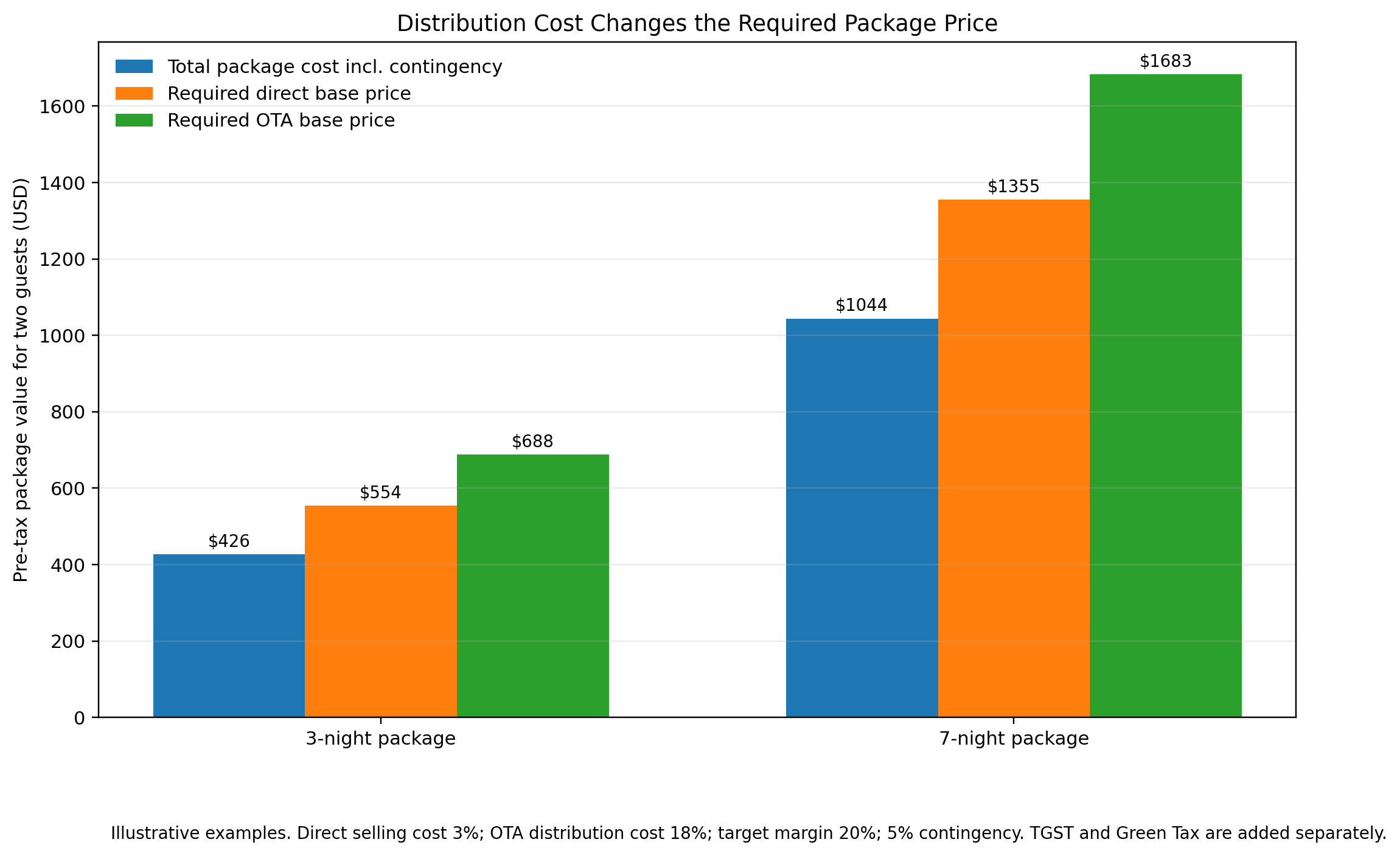
The worked examples use 3% direct selling cost, 18% OTA cost, 20% target margin and 5% contingency.
Worked example 1: three-night transfer and activity package
Assume a package for two guests includes:
three room nights;
return scheduled airport transfer; and
one shared snorkelling excursion.
Package cost
Component | Cost |
Room cost: 3 × USD 62 | USD 186.00 |
Return transfer net rate | USD 100.00 |
Snorkelling activity net rate | USD 120.00 |
Subtotal | USD 406.00 |
Contingency: 5% | USD 20.30 |
Total package cost | USD 426.30 |
Direct-sale price
Assume:
direct selling cost: 3%;
target margin: 20%.
Required base price = USD 426.30 ÷ (1 − 0.03 − 0.20)
= USD 553.64
OTA price
Assume OTA distribution cost of 18%:
Required base price = USD 426.30 ÷ (1 − 0.18 − 0.20)
= USD 687.58
The OTA base price is USD 133.94 higher because a larger share of the sale is absorbed by distribution.
This difference is not necessarily the final channel-price decision. The operator may accept a lower OTA margin for selected dates. The calculation makes that trade-off visible.
Tax and service-charge treatment
From 1 July 2025, the Maldives tourism-sector GST rate is 17%. Tourism goods and services include supplies by authorised tourist guesthouses and travel-agency service providers.
Current service-charge rules require tourism businesses, including guesthouses, to levy at least 10% on services. The regulation is designed to govern collection and distribution among employees, meaning this amount should not be treated as ordinary retained package income.
For illustration, the direct package would be presented as:
Item | Amount |
Base package price | USD 553.64 |
Service charge: 10% | USD 55.36 |
TGST: 17% of base plus service charge | USD 103.53 |
Green Tax | USD 36.00 |
Illustrative guest total | USD 748.53 |
Green Tax is calculated separately.
For an inhabited-island guesthouse with 50 or fewer registered rooms, the rate from 1 January 2025 is USD 6 per taxable tourist per day. Children under two are exempt. Green Tax is not subject to GST.
For two adults staying three taxable days:
Green Tax = 2 × 3 × USD 6 = USD 36
Tax treatment can depend on the legal supplier and transaction structure. Operators should validate the calculation with their accountant or MIRA guidance before publication.
Compare the bundle with itemised selling prices
Suppose the normal pre-charge selling prices are:
Item | Standalone price |
Three-night room stay | USD 330 |
Return transfer | USD 140 |
Snorkelling excursion | USD 160 |
Itemised total | USD 630 |
The direct package base price of USD 553.64 creates a visible bundled saving of USD 76.36 while retaining the planned margin.
The saving is financed through controlled internal costs—not by guessing a discount.
Worked example 2: seven-night half-board and excursion package
The package for two guests includes:
seven room nights;
breakfast and dinner;
return scheduled transfer; and
one full-day excursion.
Package cost
Component | Cost |
Room cost: 7 × USD 58 | USD 406.00 |
Half-board food cost | USD 308.00 |
Return transfer net rate | USD 120.00 |
Excursion net rate | USD 160.00 |
Subtotal | USD 994.00 |
Contingency: 5% | USD 49.70 |
Total package cost | USD 1,043.70 |
Direct required base price
USD 1,043.70 ÷ 0.77 = USD 1,355.45
OTA required base price
USD 1,043.70 ÷ 0.62 = USD 1,683.39
Illustrative direct guest total
Item | Amount |
Base package | USD 1,355.45 |
Service charge: 10% | USD 135.55 |
TGST: 17% | USD 253.47 |
Green Tax: 2 × 7 × USD 6 | USD 84.00 |
Guest total | USD 1,828.47 |
Suppose the components would normally sell individually for a pre-charge total of USD 1,640. The package base price creates a USD 284.55 bundled saving while protecting a 20% target margin under the stated assumptions.
Refund allocation when one component fails
A package refund should not be improvised after cancellation.
Suppose a package has the following standalone values:
Component | Standalone value |
Room | USD 600 |
Meals | USD 300 |
Transfer | USD 150 |
Excursion | USD 150 |
Total | USD 1,200 |
The excursion represents 12.5% of the standalone package value.
If the package base price is USD 1,000, its allocated package value is:
USD 1,000 × 12.5% = USD 125
If the excursion is cancelled and no replacement is accepted, USD 125 provides a defensible starting refund allocation—subject to taxes, supplier refunds and the published terms.
Allocation by standalone selling value is generally clearer to guests than allocation by internal cost, which they cannot observe.
The package policy should distinguish:
operator cancellation;
supplier cancellation;
guest cancellation;
weather substitution;
no-show;
partial use; and
missed activity caused by another delayed package component.
Do not bundle incompatible cancellation rules
A refundable room combined with a non-refundable flight does not create a fully refundable package.
The package terms should show:
refundable amount by date;
non-refundable components;
supplier deadlines;
administrative charges;
treatment of Green Tax;
refund timing; and
responsibility for currency differences or bank fees.
The operator must also know whether the OTA, supplier or guesthouse is legally responsible for issuing the refund.
Build the package, then test it
Before launch, calculate:
the cost of every component;
the direct required price;
the OTA required price;
the final guest-facing price;
the itemised comparison;
the refund exposure;
the profit if one component is used heavily;
the profit if a supplier rate increases; and
the result if occupancy or participation is lower than expected.
A package is not profitable because its total price looks large.
It is profitable when every component has a known cost, every promise has a rule and the retained revenue remains sufficient after the guest has completed the entire journey.
Next in the series
Discount Less, Add More Value
The next article will examine How to Discount Less and Add More Value.